
Life-Style
Pages from the past - I
A nostalgic memoir of how Parsis of old dressed and lived in the villages and small towns
In those early days of the last century when electricity was unheard of and a fanas (lantern) was the commonest source of light, the laid-back Parsis still maintained a lifestyle that differentiated them from other communities. These reminiscences, serialized over three instalments, evoke the sights and flavors of that era. The first instalment describes the habitation and attire of the Parsis of yore. The second instalment refers to their modes of livelihood and the communication facilities then available. The last installment concerns the rites and rituals observed, their values and beliefs.
The vacation is over. Parbhu comes dressed in a clean shirt, dhoti and traditional headgear, pugree. He feeds the bullocks and prepares the cart. Our faces fall but we get into it one by one — 10 or 12 of us — brothers, sisters and cousins waving to our parents. We do not forget the big potla (parcel) of turkey for dinner, juvar ni rotli (millet chapattis) and, of course, king size bhakhra.
Soon we are on the banks of the river Tapi and Parbhu maneuvers the cart through waters, sometimes deep, sometimes shallow, and later through the single track kuchchaa rastaa (unpaved road) of Sindhvai nu jungle — thick lush green forest — where we are greeted by flocks of peacocks and a herd of deer curiously looking at us. We move on, eagerly talking about them but the excitement wears off. As the forest is dense and formidable, after a while it gets frightfully quiet and dark. Not a soul to be seen but occasional humming and tweeting of the birds can be heard. The bullocks get a little restive. Parbhu, cautious, prepares to halt. We anxiously enquire, "What is happening?” "The king has blocked our path” — his majesty the tiger. Our faces grow pale, fists clenched we move close to each other. Fortunately the ordeal was short lived as Parbhu took out a staff and striking it on the wheels ordered firmly "Chaal uth, uth, uth (come on, get up).” Giving us a menacing look, he lazily gets up and disappears in the forest. Finally, after the grueling journey we reach our destination where we are greeted by a tall, lean, lanky, stern looking lady with her constant companion, a cane. The sight of the tiger was more pleasant we thought. In those days use of a cane generated authority and discipline.
Next day we start school. Lunch at 10 a.m. then march to school a mile away and reach before the first bell at 11 a.m. It was my first day in high school. During the half hour recess at 2 p.m. I ran up and down a sprawling verandah where a white marble plaque drew my attention: "This English Medium School was built in the year 1910 with the munificent donation of Rs 7,810 only given by Seth Shree Dhunjibhoy Dhanbhura of Bulsar.” I was overwhelmed by the charity of this Parsi gentleman who had donated a huge amount of money for the purpose of education and that too in a small sleepy town so away from his abode. I still experience the same feeling of happiness when the old memories are revived. The school had sprawling grounds, a hostel for outstation students, office blocks and a team of good and qualified teachers, mainly Brahmins, Banias and a couple of Muslims. Sanskrit and Persian were offered as second language. The school could boast of having a library and a laboratory block especially at a time when many good schools in big towns and cities had no such facility. Our school won many interschool cricket matches, Parsi and Muslim boys constituting the backbone of this team. The opportunity to play baseball too was offered by this remote town school.
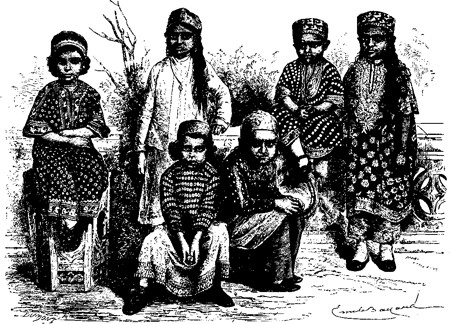
Parsi girls of yore attired in their jhabla and topi
The town
The town had at least 15-20 Parsi houses spread over two Parsi wadas (localities). The houses belonged to people settled in villages and were functional only intermittently, especially during vacation or muktad days when the village folk come down for 18 days of muktad and New Year festivity. The agiary with a couple of mobeds was functional all through the year as also a dakhma although there was no permanent nassessalar. The neighboring village boys and men undertook this job willingly and unhesitatingly. They would also cut the weeds and trees and clean the dakhma very painstakingly every year before the rains. The agiary and mobed’s residence would also be swept and washed clean before the muktad in recognition of which the priest offered them sumptuous meals and of course "chhaanto (liquor)” to fight the fatigue.
Simple abode
In earlier days Parsis seemed to have come to Surat from Sanjan and Diu, and from there some trickled down to smaller towns and villages to earn their livelihood. They started living in thatched houses for some time before they built desi (native) tiled roof houses with bamboo walls and mud and cow dung flooring. Every house had a well in the compound. The peculiarity of some of those Parsi houses was that the front side of the roof was purposely kept low, say about five feet from the ground and one had to bend a little to pass under it. Was it meant to say "Bow before me?”
Even the interiors were relatively simple with big wooden columns inside into which were driven four-five nails to hang clothes or thélis (bags) or napkins or umbrella, etc, a rickety chair or jhulla (swing), a table in the corner, matka (earthen pot) for drinking water on a tripod stand, Zoroaster’s photo or faded photo of the late father or mother. In some houses the cooking utensils were nothing more than earthen pots and pans. The dark and gloomy scenario changed but gradually into four pucca walls, Mangalorean tiled roof, plastered walls, well ventilated rooms, koba flooring and a couple of rooms on the first floor. The verandah, big and spacious, had a swing, chairs, easychair and the most favorite armchair to recline and rest or to dose off at times. There would always be "chalk chandan” and beautiful glass beads or lovely floral motif torans.
The otla (verandah) was the main domain of matidas (men), the women folk taking refuge inside. This custom inadvertently crept into their life as the otla was frequented by anybody and everybody at any time of the day or night. The possible presence of male visitors necessitated eating time segregation with the men eating first and exclusively. This unhealthy practice became the order of the day in some big families.
The inside layout was typical of a Zoroastrian abode. Alongside Lord Zoroaster’s prominent picture were family photographs of the dear and departed, of the recently married couple in a striking pose — the man standing beside his seated bride. Some of the photos may be faded and brownish but you can still read "V. N. Mehta Studio, Surat or Eos Studio, Kalbadevi Bombay.” Another common picture was that of a shikari (hunter) with his gun and a dead tiger or a gentleman riding a horse.
Parsis had not forgotten Iran either and some old time 18” x 12” picture depicting Rustom defeating Ahriman would be proudly displayed in some rural homes and places of worship all over the country. Look above the Godrej cupboard and atop rests Dinshaji Mistry’s pheta box in almost every house. The wall clock — West End, Mouthe, Kinzel, Antonia, Seikosha, Soar, Gustar Baecker or Regulator — would strike with pleasing tones in different homes. One cannot miss the Faredoon and Burjor Parsi calendar hanging on the wall and a cage with a cockatoo or majestic African Grey macau or at least their desi (local) cousin welcoming you from the corner. The sahi no khario (ink pot) with the holder having a metal nib or a katto or a sharply pointed porcupine feather and rojmel added to the decor. Most houses had a long janter (kusti weaving apparatus) or a short foldable version — a proud possession of the ladies of the house. Also noticeable was a well lacquered beautiful piece of Sabar Singu as one entered the house. The Singer sewing machine and beautiful Moon Lamp were probably part of a dowry gift. Electricity was never heard of and the commonest source of light was a fanas (lantern), kept clean and bright.
Almost every country home had weapons — guns, rifle, pistol or at least an air gun. One family had a very long range rifle (capable of shooting down an airplane) which could not be used unless mounted on a special stand. It was declared "Prohibited Bore” and the authorities confiscated the same. Single barrel, double barrel, muzzel loader or triggerless, all from English stables — Manchester, Wales, Birmingham, under the names of W. W. Green, J. W. Talley, Webly Scot — were proud possessions and kept fighting fit. The cartridges came in two varieties — chhara na and gori na, the former for small kill and the other for big shikar — bearing the stamp of Winchester or Remington or Eily Lily and Company, London. The law required the guns to be subjected to inspection every year, especially during the monsoon and Parsis from deep down would come with their arms covering a distance of 10-12 miles on foot and crossing dangerously swollen nallahs and rivulets. The guns established a kind of authority, deterred others from any misadventure as also catered to the owner’s palate with shikar meat of wild animals and fowl which were plentiful and easy to come by. A large, arm length size, five-cell Eveready torch was always by the bedside.
Unmistakable attire
The majestic "Bawaji” of the time was mostly an imposing figure, fair or dark, tall or plump, with unruly moustache, long and thick side burns and dressed in unmistakable white attire — long-sleeved badiyan (vest) covering the torso, sudreh stretching halfway up to the knees, pocketless pyjama and leather sapat. The head was covered with black or red high walled makhmal ni topi (velvet cap). The badiyan had two pockets including one narrow longish pocket for his prized possession, a pocket watch of glittering gold or shining silver, bearing the mark of Gem Macali, Durbilion, Brook Bang, Eastern, Junjhans, Thomson, Favre Leuba or Geneve. Every now and then he would flaunt his pocket watch to note the time though he had hardly anywhere to go. One of the lower pockets carried his ever present king size snuff box, either made of silver or at times sandalwood or ivory. Addicted to sniffing several times a day and even at night the powder would spill on his clothes giving them an untidy look and pungent smell. The other big pocket housed his ‘must have’ German made sharp pocket knife.
On a visit to a nearby place he would don a trouser over the pyjama and wear a ‘bandh gala’ coat stretching half way down to the knees. The coat had only one pocket at the top, at heart level. Shoes were rough and never polished, socks never worn. Some were fond of carrying an umbrella — a British legacy? The special feature of this attire was "khesh,” a multicolored soft knitted waist band, the two ends with pretty phoomta (tassels) — one tied a little longer than the other, mostly on the left side of the waist. When attending a religious meet or social function the topi would give way to the well brushed pheta or pugree — black, red or dotted, having matt finish or lacquered.
The lady of the house would be decked in a colorful badiyan puffed up at the shoulder, the sleeves mostly up to the wrist, high neck, front opening, one small pocket again for small sized snuff box. The mathubanoo, usually white, would always cover the hair and scalp. The sudreh, long enough to go below the waist, was mainly of fine, soft, white mulmul for daily use but during auspicious days a self embroidered net no sudro was proudly worn. The bright colored ijar almost touched the ankles and had a delicately embroidered kor (border) at the end. Amongst the most valued possessions was the red bangle symbolizing her saubhagya (good fortune to be married). It was never common to apply tikka on the forehead or tuck flowers in the hair. Of course the forehead would be smeared with red vermillion on "saré sapar mé daré (auspicious day).” Fond of jewelry, simple gold bangles would be worn, one on each hand and a gold chain preferably with locket containing a picture of the couple worn around the neck. A pendant, engraved with Lord Zoroaster was preferred by some and earrings, small or big, added to her beauty. It was not customary to wear nose ring or toe ring. Suede sapat was her normal footwear. The boys would wear shirt and shorts, and the girl child was dressed in a jhabla and nicely embroidered, glass-beaded topi, kept in place with an elastic band below the chin.
Villages lacked facilities for even primary education and houses in a nearby town catered to the educational needs of most up to the secondary level. Boys would barely study up to the 10th standard and plunge into the "tadi/daroo ni dukan (liquor business).” Some families, realizing the value of education, sent their children to the orphanage in Surat, the J. N. Petit Technical School in Poona, Boys’ Town in Nashik, Billimoria School in Panchgani or Avabai Petit School in Bombay. The late Dastur Khurshed Daboo, a strict disciplinarian, able administrator and excellent teacher who headed the Surat orphanage for a long spell of time, molded the life and career of many students.
To be continued
Dr Burjor Eruchshaw Patell is a senior practitioner of homeopathy and was former dean of the Homeopathic Medical College, Bombay. Born in village Kanza, Surat district, his education started in Mandvi, and later took him to Baroda, Bombay and Calcutta.
◆ ◆ ◆
From the archive