
Cover Story
The inheritors
Sir J. J. Trusts put in place worthy schemes to commemorate Sir Jamsetjee Jejeebhoy’s 225th birth anniversary
The commemoration befitted the man known as the colossus of charity. The trustees of the Sir J. J. Charity Fund and the Sir J. J. Parsee Benevolent Institution (SJJPBI) marked the 225th birth anniversary of Sir Jamsetjee Jejeebhoy, first baronet, and the 150th year of his death in a style the founder would have approved of — with a cachet of projects/events in the educational, medical and social spheres in Bombay and Gujarat.
In the space of one year, from July 2008 to July 2009, the SJJPBI, which runs 13 schools in Bombay and Gujarat, has added to their educational edifice with new buildings for the Sir J. J. Mishrashala in Surat and the Sett R. J. J. High School in Bulsar, and is in the process of purchasing a plot in Navsari for a new construction for their English medium high school there. The "Sir J. J. Scholars” scheme, launched from April this year, encourages higher education amongst those who may not be able to afford it. Two selected "J. J. Scholars” joining college will receive one lakh rupees per student per year, till they complete their graduation.
The new and airy Sir J. J. Holiday Villas at Khandala, consisting of eight independent air-conditioned rooms with all modern amenities which were opened last August, offer the Parsi public a reasonably priced, convenient getaway, with a view of the valley and lake. [Reservations can be made on 0211-4269233 (Khandala) or 022-22673843 (Bombay).]
The Medical Scheme for Parsee Senior Citizens, for those over 70 years of age whose income is less than one lakh per year, has been put in place to mitigate medical hardship. The regal bronze statue of the first baronet on its high pedestal (on which grateful patients sometimes crack coconuts as offerings to the benefactor!) and the area around it in the main foyer of the government-run J. J. Hospital was refurbished at the Trust’s cost. A new Mahindra Bolero was donated to the National Association for the Blind to transport children from their eye camps to various hospitals.
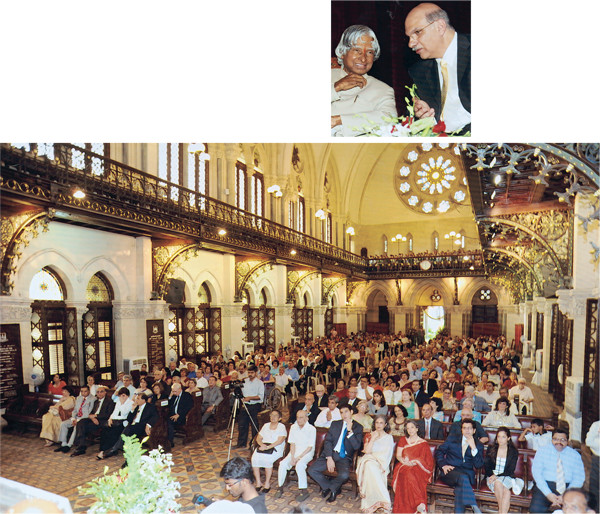
A. P. J. Abdul Kalam (left) with the eighth baronet Sir Jamsetjee Jejeebhoy; august gathering at University Convocation Hall Photos: Nazneen K. Vajifdar, Spectravision Labs
The Trust organized and sponsored two heritage tours in an open deck bus, with Prof Aban Sethna, a patient and knowledgeable tour guide. The trip covered well-known landmarks like the J. J. School of Art and the J. J. Hospital, built at a time when Bombay was a humid, unhealthy, marshy town with few civic amenities, where the poor and the rich, including British governors and their wives, succumbed to cholera, small pox, malaria and liver problems. Though the institutions themselves are familiar to the public, many do not know what the letters J. J. stand for!
The tour included a stop at the Reading Room (library) of Bombay University’s Fort campus, where the Sir J. J. Diaries are displayed in a glass showcase, amidst stacks of books and the sound of silence! The magnificent marble statue of India’s first knight and baronet at the Asiatic Society at Horniman Circle (housed, rather unfortunately, in shabby surroundings), his regal presence at the north end of Oval Maidan on Veer Nariman Road, the heritage building of the SJJPBI on Dadabhai Naoroji Road and the bustling Victoria Terminus, where there is a medallion (carved face on the façade) of not the first but the second Sir Jamsetjee Jejeebhoy, who was one of the directors of the Great Indian Peninsular railway, were among the places covered. Other J. J. philanthropies like the 40-ft diameter well on the Esplanade opposite Metro cinema, Fort’s Godavra Agiary (completed by his successors), the Mahim Causeway, the Bandra Talao (tank) on Swami Vivekananda Road (which however does not mention Sir Jamsetjee’s name) and the Panjrapole (animal shelter) at Bhuleshwar could not be visited.
At Navsari, the Trust converted Sir J. J.’s birthplace into a memorial museum, showcasing the events of his life and his bounty of contributions to society in the form of philanthropy, promotion of education, health and community service.
A highlight of the year was a commemorative function at the Sir Cawasjee Jehangir Convocation Hall of Bombay University on April 15, 2009 where former President of India Dr A. P. J. Abdul Kalam was the chief guest. Concluding the commemoration was the installation in July 2009 of Sir J. J.’s bust in the vice chancellor’s cabin in recognition of his being one of the first Indian Fellows of the University of Bombay.
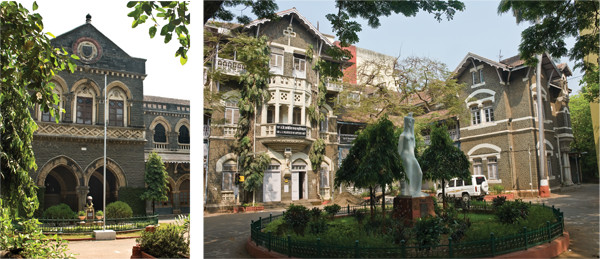
Sir J. J. School of Art, with the first baronet’s bust in the foreground (left)
"It is my humble duty to preserve the charities my great-great-great-grandfather established. He sought neither public honor nor private applause. I am proud to have inherited Sir J. J.’s legacy…I feel privileged to walk in his shadow,” said Sir Jamsetjee Jejeebhoy, the present eighth baronet at the jaher jashan at the H. B. Wadia Atas Bahram on July 15, 2008. "People ask why I devote so much time to this work… I feel no trade can be more fulfilling,” Jejeebhoy told the packed hall. Presiding over the jashan was the former high priest of the Atas Bahram Dastur (Dr) Firoze Kotwal, with Dasturs Khurshed Dastoor and Dr Peshotan Mirza of Udvada, Meherji Meherjirana of Navsari, Cyrus Dastur of Surat and around 100 mobeds participating in the ceremony. Giving away money is easy; but how, in what manner, to whom, is not easy, the baronet noted, adding that the rich must use their wealth for the benefit of the poor. "If you are not poor enough to receive charity, you are rich enough to give it,” Jejeebhoy asserted.
Steering schools is one of the main focuses of the trusts. The SJJBPI, along with its sister institution, Sett Rustomjee Jamsetjee Jejeebhoy Gujarati School Fund, runs a chain of primary, secondary and higher secondary schools in the English and Gujarati medium in Bombay (five), Bulsar (three), Navsari (three) and Surat (two), with a student body of 9,757 boys and girls. They come from all castes, creeds and economic strata and many of them are first generation learners.
In Surat, the newly reconstructed Sir J. J. Mishrashala was inaugurated on September 20, 2008. "The old building had been structurally affected by the Gujarat earthquake in January 2001,” explains Jejeebhoy. "While we did lose valuable time in finalizing our plans, obtaining governmental sanctions and getting all other unnecessary bureaucratic obstacles out of the way, there was one overwhelming positive that emerged from this exercise and that was undoubtedly the support and cooperation the SJJPBI received from the trustees of the Surat Parsee Boys’ Orphanage (SPBO) who are the owners of the land.” The primary school is built on modern lines with all the necessary teaching aids. "Though we still need to internally complete the three upper floors of this building, what we see around us today gives us the comfort of knowing that when this building is finally completed, it will stand as one of the most well planned and finely constructed school buildings in Surat. Presently there are more than 700 students studying here,” says Jejeebhoy. SPBO needs to be complimented "for their most magnanimous gesture of allowing a tenant (SJJPBI) to construct a new five-storey building on their land, with more than double the floor space, for a lease period of 99 years, at the existing rent of Rs 3,000 per month,” the baronet adds.
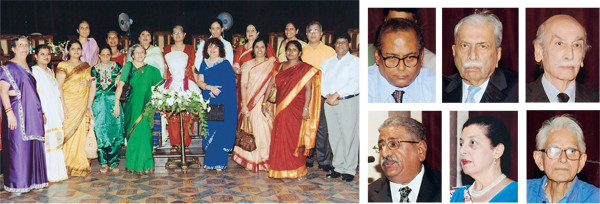
J. J. staff (left) and (below, top row, from left) Aroon Tikekar, Noshir Wadia, Jehangir Sabavala; (second row) Dinshaw Mehta, Homai Modi, Obaid Siddiqi
The new building to house the Sett R. J. J. High School in Bulsar is almost complete and classes are expected to commence in the second term of the academic year, after the Diwali vacations. With current student strength of 535, the English medium R. J. J. School is from nursery to Standard VII, with a new class added each year.
The SJJPBI is also in the process of purchasing a vacant plot of land admeasuring 75,000 sq ft in Navsari to construct a new building for their English medium high school. The project is expected to be completed by June 2011.
Giving serious examination to the prohibitive cost of pursuing higher education in India, the "Sir J. J. Scholars” scheme was launched on April 15, 2009 at a function to mark the 150th death anniversary of the man who was way ahead of his time as far as providing facilities for education was concerned. Under the scheme, the SJJPBI will provide two selected students (from their schools) with financial support to the extent of one lakh rupees per student each year, from the time they pass the HSC (Higher Secondary Certificate) examination board up to their graduation. Applications from students who have passed their HSC in April 2009 will be scrutinized by a subcommittee and the scholarships awarded.
Assistance in the form of medical aid is to be provided under the Sir Jamsetjee Jejeebhoy 150th Death Anniversary Medical Scheme for Parsee Senior Citizens. Sponsored by the Sir J. J. Charity Fund, Parsis over the age of 70 who are residents of Bombay, Poona, Udvada, Bulsar, Navsari and Surat (where the J. J. trusts have a local presence), whose annual income is less than one lakh are eligible for reimbursement of medical expenses to the extent of Rs 50,000 per person each year for the rest of their lives. "Almost 50 medical practitioners are listed on our select panel of doctors. The Scheme is administered by a subcommittee headed by Dr Jimmy Sidhva and 35 seniors have been selected so far. Disbursements of medical aid have already begun,” Jejeebhoy told Parsiana.
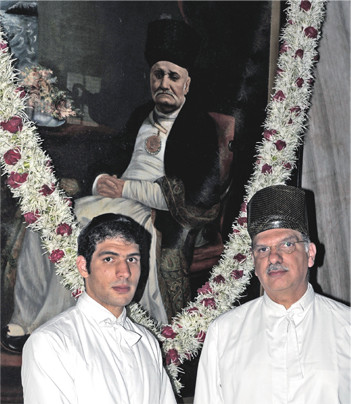
Sir Jamsetjee Jejeebhoy (right) with son Jehangir
Photo: Aspi Patel
"The institutions founded by Sir J. J. set the benchmark in philanthropy. There is hardly any Bombaywalla whose life has not been touched in some way by his charities,” the eighth baronet told the elegant gathering at the Convocation Hall which saw eminent speakers like noted neurologist Dr Noshir Wadia and legendary painter Jehangir Sabavala recall their association with the institutions that bear Jejeebhoy’s name.
"I ask myself, what was Sir J. J.’s unique quality? Here was a man of philanthropy, in British India, 150 years ago. He established the dimensions of charity — in education, healthcare, art…” Abdul Kalam posed rhetorical questions to the distinguished audience, as the evening sun highlighted the red and green of the beautiful stained glass, the glittering gold leaf of the balustrades, the deep chocolate of the polished balconies of the Convocation Hall. "When there is righteousness of the heart, there is beauty in the character; when there is beauty in the character there is harmony in the home; when there is harmony in the home there is order in the nation and peace in the world,” the former President waxed eloquent. "The great fire of Bombay of 1803 destroyed 50 percent of Sir J. J.’s property. Yet he recovered and succeeded. He defeated the problem; the problem did not defeat him. That was his second unique quality.” Evolve yourself and shape your life. Write it on a page…the very important page of human history, the page of innovation, discovery, fighting injustice and philanthropy, Kalam declared.
"In 1838, Sir J. J. promised a sum of one lakh rupees for the setting up of a hospital, as there was none at that time to treat the populace, provided the government contributed an equal amount. It was a staggering figure for those days,” Wadia, alumnus and former professor of the J. J. Hospital, traced its genesis. "The 300-bedded hospital was the first of its kind, with a medical college attached. Bombay University had not yet been formed (in 1845)…18 students were given stipends to join…it took five years to graduate.” The total amount Sir J. J. contributed to the Hospital, the Grant Medical College and the Sir J. J. Obstetric Institution eventually came to over two lakh rupees.
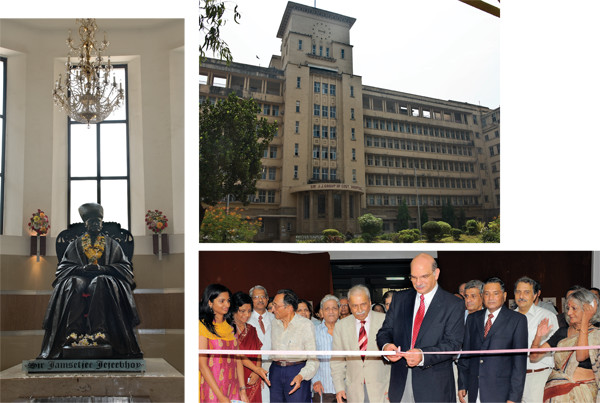
Statue of the founder (left) at J. J. Hospital (alongside); Sir Jamsetjee Jejeebhoy inaugurating refurbished area
With a frankness and heartache rarely heard from a public platform, Wadia stated he was a sad and helpless witness to the continuing deterioration of this once premier hospital over the years. "From the first choice of medical education (it has become) the last…lack of funds, transfers, tinkering, (there is) little chance to develop world class departments.” Unshackle these great institutions, he urged. Make them autonomous institutes of national importance, with their own degrees. Take private funding to restore them to their past glory. "Friends of Grant Medical College and J. J. Hospital Trust has been registered. Contributions are welcome,” Wadia exhorted ex alumni and well-wishers to help the cause.
"The J. J. School of Art is one example of his extraordinary array of charities. In 1853, education was in its infancy. A school of art was unheard of,” stated Sabavala who had been a student of the School in the 1940s. Immaculately turned out and speaking with a clarity and fluency that belied his 87 years, Sabavala who is one of India’s leading artists stated: "Indirectly I owe the patriarch a great debt. One lakh of rupees was an incredibly large amount… for encouraging art as a new and challenging vocation. Drawing, painting, sculpture, wood engraving — these were career opportunities thrown open to the public.” Later on, Sabavala continued, it was "wisely decided” to trifurcate the School into three separate departments — the School of Art, the College of Architecture and the Institute of Commercial Art. The institution, however, is at the crossroads; it needs restructuring and modernizing for an even more purposeful future, Sabavala observed.
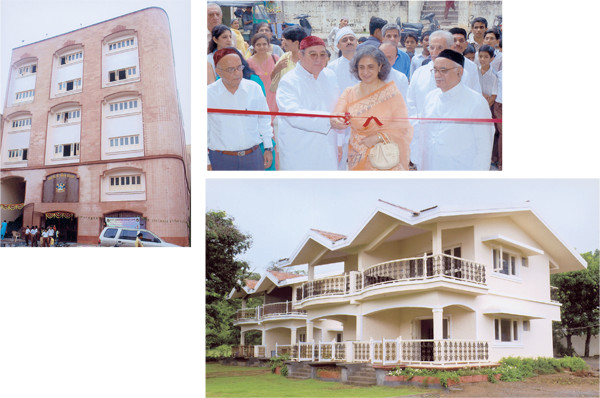
New building of Surat’s Sir J. J. Mishrashala; Lady Jejeebhoy inaugurating new structure; (below) Sir J. J. Holiday Villas at Khandala
"Bombay University is the proud custodian of 44 volumes of diaries of Sir J. J.…He was a signatory to the requisition made to the government for the need to establish a university and law college,” stated the University vice-chancellor Dr Vijay Khole. Bombay University was established in 1857 and Sir J. J. was appointed one of the five Indian Fellows. It was the period of the British raj but a name that stood "high in public and private esteem in community and public life” was that of the first baronet, said Khole. Sir J. J. also strongly supported the cause of female education, incurring the displeasure of the Parsi community of the time. His daughter was among the first Parsi women to learn English. By the time of his death in 1859, the SJJPBI had established a total of 19 schools, Khole asserted.
Bombay Parsi Punchayet (BPP) chairman Dinshaw Mehta, in a brief, off-the-cuff address, recalled that the first baronet and several of his successors had been trustees of the BPP. He invited the present baronet to "offer himself” for trusteeship but Jejeebhoy maintained a stoic silence!
"Sir J. J. was one of the earliest makers of Bombay,” stated Dr Aroon Tikekar, president of the Asiatic Society. In a socially and politically changing society, he was a worthy contemporary of Jagannath Shankersheth, Premchand Roychand and other stalwarts. Sir J. J. was also one of the earliest Indian members of the Society. "In a monument to the civic virtues of the man, funds were collected by common consent for a marble statue of Jejeebhoy to be placed in the Society’s premises. Regretfully, he did not live to see the grand statue carved by the famous Italian sculptor Baron Marochetti arrive in Bombay from England,” Tikekar recounted.
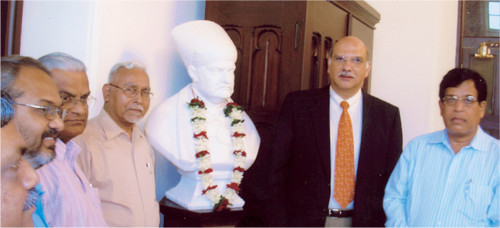
Vice-chancellor Vijay Khole and Sir Jamsetjee Jejeebhoy (third and fourth from left) at the installation of Sir J. J’s bust in vice-chancellor’s cabin
Dr Asiya Siddiqi, eminent historian who has done extensive research on the J. J. Diaries, was to have presented the keynote address, but could not be present due to illness. In her absence her paper was read out by her husband Dr Obaid Siddiqi, tracing the landmarks of the life of the lad who moved from the trade of selling old bottles to establishing a remarkable commercial enterprise and became India’s first knight and baronet. Unlike Dadabhai Naoroji, Jamsetjee did not attribute the poverty in the country to British rule. He had many friends among officials. He saw British rule as one that had fostered prosperity, opined Siddiqi. Was he unaware of the harm the opium trade was doing to the people in China where it was smoked, unlike in India where it was eaten? The question remains unanswered, Siddiqi believed.
"The question comes to my mind — what is the relevance of Sir Jamsetjee in today’s time? What purpose can be served? Can any good come from all this?” the eighth baronet reflected aloud at the Convocation Hall function. The lessons to be learnt, he believed, came from his ancestor’s secular and humane outlook, with charities catholic in nature. "Titles and honors added not to his worth; he was himself an honor to his title,” Jejeebhoy asserted.
◆ ◆ ◆
From the archive