
Books
Feisty fighter
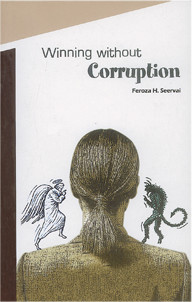
Winning Without Corruption by Feroza H. Seervai. Published in 2006 by Public Concern for Governance Trust (PCGT), B/2 Mahalaxmi Chambers, 22, Bhulabhai Desai Road, Bombay 400026. Pp: 84. Price: copies available against suggested contribution of Rs 180 per copy to PCGT.
Winning Without Corruption by Feroza H. Seervai. Published in 2006 by Public Concern for Governance Trust (PCGT), B/2 Mahalaxmi Chambers, 22, Bhulabhai Desai Road, Bombay 400026. Pp: 84. Price: copies available against suggested contribution of Rs 180 per copy to PCGT.
Drawing on her experiences with officialdom over a period exceeding six decades, social worker and activist Feroza H. Seervai has set down, in this slim but eminently readable and entertaining book how she managed to get work done without payment of speed money. Only in one case did a clerk suggest that she should pay a bribe. Some have ascribed her success to the fact that she was the wife of the late jurist Homi M. Seervai who served as advocate general of Maharashtra for 17 years, but the feisty fighter debunks this and writes that her skirmishes with the authorities in her quest for what was right and fair began in early childhood. Her father first and her husband later, both peaceable men, never deterred her in her efforts to set right any wrong or work toward any worthwhile goal.

Feroza Seervai: righting wrongs
Seervai attributes her success to thorough homework, argument and persistence, and the conviction that no favor was being asked, that government officials and others in authority were doing no more than they were there to do. Once, she recalls, she argued at such length with the then revenue minister Morarji Desai that he asked: "Did your husband teach you to argue? Or did you teach him?” In many cases it helped that she had "a voice that dominated the cannon, the sea and the tempest (in her husband’s fond description, she explains in an aside).”
In his Foreword Julio Ribeiro, former commissioner of police, Bombay and executive chairman of PCGT which has published the book, writes: "Whenever the issue of fighting corruption arises, the general reaction is of throwing up hands in despair saying that it is something to accept because it can never be removed… the truth is that we get so concerned about what we cannot do, that we avoid doing the things we can.” Since Seervai’s is a chronicle of day-to-day real life events, Ribeiro specially commends it to cynics and the vast majority of silent good people who may muster up courage and usher in the dawn of a new era. PCGT was founded in April 2002 by noted citizens B. G. Deshmukh, Ribeiro and Dr R. K. Anand to support laws and policies which promote honesty, transparency and accountability in governance so that the malady of corruption is stemmed in society.
Seervai confesses that she has been an atheist since the age of 16, but at the same time claims she is a good Zoroastrian. The apparent contradiction is superficial, she assures readers. There is much more to the teachings of Zoroaster than exhortation to praise Ahura Mazda in prayer. For her, prayer is expendable. What is important is to live by good thoughts, good words and good deeds. In a universe where the powers of good and evil are constantly and continuously pitted against one another, the good Zoroastrian is to be judged according to how fearlessly he or she wages war so that good triumphs over evil. Rather than bemoan her atheism, Seervai asks friends and relatives who selectively observe the rites and rituals of the religion to remain alert and do battle to support the good.
Among the notable successes Seervai, along with others, has worked toward in the public interest are the saving of Oval Maidan from being built upon and its subsequent restoration under the OVAL Trust which now looks after the heritage precinct; establishing of Bombay International School; and setting up of the Purshotamdas Thakurdas Hostel for Working Women of the Womens’ Graduates Union at Colaba, Bombay. On the personal front, in 1947 she persisted in obtaining residential accommodation under a government scheme to requisition unoccupied flats; helped a cousin to collect a cheque due from the government which an unscrupulous clerk was delaying in hope of extracting a gratuity; and fought off the depredations of hackers who had misused her VSNL e-mail account and made them not only pay for time stolen but also apologize in writing for their misdeed!
In the Epilogue Seervai has listed salient features of what is likely to ensure success when undertaking citizen action or individual action. A person must be prepared to give time and effort; do intensive homework; persist, persist, persist and not give in when obstacles appear; seek transparency, for the citizen has the right to know; recognize different types of corruption and not offer a quid pro quo for work done. While acting in a public interest matter one should secure the support of many individuals, groups and organizations; offer unstinting assistance to the initiatives of others by collecting signatures of supporters; and in the last resort take the matter to a court of law. With collective effort, goodwill, determination, hard work, courage and persuasion right will prevail over wrong, good over evil.
Written when she was 82, the book is a testament not only to Seervai’s redoubtable grit and determination but also to her remarkable memory (though she admits that she consulted friends in recollecting details). Her racy, conversational style and energetic narration hold the reader’s interest while the clear print is easy on the eyes. A well brought out and useful publication which will hearten citizens to persevere in their own quest for right over might.
◆ ◆ ◆
From the archive