
Cover Story
Titan of the turf
Besides chairing the Royal Western India Turf Club, Dr Cyrus Poonawalla is the first Indian to serve as vice president of the Asian Racing Federation
Steeds…strength. Races…rivalry. Club…control. Reins firmly in hand once he had established his supremacy as reelected chairman of the Royal Western India Turf Club (RWITC), Dr Cyrus Poonawalla surged ahead to make his mark on the international arena. After serving on the governing council of the 25-member Asian Racing Federation as India’s sole representative for the last five years, on January 24, 2007 he was elected the first Indian vice president of this body which gives him a seat in the International Horse Racing Federation Authority based in Paris. "This apex body controls the policies of horse racing and breeding worldwide,” states Poonawalla in an interview with Parsiana at the Taj Wellington Mews Luxury Residencies in Bombay on February 3, 2007, adding, "This will give me an opportunity to take up issues concerning Indian racing on the international body for the first time.”
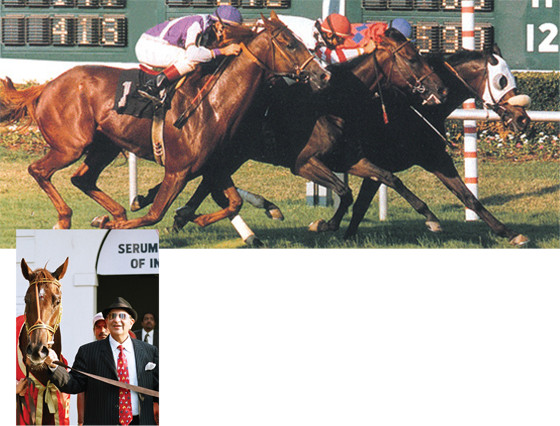
Dr Cyrus Poonawalla (above): for the growth of racing
When interacting with major racing countries like England, France, US, Japan, Italy, Germany which have a seat on the world body Poonawalla is determined to see that "our Indian horses are allowed to move freely… to travel abroad for sale and races.” Presently America permits entry of Indian horses, but not so many of the European countries from where he would like the quarantine removed.
To honor Poonawalla for the landmark attained in the international field, a special felicitation was organized for him by the Turf Authorities of India (where Poonawalla had twice officiated as chairman) on February 4, just before the race for the McDowell Indian Derby at the Mahalaxmi Racecourse, Bombay when he was presented a silver salver. Besides the RWITC there are four other Turf authorities in India — in Calcutta, Bangalore, Hyderabad and Madras. The racing standards are reportedly very high in Bombay and Poona but it is in Bangalore and Hyderabad where betting is higher because of tax policies.
In fact on almost every race day, Poonawalla’s presence at the racecourse is taken for granted, to observe things firsthand, reports the Afternoon Despatch and Courier of January 17, 2007, giving him credit, "Nobody in the turf has done so much for racing …He started the first Million race in the country — The Poonawalla Breeders’ Million (which) has now become The Poonawalla Breeders’ Multi Million…In addition to this race there are other Million races started by Poonawalla in Poona and Bombay. And in Mysore too. The Mysore Derby is sponsored by him. He digs into his pocket every now and then for bringing about development. Recently he spent nearly half a crore for bringing in new facilities in Poona. And we see the new telecast features by the Poonawalla group…The perception now is strong that Poonawalla has no other interest but the growth of racing and smooth functioning of the Club.”
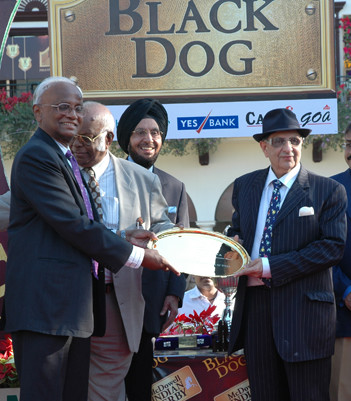
Cyrus Poonawalla (right) receiving salver
It was this overwhelming confidence reposed in him by the members of the RWITC that helped Poonawalla and his team counter the combat of liquor baron Dr Vijay Mallya and his "unholy alliance” contends Poonawalla to describe the "bitterly fought, one of the toughest elections in the annals of RWITC.”
Others in the fray from the Poonawalla camp were the "heavy-weight” father-son duo of S. C. Jain and Vivek Jain, Champaklal Jhaveri and Shivlal Daga. Poonawalla, who had replaced Khushroo Dhunjibhoy as chairman in the previous year’s election, was facing the combined might of Mallya, Dhunjibhoy, Shyam Ruia, Ravi Ghai, Vijay Shirke, Sunil Jhangiani and Arun Nanda. "When the equestrian emperor Poonawalla stultified the king of good times Mallya, it certainly drove the media into a feeding frenzy of sorts,” summed up the cover story in Society (February 2007).
"The results were resounding… beyond my expectations,” declares the chairman. That every member of Poonawalla’s five-member winning team scored higher than his formidable opponent Mallya and his allies at the elections held on December 21, 2006 was viewed as a mandate from the members that they would rather opt for "clean racing and integrity” as pursued by the winning team than be swayed by the "flamboyance and pie in the sky” promised by the contenders. "Their strategy for the elections was based on the party’s future promises whereas our strategy was based on actual performance in the past and long-standing credibility and trust members had reposed in me and Dr Jain over the last decades,” conveys Poonawalla.
The election results vindicated the maxim "an outstanding stallion lifts a mediocre mare to glory above,” observes Berjis Desai of Capricorn Stud Farm, adding, "To defeat Mallya is remarkably outstanding.” What he considers even more amazing is that "some relative nonentities (from the Poonawalla camp) could score more than Mallya.” Of the nearly 1,400 Turf Club members with voting rights, a record 1,109 cast their votes, mentions Desai. The Parsi membership of nearly 300 was largely supportive of Poonawalla.
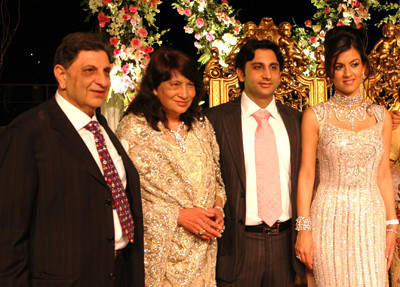
From left: Cyrus, Villoo, Adar and Natasha Poonawalla
As compared to clean racing, transparent management, higher income and better infrastructure, promised by the Poonawalla pentagon in their Power Point presentations, at his lavish parties Mallya’s seven were plugging for changes like night racing, speedy construction of the Clubhouse and bankrolling of racing activities using the vast resources of his United Breweries Group, as reported in the Hindustan Times of December 12, 2006. Vivek Jain, chairman of the media and marketing committee, claimed that under Poonawalla’s stewardship they were able to bring down the annual losses from Rs 1.74 crore to Rs 36 lakh. Their disclosure that they could generate two crore rupees through sponsorship made an unimpressed Mallya comment, "In the current scenario two crore is pittance. I want the RWITC to benefit from the economic boom.”
As the chairman of the Poonawalla Group of Companies with an annual turnover exceeding Rs 7.5 billion, engaged in horse racing and breeding, (Poonawalla Stud Farms) manufacturing pharmaceuticals (Serum Institute of India Limited is the largest exporter of vaccines and immunobiologicals in India), engineering [Eagle Poonawalla Industry Limited, Inter valve (India) Limited and El-o-matic (India) Private Limited are market leaders in the manufacture of mechanical seals, industrial valves and pneumatic actuators], exports, financial services and now even luxury hotels Poonawalla’s professional stakes are high but as he explained to the Hindustan Times correspondent, "Running a corporate business successfully… is completely different from the voluntary and social work the chairman of the Club is expected to do. He has to sacrifice a great amount of time…I have chaired or attended about 100 meetings this year which involves a great sacrifice of my time and energy.”
"It’s a hands-on job,” reiterated Poonawalla during his conversation with Parsiana, spelling out his team’s priorities: "With the enhanced mandate that my team and I have received we would be able to get on with the task of turning around the Club’s finances… undoing the wrong contracts which the previous committee had entered into…looking after the Club’s properties and laying the foundation stone of a much desired Clubhouse…The corporate involvement in horse racing which was triggered last year is being put into reality with new integrity in the sport.” With 20 new sponsors including the two-and-a-half-crore offer from Diageo (one of the world’s largest spirits company) for the Indian Derby which the RWITC cannot afford to lose, they are planning to ask Mallya to enhance his offer for the McDowell Indian Derby. Members can also look forward to upgraded facilities like airconditioning of one of its stands and a giant audiovisual screen, says the chairman, keen to "bring up the general infrastructure and ambience of the racecourse.”
Serious efforts are being made to "infuse confidence” and raise the "sagging image” of racing which has led to a decline in the popularity of the sport. Race attendance has considerably declined which Poonawalla believes is due to the lure of "alternative sports and entertainment.” Their recent talks with the government though have been encouraging because they have been promised relief in taxes, if possible.
From 40 thoroughbred indigenous foals in 1938 India had a peak in 1997 when 1,902 foals were dropped at various stud farms around the country, according to information available on the Internet. Since then the numbers have hovered around 1,350-1,400 with numerous stud farms having closed down. The Poonawalla Stud Farms is reportedly the highest stakes earning establishment in the country with over 166 home breds earning stakes in excess of one million rupees, according to their website. Among the other Parsis in the country who have considerable stakes in stud farms are Dhunjibhoys (Nanori Stud Farm), Shapoorji Pallonjis (Manjari Stud Farm), Farokh Wadia (Yerrowada Stud Farm) and Dinshaw Mehta, Berjis Desai, Jimmy Sarbh and other partners (Capricorn).
"From the time of Sir Cusrow Wadia, Parsis had played a great role in RWITC,” comments Poonawalla who is "unfortunately disappointed that lack of clean racing” is evident in this once respectable community too which has "not lived up to expectations.” He is happy to see the new generation taking an interest but he believes the community is laid back and observes that in affluent families "wealth is dissipated in litigation…
"Even though they have an advantage over other communities with all the cultural background and intelligence inherent because of our education and reputation, they are much less achievers,” remarks the chairman, adding, "One of the reasons is the younger generation is not strongly motivated and disciplined to perform early in life.” Being mollycoddled, things are offered to them easily with the result they have "lost the zeal to achieve which is in its prime between 16-25. After 25 the mindset starts changing and one tends to become technical and white collared… That is why I brought my son in at 21 before he did his masters so that he could learn hands-on at the plants and the farms.”
The Poona Stud Farm established by Soli Poonawalla in 1946 has grown to become the Poonawalla Stud Farms which is presently in its diamond jubilee year and as per their website "remains deeply committed to ensuring that the Indian thoroughbred finds his way onto race tracks in all the world’s prominent racing nations.”
◆ ◆ ◆
From the archive