
Books
"What manner of man?"
Evoking H. M. Seervai: Jurist and Authority on the Indian Constitution, 1906-1996 by Feroza H. Seervai. Published in 2005 by the author, Maison Belvedere, 107, M. Karve Road, Bombay 400020. Pp: viii + 356. Price: Rs 525 (only in India).
Evoking H. M. Seervai: Jurist and Authority on the Indian Constitution, 1906-1996 by Feroza H. Seervai. Published in 2005 by the author, Maison Belvedere, 107, M. Karve Road, Bombay 400020. Pp: viii + 356. Price: Rs 525 (only in India).
In the introduction to her book Evoking H. M. Seervai, Seervai’s widow Feroza says: "Its purpose is to evoke my husband as he was. It is not a biography, but it is a biographical book. What manner of man was he?” Nobody knows, or would know, what manner of man Seervai was better than Feroza herself. Having known her for several years and aware of the intellectual companionship she gave her husband for as long as he lived, this reviewer has no doubt that she could have done an excellent, more intimate job of her husband’s biography. As it is, the most interesting and the most touching parts of this book are the recollections of his widow and other members of the family. Besides, the many tributes by lawyers, friends and High Court judges, richly deserved as they are, tend by their very nature to be repetitive.
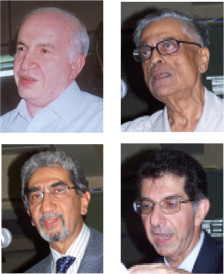
Clockwise from top left: Tehmtan Andhyarujina, Atul Setalvad, Navroze Seervai and Iqbal Chagla
No doubt their tributes are heartfelt and touch the reader’s heart. They acclaim how by precept and example Seervai showed that the heights of the legal profession could be reached without compromising moral character and ethical conduct. He gave to the legal profession the dignity and respect that popular perception has often denied it. Apart from being a legal luminary, Seervai was a singularly enlightened human being whose knowledge and integrity were above question, who always put truth in the first place and always had the courage and fortitude to defend it. Above all else, he was a family man who put the interests of his family members before even his professional interests. As former solicitor general of Maharashtra Tehmtan R. Andhyarujina puts it in his tribute: "No account of Seervai would be complete without mentioning Seervai’s love and devotion to his family and loyalty to his friends. Seervai was first and last a family man and drew his inner strength and inspiration from his family. Even on his busiest days, he would set aside time to chat and play with his children and help them with their studies. In his wife Feroza, he had a companion of equal grit and determination who identified herself with everything Seervai believed and acted on in his life. It would be difficult to find a couple so totally matched to each other.” All the more reason for Feroza to have undertaken the final responsibility of recording his life for posterity.
In "Recollections By The Family” in what she calls "the words of an old woman who had 50 remarkably happy years with him,” Feroza goes on to recount: "They were years of close comradeship, friendship full of laughter, of complete freedom of thought and action, of gentle and passionate love, of incessant recitation of poetry and prose and of talking, talking, talking, of walking for pleasure and also of silent togetherness, of reading books aloud to each other, of a deeply shared parenthood. He would, however, miss me whenever I spent too much time with our children and away from him. Our neighbors wondered that a couple married over 40 years had so much to talk about with each other.”
Feroza’s account is replete with humorous incidents like the one about going "to tie the kusti,” which was a euphemism for visiting the bar. An acquaintance came up to Homi and asked him ‘Aren’t you going to tie the kusti?’ Homi, a strict tea totaller, hadn’t a clue as to what was indicated, and said quite simply, ‘There’s no need to.’ I told him he was being invited to visit the bar. However, Homi enjoyed the joke of our son’s violin teacher, Adrian D’Mello, about the bar. A man returning home late told his wife he had been to see the doctor. ‘What did he diagnose?’ she asked. ‘Syncopation,’ he replied. She sought the meaning and found ‘an irregular leap from bar to bar.’”
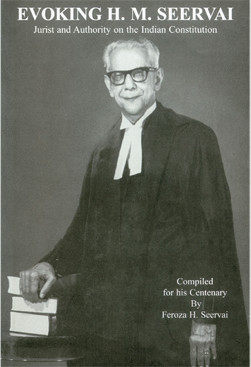
It appears that in his bachelor days, Seervai used to prepare desserts and his oven-cooked cheese toast was in constant demand in later years by family members. Homi loved amusing children with his "birdie whistle.” As interesting as Feroza’s are the recollections of his daughter Meher J. Pocha, his son Navroz H. Seervai, and his grandson Jehangir P. Madon. Homi’s own articles, like the one on justice, his papers and memoranda give evidence of his lofty thinking and the wide variety of themes which roused his curiosity and which he researched.
Seervai was a wise man in the sense a great poet used the word: "It is not wisdom to be only wise/and on the inward wisdom close the eyes/But it is wisdom to believe the heart.”
Evoking H. M. Seervai is no doubt an illustrious book. But somehow this reviewer feels it lacks the heart-to-heart intimacy which Feroza alone could have brought to it. Then it might have become an illuminative work.
Burjor Karanjia
◆ ◆ ◆
From the archive