
Politics and Policy
Minute by minute...
The phase “tyranny of the minority” in the minutes of the Federation of the Parsi Zoroastrian Anjumans of India sparked off a controversy
A startling statistic from the Calcutta Zoroastrian Community’s Religious and Charity Fund representative Bahadur Postwalla that 12 out of 13 marriages in that West Bengal city in the past two years were outside the community proved a sobering note for the 60 or so delegates present for the Federation of Parsi Zoroastrian Anjumans of India general body meeting in Bombay on September 24, 2006. The executive council meeting of the all-India body was held a day earlier (see "The flavor of the Federation,” Parsiana, October 21, 2006).
Calcutta, along with its counterparts in Delhi, Jamshedpur and Lucknow, welcomes non-Parsi spouses at all anjuman social functions.
Whom did Bombay Parsi Punchayet (BPP) trustee Dinshaw Mehta have in mind when he voiced an apprehension about "the tyranny of the minority” during the executive council meeting of the Federation in Thana on March 25 and 26, 2006? Was it the small vociferous anjumans who threaten to derail the Federation or the body’s leadership?
Stung by criticism that the The BPP Review only glorifies the trustees and not the organization’s considerable achievements, the latest issue released at the meet focuses on the various institutions and projects run by the premier Bombay trust (see "BPP Review special issue,” Events and Personalities, page 9). As the irrepressible west zone II vice president and Ahmedabad Parsi Panchayat president Areez Khambatta quipped "bolé ténaa bor véchai (who praises his wares manages to sell them).”
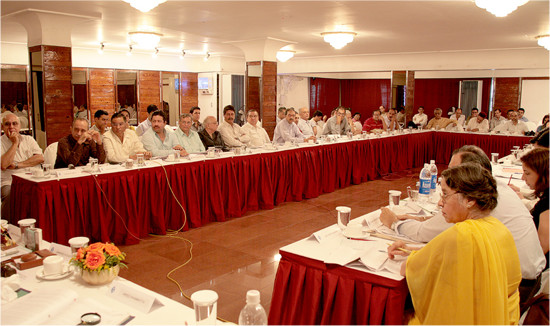
General body meeting in process at the West End hotel
The activities of the Federation of Zoroastrian Youth Associations (FOZYA) have been stymied due to accounts not being filed for the last four years and the balance monies not being transferred to the new office bearers, stated Shovir Irani, the secretary of the all-India youth body.
Of the 32 lakhs that the Surat Parsi Panchayat (SPP) has distributed as loans to entrepreneurs not a rupee has come back, said SPP president Darayes Master. When questioned about the repayment, the recipients’ answer is "Tamaara baap nu hathu ké paachha joiéch? (was it your father’s money that you are asking for it back)?”
Belgaum Parsi Zarthosti Anjuman representative and founder member of the World Alliance of Parsi Irani Zarthoshtis (WAPIZ) Khojeste Mistree noted that while many of the delegates praised the aid extended by the World Zoroastrian Organisation (WZO) through the managing trustee of the WZO Trust Funds (India) Dinshaw Tamboly, especially in the aftermath of the devastating floods that hit Surat, little credit was given to the assistance rendered by WAPIZ. Mistree and Master exchanged words on the subject.
The picture of the community’s youth appeared gloomy with several anjumans reporting that they had no youth or very few. The number of births reported also was minuscule compared to the number of deaths.
Khambatta’s key ally in the Federation Jamshed Mohta was reelected as a trustee but not as president of the Bardoli Jarthoshty Anjuman. In his absence the APP president received strong support, however, from Bardoli representatives Pervez Mehta and Yasmin Sanjana both from Bardoli. Khambatta’s prime supporter from Poona, Poona Parsi Panchayet (PPP) trustee Pourasap Mehta did not attend the second day’s deliberations.
And WAPIZ founder member Yazdi Desai scored a hat trick when after representing the anjumans of Panchgani and Jabalpur in the past, he and his wife Anahita represented the Badnera Amravati Parsi Anjuman. An e-mail from a Zubin J. Dotivala stated "please find attached herewith an authority letter for meeting attendance on our behalf. J. J. Dotivala, president, Badnera Amravati Parsi Anjuman.” The letter with no name or signature below "Yours faithfully” authorized the Desais to represent the anjuman. No reference to any resolution authorizing the representation was mentioned and no letterhead of the anjuman was used nor any rubber stamp affixed.
Anahita Desai has represented the Solapur Parsee Anjuman earlier. Interestingly that anjuman has decided to close down its dakhma after the demise of its two elderly priests, a development that Desai did not allude to earlier and may not even have been aware of.
"All is well at Khergam,” said representative Tannaz Parakh humorously referring to the same phrase she uttered at the Bombay September 2005 meet when she failed to report about an encroachment on the Khergam Parsi Anjuman property there.
The Federation condoled the deaths of Hormazdiyar Dalal, community researcher and author, Nora Elizabeth Mary Boyce, professor emeritus of Iranian studies at London University, Jehangir Gagrat, noted solicitor, L. S. D. Mehervanjee, former chief fire officer of Bombay fire brigade and the last surviving officer of the Bombay Dock explosion, Sir Jamsetjee Jejeebhoy, seventh baronet and trustee/chairman of several large community trusts and associations, Rohintan Daviervala, president Sanjan Memorial Column Local Committee.
BPP president Minoo Shroff started the day’s proceedings requesting delegates to "stick to the subject,” "not to interrupt,” to "address the chair” and to ensure that "no single person should speak for more than five minutes.” (Khambatta had hogged the microphone for a 47-minute monolog the previous day.) Shroff noted that Parsis were "getting publicity for the wrong reasons. Let us conduct ourselves with restraint and dignity.”
Parakh too observed that the WAPIZ troupe had been instructed "to have a fruitful meeting today.” As Mistree observed, "one group (is portrayed) as the trouble-makers and the leadership as the good guys.”
Except for a clash between Mistree and Satara Zartosti Anjuman representative and former BPP trustee Jamsheed Kanga over the functioning of Doongerwadi, the meeting was on the whole peaceful.
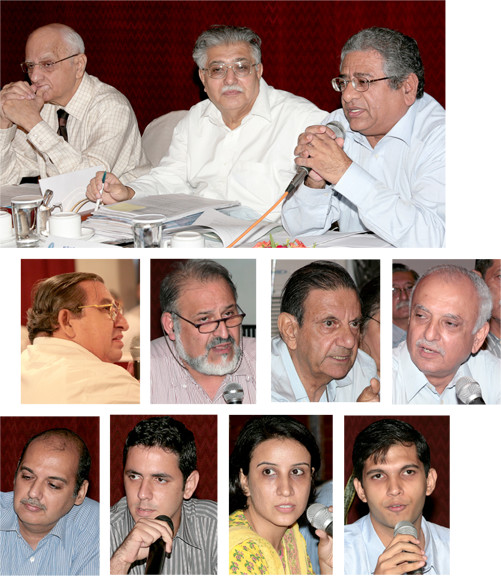
Top from left: Minoo Shroff, Keki Gandhi and Dinshaw Mehta Second row: Darayes Mas-ter, Khojeste Mistree, Jamsheed Kanga and Bahadur Postwalla; Bottom from left: Jehangir Bisney, Shovir Irani, Pareecheher Dav-iervala and Hoshaang Gotla
Whose tyranny?
Peeved at being left out of the Thana meet which was only for executive council members, the delegates from Belgaum and Khergam quibbled over the minutes of the meeting. Parakh alleged the Bombay September minutes "wrongly recorded statements.” Plus the minutes of the Thana executive council meeting were "not circulated to others like me” who did not attend. She felt the exclusion of the general body member anjumans who are not on the executive council was "arbitrary. We are told ‘now you cannot come.’ In the past there was no distinction between the executive council and the general body… (they) merged and flowed into the other.” (In former times a strict distinction was drawn between the two. At certain executive council meetings the general body was not invited. And when both meetings had to be held one after the other, non-executive council members were not permitted to sit at the main table till the general body meeting was called to order. Eventually the distinction blurred and not only member anjumans but people who had no connection with the Federation nor represented any association also attended, often uninvited — editors.)
"The minutes reflect (the history), they are historical documents,” stated Mistree. "We are told the minutes will be corrected. We never receive corrected minutes.” He wanted to know whether Mehta actually said "tyranny of the minority.” Federation joint honorary secretary Keki Gandhi replied that Mehta’s phrase was correctly recorded in the minutes.
"It’s not correctly recorded,” countered Mehta. He said he pointed out the inadequacy of the statement but was told to "let the matter be in the interests of peace.”
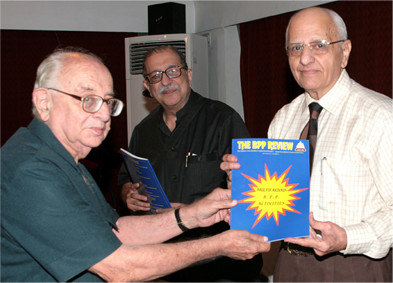
From left: The BPP Review editor Godrej Dotivala, Areez Khambatta and Minoo Shroff releasing the special issue
Gandhi: "‘Tyranny of the minority’ was said” but not that Mehta opposed the proposed changes in the constitution.
Mehta: "‘No need for change (in the constitution)’ was not mentioned in the minutes.”
Khambatta: "Send a corrected copy. We’re told it will be done, done, done, but nothing is being done. The Federation is run on a shoe string budget. (This is) being penny foolish, pound wise (what he meant was penny wise, pound foolish — editors). It’s a shame (the Federation) being without staff.”
Mehta clarified that he was "firmly of the opinion there is no need for change” in the constitution of the Federation as desired by nearly all the office bearers. (In the Thana meet Mehta had stated that they had seen "a dramatic change” in the Federation’s functioning in the last two years. Maybe because of this the necessity for change was felt so that the "tyranny of the minority that has happend in the past,” is not repeated. He requested that the change should not result in a schism in the community.)
Shroff interceded to note that "these are Dinshaw’s points of view. It’s not the inclination of the BPP. Other anjumans felt the need for some sort of harmony. (Hence) the necessity for changing the rules.”
Mistree: "What is said in the tapes is not accurately recorded (all the proceedings of the Federation executive council and general body are tape recorded. The core committee meeting in Bombay on August 5, however was not recorded — editors). "A selective recording of the minutes is taking place. Even a year later we are not given the opportunity to rebut. The tapes should be made available to all.”
Shroff: "The general feeling is that the minutes report what is said.”
Kanga: "A person has the opportunity at the next meeting to correct” any errors or misunderstandings.
Gandhi: "Dinshaw Mehta is free to say he did not mean it…the minutes cannot draw inferences.”
Feroza Mistree who represented the Calicut Parsi Anjuman at the 2005 Bombay meet and co-represented the Khergam anjuman this time, inquired: "Who did he (Mehta) mean” when he referred to "the tyranny of the minority? The leadership or the numerous anjumans?”
Gandhi: "I can record what was said. Not what was in the mind of the speaker.”
BPP trustee Burjor Antia: "We have come here to finish the agenda.”
Shroff: "Reducing many pages of transcripts to a few is an art.”
(Throughout most of the discussions on Mehta’s reference to the minutes, he sat with both hands covering his face.)
Aid to Surat
A discussion on the Federation’s accounts led to talk about the aftermath of the floods in Surat this monsoon. Excessive rain and the opening of a dam’s floodgates resulted in the Gujarat diamond cutting capital of India being inundated with water.
"A 25,000 crore loss was suffered by Surat including the Parsi community,” said Master. The human toll was also considerable. The SPP distributed Rs 2,000 to affected, needy Parsi families at Pateti. Damage to community property was estimated at 2.5 crores, said Master. "Antia and Tamboly helped. Areez gave two-three lakhs. Others also assisted — Rustom Jeejeebhoy also promised us assistance,” he added.
Shroff noted he has personally donated a lakh of rupees. Kanga recommended that an appeal could be made for specific rehabilitation projects to the Tata Trusts.
In reply to Baroda Parsi Panchayat trustee Boman Cama’s question as to how many Parsis were affected, Master said, "l60 applications” from families had been received by the SPP from Surat and the surrounding villages. Baroda had sent Rs 25,000 and was collecting more funds. Cama asked about the safety of the fire temples. Master noted that in the Goti Adarian, the holy fire had been shifted to the first floor of the agiary structure.
Kanga: "We should create a fund in anticipation of disaster.”
Anahita Desai said nine lakh rupees had been utilized for Surat flood relief work by WAPIZ. Two hundred and ninety families were assisted. "WAPIZ is also there for you all,” she added.
Sanjana noted that affected families were also personally contacting trusts.
Shroff: "People take advantage of disasters. That is why we have the Liaison Committee. The trusts should screen the applicants.”
Parvez Irani of the Iranian Zoroastrian Anjuman suggested the funds should be collected centrally and forwarded to the SPP. Master noted that he had personally rushed in his truck to assist people but was thwarted for two days by 12-foot-deep flood waters. Master said 50 kilograms of rice, dal, wheat, flour was distributed. He stated that aid from WAPIZ was not "given to” the SPP. The SPP was not taken into confidence by WAPIZ, said Master. He noted that SPP trustee Yazdi Karanjia had also reported no knowledge of any aid from WAPIZ.
Omim Debara of the Parsi Zoroastrian Anjuman of Secunderabad and Hyderabad: "Let’s not fight amongst ourselves. People take undue advantage.”
Mistree: "We were one of the first to get in touch with Darayes Master. We did not receive any phone call (in reply). We called again. Master mentioned WZO three times (today). WAPIZ also offered help.”
Mehta and Sanjana noted that Bardoli Parsis prepared and delivered food and relief packets to Surat Parsis but the act was not being "appreciated.” The exposure to the polluted flood waters resulted in nearly all the Bardoli volunteers taking ill, she added. Khambatta said a lakh of rupees and dumpers were sent.
Mistree: "I object to this one-sided view.”
Shroff ending discussion: "The Surat Parsi Panchayat has done a commendable job.”
Youth
FOZYA was founded in the early l990s, said Jehangir Bisney of Secunderabad-Hyderabad, the organization’s founder president. "It had a certain vision. For the last few years, it’s been dormant. I’m disappointed. The onus is on the present” leadership to infuse new life into the body.
Shovir Irani blamed the present lack of activity on the earlier committee that has not submitted the accounts since the hosting of the Third World Zoroastrian Youth Congress in Poona in December 2003.
"In case they don’t submit the accounts, I request the BPP and the PPP to intervene,” said Irani. (Bisney told the delegates he phoned former FOZYA president Sarosh Palkhivala of Poona during the Federation’s lunch break and was told the accounts and the balance monies would be submitted in a week’s time. At the time of going to press Parvez Irani informed Parsiana that details of the accounts sought by the auditors in Dahanu were still pending but were expected shortly.)
The Congress was said to have generated "a surplus of three to four lakhs,” Shroff stated. Gandhi noted that Nozer Kassad is the current FOZYA president and that he has big plans for the body. He felt whatever the reasons, the body’s activities should not stop (Gandhi was instrumental in launching FOZYA but as it was formed as an autonomous body and not answerable to the Federation, its functioning has been erratic. Aside from the lacuna of Bombay youth not being adequately represented, especially in the early years, some of the FOZYA youth delegates who used to attend the Federation meetings spent most of their time chatting amongst themselves, thereby distracting the delegates and especially the Press — the most attentive listeners to the day’s proceedings. Presently one FOZYA representative has a seat on the Federation executive council — editors)
Referring to the BPP’s Holiday Programme for Youth (HPY) conducted by Diana Marfatia, principal of the Byramjee Jeejeebhoy Parsee Charitable Institution (BJPCI), HPY spokesperson and alumnus Hoshaang Gotla referred to how "that one month (of the program) changes people’s lives.”
Over 20 years around 4,000 Parsi youth have attended the HPY programs that are meant for students who have passed the 10th standard examination that year. The students are exposed to various vocational opportunities and are kept informed of community developments and facets of the religion. Gotla noted the organizers were collecting data on their alumni.
Student counselor Pareecheher Daviervala noted there was a "rise in the number of autistic children… Suicidal impulses and depression among Parsi children,” was also notable. One reason for this was demanding parents. Love "affairs were also starting at earlier ages, even in the sixth standard,” she noted. Daviervala recollected one girl in the 10th grade wanted to leave school "to get married” to her boyfriend.
Learning disabilities was another affliction needing attention. Special tutoring for such children was "very expensive from Rs 250 to 300 and 400 rupees a turn,” she noted. Can we do anything (to financially assist) Parsi children?” she asked the gathering.
"The youth are confused thanks to their elders,” observed Bisney.
"The elders are confused,” interjected Kanga.
Health hazard?
The open forum session saw the only major acrimonious exchange for the day when Mistree stated the present system of disposal of the dead at Doongerwadi was "working extremely well… Those who want to break down the system will differ. This is how the system should work with bodies in different stages of decomposition,” he said referring to the photographs and video of the rotting corpses lying in the dakhmas distributed by activist Dhun Baria.
Mistree claimed the bodies "posed no health hazard” and that opponents of the system were trying to pull "the biggest con trick on the community.”
"The Bombay Municipal Corporation will not accept a certification (that the bodies pose no health hazard) from Khojeste Mistree,” asserted Kanga. He stressed the need for microbiologists and medical personnel to determine whether the bodies posed a hazard or not. Kanga reiterated he did not want the dakhma system to be closed but that facilities be extended to those opting for alternate means of disposal.
His remarks were met with shouts of "b_ _ _ s_ _ _” amid others disparaging his character.
Mistree: "What empirical disease comes from dakhmas? Have the nassessalars died like flies?”
Khambatta: If "alternative methods (are allowed) then there is no disease?”
Parakh: "Have you called a microbiologist to say it’s not hunky-dory? Do we die from the smell (of the corpses)? (Isn’t there) smell in a fish market?”
Sanjana: "The people in Godrej Baug (which abuts Doongerwadi) are hale and hearty.”
Shroff: "We are committed to the system (of dakhmenashini). Don’t articulate the problem in the non-Parsi Press… The most important thing is to protect trusts (from government takeover). Let us not be complacent.”
The report on the individual anjumans will appear in the next issue of Parsiana.
◆ ◆ ◆
From the archive