
Cover Story
“A new beginning...”
Around 50 anjumans were represented at the meeting convened by the Federation of Parsi Zoroastrian Anjumans of India under the sway of the orthodox leadership
"This will be a learning experience…bear with us,” beseeched Bombay Parsi Punchayet (BPP) chairman Dinshaw Mehta in his new avatar as ex officio president of the Federation of Parsi Zoroastrian Anjumans of India (FPZAI) when addressing the nearly 50 anjumans represented at the executive council and annual general meeting on September 5 and 6, 2009 at the hall in the compound of Bombay’s Banaji Atash Behram. Hitherto having only played a passive role as joint honorary secretary in the presence of his dynamic counterpart Keki Gandhi who opted to step down this month, Mehta’s leadership at this juncture was crucial, more so when the orthodox anjumans, in the majority now, tried to assert their voice and sway the body.
Determined to conduct a "fruitful and result oriented meeting,” he repeatedly stressed on the need for "united endeavor,” to place "personal issues on the backburner” and to leave behind "whatever past acrimony.” He chose to call this meeting "A new beginning…”
In the spirit of this new-found camaraderie, minutes were passed without any dispute since they concerned a meeting held over three years ago and matters arising from the minutes were summarily dismissed on the rationale, "if there are issues, keep them aside.” Audited accounts for the last three years were passed unanimously and so too were all anjumans in favor of reelecting H. D. Jain and Company as auditors.
Elections which were meant to be "interesting” proved to be a dampener as for the five posts of zonal vice presidents there was either only one candidate or one withdrew his nomination. Thus the new vice presidents are Noomi Mehta (of Calcutta for East Zone), Tehmton Anklesaria (of Ratlam for North Zone, after Dadi Mistry of Delhi withdrew), Kerfegar Antia (of Secunderabad and Hyderabad for South Zone), Areez Khambatta (of Ahmedabad for West Zone B after Darayas Master of Surat withdrew) and Porusasp Mehta (of Poona from West Zone A after Rustom Cursetji of Thana withdrew).
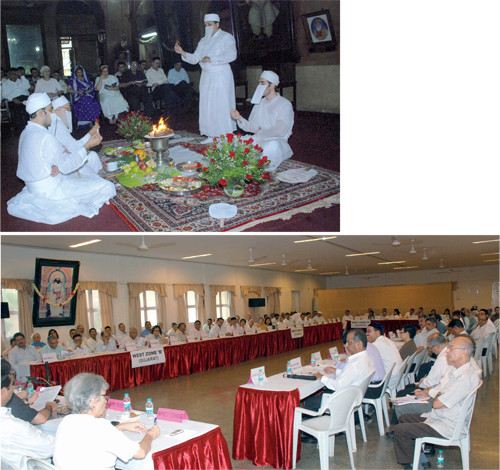
Jashan (top) preceding the Federation meeting in Bombay (above)
As zonal representatives, the anjumans of Allahabad, Indore, Jabalpur, Jhansi and Mhow were deemed elected from the North Zone as the Agra representative Porus Debara was not present on the first day, with no East Zone representative present (Bahadur Postwalla of Calcutta arrived later) the seat could not be finalized, Keki Colah (of Secunderabad and Hyderabad) was elected for the South Zone, Dahanu and the Iranian Zoroastrian Anjuman (IZA) for West Zone A (after Nagpur withdrew). For the two seats for West Zone B, the 20 anjumans from the Zone had to elect from the three — Bardoli, Nargol, Vadodara. In the earlier decades Vadodara’s Baman Cama used to be one of the most regular attendees. But since there was no representative from Vadodara present at this meet, it earned only one vote from the Bharuch anjuman, while Bardoli won 20 votes and Nargol, 19. In addition to the five permanent seats reserved for the BPP which will be occupied by Mehta, Khojeste Mistree, Jimmy Mistry, Yazdi Desai and Armaity Tirandaz, the other permanent seats are assigned to the IZA, Poona, Navsari, Surat, Calcutta, Delhi, Madras and Secunderabad-Hyderabad. The five members co-opted to the executive council were Keki Gandhi and Dadi Mistry of Delhi, Navroze Daver of Nagpur, Noshir Paghdiwalla from the Borivli and Suburban Zoroastrian Association and IZA’s Mehrwan Irani. Khojeste Mistree and Pervez Mehta of Bardoli will now function as the joint honorary secretaries, and Irani and Yazdi Desai as the joint honorary treasurers. Arnavaz Mistry of the BPP offered to be the new executive secretary.
The Poverty Amelioration Scheme (PAS) proposed by Khambatta was officially launched to give monthly financial aid "to poor humdins living in far-flung, isolated areas all over India.” Initially the financial burden would be jointly shared by Khambatta and the BPP until any moneys earned from defunct anjuman properties can be diverted to this cause. The anjumans or neighboring anjumans would only be required to authenticate the genuineness of the applications, 19 of which had been received so far. Believing that the assets locked up in defunct anjuman properties must be worth Rs 500 crores, Khambatta recommended that in the event of realization of funds, help should first be given to people living in those areas, thereafter to the PAS, and finally to protect the sacred fires. He referred to his efforts in saving "valuable land” — Damriwad from being lost to the community in Rajkot and castigated the "thavaa déni, javaa déni (laidback) attitude of orthodox Parsis.”
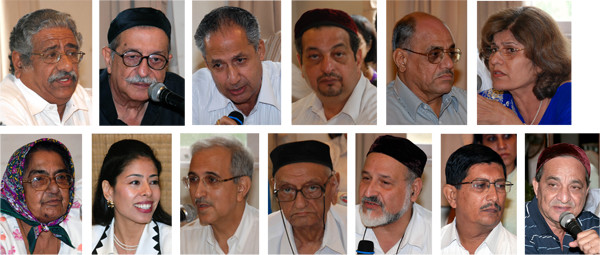
From left (top row): Dinshaw Mehta, Areez Khambatta, Tehmton Anklesaria, Porusasp Mehta, Kerfegar Antia, Arnavaz Mistry; (second row): Dr Mehroo Bengalee, Shernaaz Engineer, Kersi Limathwalla, Sorab Katpitia, Khojeste Mistree, Pervez Mehta and Mehrwan Irani
Congratulating the Federation president for starting the meeting with a jashan "so that half the battle is won,” Khambatta opined that the Agiary Adoption Scheme as mooted by BPP trustee Jimmy Mistry be promoted. Offering to adopt two agiaries, he was keen that Dinshaw Mehta adopt one agiary and tried to convince Mani Clubwala of Madras who reminded the members that next year being the centenary of the Clubwala Dar-e-Meher in Madras "we’ll be requesting you to donate to our agiary.” Commodore Medioma Bhada representing Belgaum felt that instead of doling out money we should teach a starving man how to fish but Khambatta argued that these people being so old they could hardly get out of bed, leave alone fish!
On the recommendation of Bomi Heerjee of Indore that there be a legislation to authorize the Federation or the nearest local anjuman to take over custody of Parsi properties in the case of defunct anjumans, just as in the case of the Hindu Religious and Charitable Endowments Act and the Muslim Waqf Act, the Punchayet will be seeking legal guidance on proceeding in the matter. In the meantime Jimmy Mistry was anxious that the intellectual property that vests with Sorab Katpitia be audiographed and videographed for posterity. To recover defunct anjuman properties, 82-year-old Katpitia, on behalf of the Federation is involved in 52 pending judicial cases. As analyzed the veteran, 70 percent of the defunct anjuman responsibilities involves judicial work, 20 percent revenue and the balance 10 percent administrative work. Although he is training Jimmy Bacha of Navsari in this massive work that involves recovering assets at Deesa, Bhopal, Nanded, Amroli, Bhusaval, Beena, Junagadh, Gadakh, Dharwar, Hathras, he repeatedly urged anjuman representatives, "Please furnish details of how many Parsis remain now as versus 10 years ago.”
There are 17 State Minorities Commissions all over India but unfortunately only three of them have Parsi representation although it is mandatory that each of the five religious minorities should be represented, pointed out Dr Mehroo Bengalee, the Parsi representative on the National Commission for Minorities (NCM). At the State level there is Noshir Tankariwala in West Bengal, Sam Pavri in Madhya Pradesh and Dinshaw Mehta in Maharashtra. Hopefully Andhra Pradesh and Karnataka will soon have a Parsi representative too. "Every one is complaining, ‘Where are the Parsis?’” remarked Bengalee. When the general perception of the community is one that is literate and prosperous, "It’s difficult to present a sorry picture of the Parsis…” she added. Having toured extensively during her association with the NCM she has tried to impress on the authorities that only 30 percent of the community is capable of working, our age composition being such. Between 2001-2006 she found the range of births varied between 171 to 223 a year and made a desperate plea that the community numbers be increased as in terms of numerical strength we would not even qualify as a tribe.
Regretting that Parsi parents "do not visualize the current employment scenario” but are only keen on their children getting degrees, even if they have to spend a crore on foreign education, she emphasized how Parsis can use their religious/linguistic minority quota in institutions founded by Parsis or by sister Gujarati/Sindhi/Catholic communities if there is a vacancy in their quota. "We need a syndicate to guide our members” on how privileges earmarked for minorities can be availed of by filling in the right forms with the requisite enclosures, due attestation and most importantly, on time, she advocated. She also regretted that there is no updated list of Parsi anjumans with relevant contact details. "There are 7,000 crores of rupees set aside for upliftment of minorities. Make sure you lift that quota…” she advocated.
Anjumans requiring funds towards repair/restoration of agiary/doongerwadi/aramgah/other properties should send in details to the Federation secretariat where a three-man committee of Khambatta, Khojeste Mistree and Jimmy Mistry will prioritize which of the institutions need funding.
In the case of agiaries left with only one or two worshippers, Dinshaw Mehta pointed out it is "difficult to maintain such agiaries. We need consolidation of agiaries all over the world. It is our priests who need looking after. Jimmy says we should be offering them a salary of Rs 25,000 per month.”
Parsis in Pakistan who wish to get their children navjoted in India "are suffering from lack of visas,” mentioned Khojeste Mistree. With the present political scenario in Pakistan there could be "a complete exodus — whether Parsis would come here (to India) or prefer to go to US…” Through the BPP and the NCM, Parsis in Pakistan who are finding it difficult to secure jobs especially in the shipping industry should be assisted to migrate to India, recommended Jamsheed Kanga of Satara, offering to use his contacts in the government circles, being a former IAS (Indian Administrative Services) officer.
Although there was no authorized Surat Parsi Panchayat (SPP) representative present at the meeting, Yazdi Katpitia on behalf of the Alert Zoroastrians from Surat used the forum to criticize and distribute literature criticizing the SPP trustees for their alleged "manipulation and fraudulent practices causing great monetary and administrative loss.” "In the absence of any representative from SPP,” Mehta opined it "was not fair” to allow the attack to continue.
Among the guest speakers on the first day was freelance journalist, and now editor of the BPP Review, Shernaaz Engineer who believed that whilst pursuing one’s personal path we had a "collective responsibility to safeguard, nurture and strengthen our glorious legacy” which she felt was possible if the community focused on "holistic development of the youth and empowerment of the clergy.” She referred too to the responsibility of seniors "to create right role models for the youth,” making Kanga comment, "Let us keep our self-respect…fight our battle within ourselves” instead of carrying our differences to the national Press.” This earned a prompt response from Khambatta, "Provided the Parsi Press gives…both sides of the coin.” Khojeste Mistree added, "The first move needs to come from a very biased Parsi media…Let the Parsi Press not go into attack mode week after week…” Enquired Tannaz Parakh, representing Khergam, "Is it OK to vilify and attack in the Parsi Press?” making Kanga respond, "I can disagree with my wife at home...”
Another speech that started innocuously was the presentation by Kersi Limathwalla, president of the World Zarathushti Chamber of Commerce (WZCC) who referred to the worldwide network of 20 chapters and reminded the audience, "If the community was prosperous in the past it was due to business…In 1901 there were 13 people in India with an income of over one lakh rupees of whom six were Parsis…In the 1930 census, the community has been defined as a trading and business community…” Urging prospective entrepreneurs to look for "Opportunities in recession you may not get in boom period,” he announced WZCC’s Business Plan Competition. Supplemented Cyrus Bagwadia, former managing director of Essel Propack Limited, "Developing an industry is the biggest act of contribution to one’s community” and offered to show a "road map to those who want to start a business.”
The post-lunch session started with Yasmine Sanjana, representing Dumas, enquiring, "Is the WZCC connected with the World Zoroastrian Organisation (WZO)?” Although Limathwalla gave a brief reply, "The WZCC is not connected to any organization,” Dinshaw Mehta wanted him to elaborate on why he chose to resign from the UK board of WZO. The decision of the UK board to "open its doors to anybody who professes Zoroastrianism,” Limathwalla felt "was not right…It was vertically dividing the global body…Without any checks and balances it was opening the doors to anybody and everybody.” Viewing this amendment of "historical importance” as a "historical blunder” Limathwalla was able to convince the India board not to accept the proposal. Though initially it was the intention of the Federation to pass a "resolution that would be the voice of the Parsi community in India (and) should hold a lot of weight” it was subsequently sidetracked. By the time Adil Nargolwala of Delhi enquired, "Why are we debating on this issue?” Anahita Desai, representing Dumas, responded, "We are debating because we are affiliated…We need people like him (Limathwalla) on the board.” The discussion would have continued ad infinitum had Mehta not called a halt and invited Pareecheher Daviervala to brief the audience about BPP’s school counseling service.
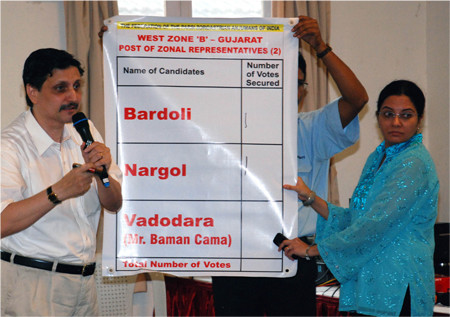
Yazdi and Anahita Desai keeping count of votes for West Zone B anjumans
"Looking at the unprecedented turnout,” guest speaker Eruch Desai, former chairman of the BPP, commented, "It indicates a resurrection of the community…that more anjumans are concerned about what the community is going through… In our times hardly 10-20 people attended. The Federation, I feel, is one organization that unifies members of the community. It is a link in a chain with world Zoroastrians.” Giving credit to the Federation for having introduced the Indian Succession Act and the Adoption of Children Bill his subsequent talk to the members dealt largely with the issues he had presented in his article on the Shahenshahi New Year (see "Dealing with dissent,” Parsiana, September 7, 2009). When Burges Wania of Daman-Vapi sought the Federation’s endorsement on the BPP ban of two Bombay priests from praying at the Punchayet run agiaries and at the Doongerwadi, Eruch Desai, a veteran of such meetings advised, "This is a local problem. As per the Federation constitution, each anjuman has to manage its own affairs…The trustees of the BPP are the right people for the right job. They’ll manage with the High Priests’ endorsement. I don’t think other anjumans should involve themselves.”
Since Desai’s speech had alluded to the need to continue with the dakhmenashini system at Doongerwadi lest it invite the government’s unwarranted interference, Parakh referred to the court case concerning Doongerwadi pending in the High Court and whether Kanga, one of the petitioners, could be requested "to withdraw the case that would jeopardize the property.” Kanga initially chose to maintain his silence on this issue. Provoked Khambatta, "Kanga is ever ready to speak…” Countered Kanga, "I didn’t want to convert this into a circus but since Areez has started the first act… This is a legal issue. We have only asked for the legal position to be clarified… The Doongerwadi land has been bought from community funds… there is absolutely no danger of the property of a minority being touched by any government. Why are you scared for the court to decide?”
Questioned Eruch Desai, "If the court says a bungli can be used for prayers for those opting for other modes of disposal like burial or cremation…tomorrow we don’t know the government’s (response).”
Retaliated Kanga, "One of the rules of the Federation states religious matters should not be discussed.”
Interjected Firoza Punthakey-Mistree who was representing Ankleshwar: "Mr Kanga should have the decency to let the guest speaker have his say.”
Insisted Kanga: "We have to function according to the rules of the body. This is not a subject to be discussed at this forum.”
Decreed Dinshaw Mehta: "This is not the right forum. Let us close the chapter.”
Seeking to have his first say in the deliberations Yazdi Desai was keen to read the relevant constitutional requirement that states religious matters "shall not be discussed unless 80 percent …demand that the matter be discussed.”
Concluded a firm Mehta: "Even if 100 percent want it I will not (permit)... Why are we unnecessarily creating unpleasantness?”
The next six-monthly meeting of the Federation will be held either in Delhi or Jabalpur.
On behalf of the dormant Federation of Zoroastrian Youth Associations of India, secretary Shovir Irani announced plans to activate it with a committee meeting in October followed by a seminar at the start of 2010. In the meanwhile, the BPP’s new youth body — Zoroastrian Youth for the Next Generation (ZYNG) — expect to be the mediators for Parsi colonies and for all over India,” announced Hoshaang Gotla, an active member of BPP’s Holiday Programme for Youth.
The next report on the two-day meeting will carry further insights on the deliberations.
◆ ◆ ◆
From the archive