
Politics and Policy
Flavor of the Federation
While a committee will study the proposed revision in the Federation’s constitution, member anjumans have been given further time to provide feedback
Allaying the fear of smaller anjumans that they would be sidelined in the all-India body, the Federation of Parsi Zoroastrian Ajumans of India decided to constitute a committee to study the proposed changes in the rules and regulations of the Federation’s constitution.
The necessity for a change was further highlighted when constant disruption by Federation vice president and Ahmedabad Parsi Panchayat president Areez Khambatta resulted in two Bombay Parsi Punchayet (BPP) trustees Dinshaw Tamboly and Burjor Antia threatening to walk out of the September 23 executive council meet at Bombay’s West End Hotel if a vote of no confidence was not passed against the recalcitrant office bearer. With his "one-man army,” as Khambatta was wont to refer to himself, he was able to interrupt and enliven the proceedings, as also to alienate other executive council members with his allegations and accusations.
Responses to the revision in the rules and regulations proposed by the Parsi Zoroastrian Anjuman of Secunderabad and Hyderabad (PZASH) were received from only four anjumans — Jamshedpur, Mhow, Indore, Vadodara. To allay the apprehensions of the smaller anjumans who feared marginalization, south zone vice president Jehangir Bisney explained that the move was necessary "as a small check we want to put in place so that smaller anjumans cannot wind up the Federation.” It was decided that after the circulation of a revised note within a week, incorporating the views of Ahmedabad and Calcutta, the executive council members would be given a further two months to revert to the Federation on this issue and simultaneously a committee (to be constituted by Shroff) would deliberate on the subject. At the time of the next council meeting if the revised draft wins the consensus of the house it would thereafter be placed before the annual general meeting for approval.
The bona fides of a membership application from the Nanpura anjuman to the Federation were questioned by Nanpura trustee and president of Surat Parsi Panchayat (SPP) Darayas Master who sought to know who had signed the application and sent the accompanying demand drafts. The Nanpura Anjuman has no minutes to the effect that membership is sought from the Federation, clarified Master. As decided at the executive council meet in Thana the membership applications from Nanpura, Olpad, and Shri Abu Road and Mount Abu Zarthosti Anjumans had been kept in abeyance until a final decision was taken on the proposed amendments to the Federation rules.
The Federation does not need a website to post circulars, notices, etc, maintained honorary secretary Keki Gandhi in response to a suggestion from Pervez Irani of the Iranian Zoroastrian Anjuman (IZA) that if all circulars concerning anjumans are placed on the website then anjumans cannot complain of non-receipt of official communication. Gandhi preferred to communicate with the 70 member anjumans rather than have the website abused by vested interests.
Criticizing the Federation honorary secretary for the delay in not sending "corrected minutes” to the delegates, Khambatta demanded that the previous minutes "be corrected and then we will okay.” Gandhi clarified that the rectification sought in the minutes of the Ahmedabad meeting had been made at the Thana meeting and regarding the points disputed by Khambatta at the Thana meeting since they had been checked against the transcripts of the tape recording by Shroff and found to be in order, no revision of minutes was necessary.
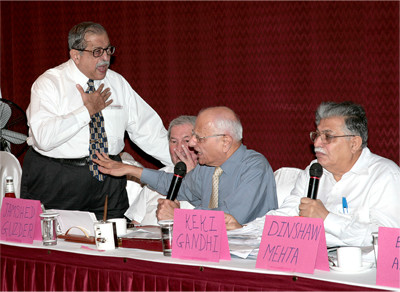
Altercation between Minoo Shroff (center) and Areez Khambatta (left) as Keki Gandhi looks on
Khambatta then complained that his name in the roster for signing was below that of J. J. Irani (Kt), vice president of the east zone and president of the Jamshedpur Parsee Association. Gandhi said he would check to see who was senior "and correct (the sequence) if required.”
The SPP has offered to help the Federations’s defunct anjumans project and Khambatta showed his willingness to work on the Rajkot lands which were being encroached saying, "I’m taking up the challenge myself.” In a subsequent statement he said, "I am prepared to take up the entire Federation,” which made Shroff retort, "The Federation is not for sale.”
The Federation has not yet been able to find a professional to handle its defunct anjumans project despite repeated advertisements. The lure of lucre evokes some initial interest but after the candidates realize the efforts involved to free the land of encroachment and legal encumbrances they opt out.
"I’ve been a trustee for over 20 years. I’ve never seen such tumultuous times,” said Federation president and BPP chairman Minoo Shroff in his opening address at the two-day meet (the general body get-together was on September 24). Community issues were now in "the public domain…into the non-Parsi Press…”
Referring to the possibility of government passing a legislation to take control of minority trusts, Shroff cautioned the delegates, "I humbly urge ghér ni vaat ghér maa raakho (restrict domestic matters to the home)… The government has a coveted eye on all trusts. (They) intend to make all the present trustees ineffective… to suspend the powers of trustees.”
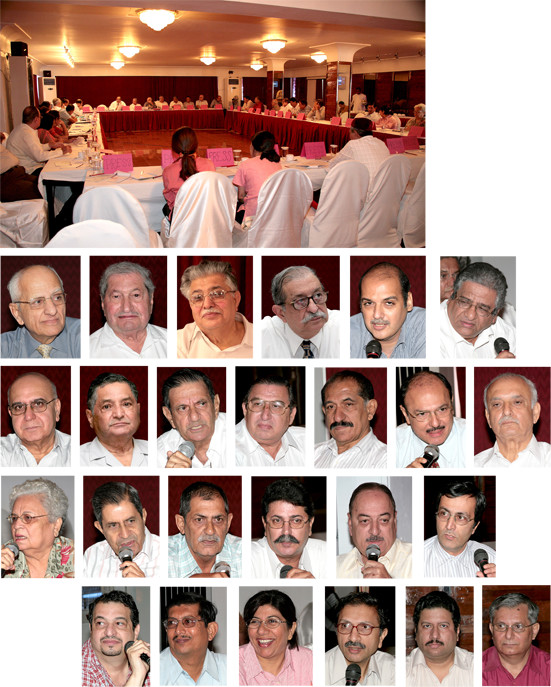
Top left: The executive council meeting in progress Below (from left) 1st row: Minoo Shroff, Jamshed Guzder, Keki Gandhi, Areez Khambatta, Jehangir Bisney and Dinshaw Mehta 2nd row: Dinshaw Tamboly, Burjor Antia, Jamsheed Kanga, Darayas Master, Pervez Bhesania, Zarsis Udhnawala and Bahadur Postwalla; 3rd row: Mani Clubwala, Bomi Heerjee, Omim Debara, Pervez Irani, Farokh Kavina and Tehmasp Bharucha ; 4th row: Porusasp Mehta, Pervez Mehta, Yasmin Sanjana, Farrokh Rustomji, Mehli Colah and Cawas Panthaki
New memberships
In response to Bardoli representative Yasmin Sanjana’s query regarding the status of the Nanpura Anjuman’s membership application, Gandhi clarified that since the revision of rules is yet under consideration, their application has been kept on hold and the accompanying demand drafts returned. With Master enquiring, "Who has applied?” Gandhi recalled that one of the applications bore a signature in Gujarati. Not only is the authenticity of the application questionable, Gandhi wondered if small puras like Nanpura, Gopipura and Rustompura should be given Federation membership considering they are only small pockets which can be represented by the SPP. Baugs and colonies in Bombay will then start asking for Federation membership. Sanjana pointed out that the Borivli and Suburban Zoroastrian Association had been granted membership but Gandhi felt that the strength of Zoroastrians in Bombay (nearly 50,000) as compared to Surat’s 3,000 was not comparable.
Olpad, reportedly has only one Parsi residing there. Khambatta though insisted that if the single family Satara Anjuman represented by Jamsheed Kanga can be given a seat on the executive council, Nanpura which has an agiary and a dakhma, could be given membership considering he had been receiving enquiries from the lady trustee there. Master clarified, "There is no lady trustee, no agiary and no dakhma.” When Khambatta persisted, "I will produce the lady,” Zarsis Udhnawala from Thana asked, "And the dakhma also?”
Proposed amendments
"Bisney has done a remarkable job” in preparing the 28-page note on the proposed revision in the Federation rules and regulations, incorporating therein the views of the four anjumans – Jamshedpur, Allahabad, Indore and Baroda – which had sent their feedback in time, commended Shroff. Khambatta was upset that the views of Ahmedabad had not been included although they were sent to the Federation secretariat and other member anjumans. He ruffled through his papers to finally produce the document addressed to honorary secretary "Dinshaw Mehta, D. N. Road” which as Shroff commented was not sufficient address to reach the right person. However neither Mehta nor any other member of the executive council had received Ahmedabad’s feedback. Both Ahmedabad and Calcutta’s response will be circulated for consideration by member anjumans and the specially constituted committee. Member anjumans have been given two months’ time to deliberate on this issue and revert to the Federation so that before the next executive council meeting a revised draft can be readied.
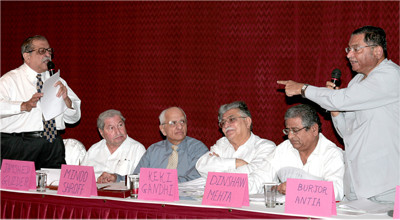
Burjor Antia at extreme right addressing Areez Khambatta at extreme left: "You’re spoiling our atmosphere”
"I have been told that the president of PZASH wants to reconsider” the proposal which had originated from their Anjuman, announced Khambatta who was supported by Porusasp Mehta of Poona. "I’m surprised that people outside our anjuman seem to know more than what we know,” countered Bisney. "The PZASH view is that the final decision should be taken after receiving the feedback from other anjumans.”
PZASH president Gulbanoo Chenoy had apparently sent a sealed letter to the Federation secretary through Secunderabad representative Omim Debara, the contents of which were read: "Some of the clauses are extremely harsh…could lead to marginalization and figureheads… Anjumans like Indore and Mhow should be taken into consideration… In the meanwhile we request you to refrain from taking final view.” Once again Bisney clarified, "An impression should not be created that we are having second thoughts. We are open. We are not rigid, in the larger interest of the Federation.”
Bomi Heerjee of Indore expressed that as per the proposals, "smaller anjumans will be put on the back burner…The amendments bristle with a lot of problems.” The president and the trustees of the BPP together get one-third of the voting rights as per the revised structure and the remaining anjumans get weightage depending on the strength of the Zoroastrians they represent. Heerjee added, "The events of the past few months have shaken our faith in the BPP. We looked up to the BPP as the custodian of rights and duties. Today we feel it’s a fragmented, fractured body.” Instead of granting them one-third of the votes, let the BPP enjoy veto power he recommended.
Responded Gandhi, "I am perhaps the only person to have the experience of running the body without the BPP (referring to the schism from 1978 to 1983). Their manpower, resources play an important role in the Federation…The destiny of the community may go into different hands…the community will get the government it deserves…What happens to the BPP will happen to the Federation but the reverse will not hold true. It is better to respect the BPP sovereignty, better to give voting rights to the BPP. Let not anjumans belittle the BPP because they want to do things in certain ways. Smaller anjumans could be given the weightage they deserve and they are entitled…” Fifty votes of the smaller anjumans as versus 20 votes of the bigger anjumans could wind up the Federation, he feared.
Clarified Shroff, "We don’t want the tyranny of the minority. We don’t want to be subjugated. The tail is wagging the dog today. The United Nations is also facing the same problem where US and Papua New Guinea have the same vote (in the General Assembly)…There is no intention of the BPP dominating. For what? Do we want to take away your anjuman or your funds? Things will be much better in a few months’ time. BPP will emerge a stronger, better body. What makes you think more worthy, more deserving people will not come?” Supported Antia, "The institution will go on forever. Men may change. Tomorrow will be better than today.”
Considering that some anjumans like IZA and Calcutta do not maintain a register of members, how will they determine the weightage? wondered Irani before declaring, "Where’s the question of BPP taking over the Federation? The Federation works to protect the anjumans. Why create doubts? Where’s the question of coming to harm?… Only in the past two or three years there’s been a dissenting voice in the Federation. In the past, decisions were taken only by consensus and not by majority. What’s wrong?” "Everyone,” declared Khambatta, telling Irani how the Federation name does not even include the term Irani. But Irani responded, "I consider myself a Zoroastrian.”
Federation assets
Khambatta was critical of the way the receipts and payments statement for defunct anjumans was presented, "As usual no details... of defunct anjumans are given. We can’t ask questions. Accounts should come in proper fashion, in proper method, according to the CA rules and regulations.”
"What are the resources of the Federation?…The individual net worth of each of us would be much more than the Federation,” observed Shroff. Countered Khambatta, "Unfortunately that is because the president himself does not know the aims and objects of the Federation.” Continued Shroff, "The Federation’s role is that of a catalyst. The aims may be anything, but where are the means?”
When Heerjee enquired why a contribution of Rs 3,353 was paid to the charity commissioner and expressed that Rs 1,07,111 annually expended on the Fed Newsletter was high, Gandhi explained that actually the cost of the newsletter is set off by the sponsorships and donations received (Rs 1,19,677). Referring to the statement of expenses where the cost of publishing and mailing the Fed Newsletter was shown as Rs 78,559 from September 2005 to March ’06 and Rs 61,036 from March to September 2006, Gandhi pointed out that the difference was due to the fact that the paper stock for the whole year is bought at one time. He further explained that the contribution was paid to the charity commissioner as per the statutory formula.
When Pervez Mehta of Bardoli advocated investment of amounts received, Khambatta promptly interjected, "especially since the amounts are not spent.” He was critical of the Federation not aiding Surat following the recent floods; of the BPP not helping the bomb blast victims… especially since the APP had sent "dumpers trucks…more than Rs 3.25 lakhs cash whilst the World Alliance of Parsi Irani Zarthoshtis (WAPIZ) under my chairmanship was the first to have rushed food materials and also contributed about Rs 10 lakhs,” as per his note of September 21, 2006 addressed to the honorary secretaries of the Federation and selectively distributed to those present.
Shroff commended the good work done by the World Zoroastrian Organisation in assisting the Surat victims before declaring, "We need to supplement and complement; not tear each other apart.” Each day the Punchayet spends Rs 2,00,000 on religious or welfare activities, conveyed Shroff and referred to the house gifted to the bomb blast victim’s widow. We spent Rs 20 lakhs on the demographic report (on the community). Do things by stealth and let it be found out by accident… The right hand should not know what the left hand is doing.” "Let’s practice what we preach,” shot back Khambatta.
When Shroff sought to know the annual outlay of major anjumans, Poona’s Tehmasp Bharucha said they spent Rs 11 lakhs on relief of poverty and nine lakhs on education; Ahmedabad has an annual outlay of 25 lakhs; Thana generates an annual income of about four lakhs spent on educational, medical, poverty and social objects; the IZA’s 35-45 lakhs are spent on education, medical needs and relief of poverty; SPP spends Rs 25 lakhs on its hospital…
Office bearers
Nominations had been received for the continuity of the present office bearers: Farrokh Rustomji and Mehrwan Irani as two honorary treasurers; Keki Gandhi and Dinshaw Mehta as two honorary secretaries; and Cawas Panthaki as executive secretary. While no objection was expressed for the first four, Khambatta was not in favor of Panthaki, an employee of the BPP being appointed executive secretary: "No work is being done there… Letters go unanswered…He would be obliged to the BPP. That’s why we don’t want him.”
Shroff believed Khambatta was "casting aspersions… Does the House agree?”
"Even if you have a paid secretary you can never equal the efforts and time put in by Keki Gandhi,” responded Capt Homi Dandiwalla of Allahabad.
"For a paid secretary we would need an office and other equipment (costs which are otherwise saved under the present set-up where the executive secretary functions from the BPP office),” pointed out Dinshaw Mehta. The two honorary secretaries are doing "excellent work,” commended Tamboly referring to Pluto’s words, "Wise men talk because they have something to say. Fools, because they have to say something.”
Referring to BPP chairman emeritus Jamshed Guzder’s silent presence at the Federation meeting Shroff noted, "The seniormost amongst us is Jimmy. No one has recognized him.” A round of applause greeted the statement before Shroff continued, "Why do you always blame us? The documentation here is more than what one receives for a 10,000 crore company. The executive secretary has to report to the honorary secretaries.” Instead of preparing such lengthy minutes of meetings, the gist, conveying the materiality and decision taken, should suffice, suggested Shroff. The delay on defunct anjuman issues was due to several factors, he realized.
Defunct anjumans
Khambatta’s contention that the Federation was not paying sufficient attention to the dwindling anjumans before they become defunct and their assets are lost to the community was refuted by Gandhi and Shroff. "The trustees (of dwindling anjumans) are most disinclined to hand over their assets to the Federation or to admit that there are no members,” Shroff related his experiences. Farokh Kavina of Ahmedabad reported how he had met the trustees of the Deesa Parsi Anjuman who insisted that their names were officially registered at the charity commissioner’s office and they were taking good care of their Anjuman. But Panthaki related that as per their knowledge a complex was being created and shops sold on Anjuman properties in Deesa. "That’s why we are proceeding legally.” According to Gandhi, dwindling anjumans take the Federation’s help to get the property registered in their name and once that is done they do not welcome Federation involvement nor are they willing for a custodian-trusteeship agreement. Heerjee reported that due to the bypass operation on Ratlam president Tehmton Anklesaria and the heavy floods which blocked roads, they were not able to visit Bhopal and Neemuch.
When Farrokh Rustomji suggested that Khambatta or Master be inducted onto the defunct anjumans subcommittee, Master narrated in Gujarati how difficult it was to obtain information from the collector or mamlatdar or talati of a village which veteran Sohrab Katpitia has been able to do with his knowledge and experience. Only "those who have shakti pahonchi saké (with strength can get the job done),” added Master referring to Suvey No 55 near the Surat dakhma which has been encroached upon by Muslims who have set up 200 shops. It is the SPP which has been served a notice for tax payment of one crore, one lakh because of that.
"We require full cooperation of voluntary people” to take possession of defunct anjuman properties that are being lost to the community, emphasized Shroff referring to the difficulty of finding salaried persons who would be committed to the task. When Khambatta faulted the team for framing the advertisement wrongly, Antia shot back, "Why don’t you find someone? It will save us the cost on the advertisement.” Responded Khambatta, the chairman of Pioma Industries, the makers of Rasna, "I am a flavorist. I can give you salesmen, as many as you want.”
"Instead of being a critic, be a creator,” advised Kanga, "People are not willing to lift a finger but they are only wagging their tails.” Let the regional representatives take on the onus of managing the defunct anjuman property in their area and report on the progress at the next executive council meeting, insisted Kanga. If required the center can assist or guide. "Let the responsibility of finding, guiding, controlling professionals vest with the zone. Let those who shout the most do the most work.” People from the region would enjoy greater rapport and respect from their own men. Responded Gandhi, "Madhya Pradesh has come forward and we’ve delegated but we can’t thrust responsibility.” PZASH representatives had earlier conveyed that neigboring anjumans would be more willing to help out if, in addition to the costs of reimbursement, incentives are also offered . "Money cannot be the birthright of only one person in the community,” Bisney indirectly referred to Khambatta’s frequent claims to the wealth he commands and disburses.
A peeved Khambatta interjected, "There is too much wagging by people who don’t know anything...I’ve already told you I’m a flavorist. It’s the duty of a solicitor (referring to Antia) to find someone.”
Kanga: "Your comprehension is limited.”
Khambatta once again sought to ascertain why details of individual anjumans were not given, why more than half the amount earned on the Cambay property was spent…
Kanga’s interruption at this stage earned him Khambatta’s wrath, "Shut up, fool that you are. There is a High Court ruling against you…I’m a one-man army…” The next victim was Gandhi, "The whole Federation is going down because of you, you and you. You are like a mongoose, a rat, a rabbit...”
Interposed Antia, "Such an attitude should not be tolerated. He’s a disgrace to us. You’re spoiling our atmosphere.”
Tamboly insisted a vote of no confidence be passed against Khambatta or they would stage a walk out. This compelled Shroff to announce that the meeting had been adjourned. Earlier in the day Shroff stated, "I’m accused of being too mild and gentlemanly. But short of throwing a person out how else can I control?” When Dinshaw Mehta sought to placate Khambatta, he thundered, "É loko bolé tau bhagwan bolé né hu soo 10 minute nahi boli saku (When others speak it is as though God is talking and I am not permitted 10 minutes)?”
After lunch though, normalcy was restored with Khambatta being cautioned to keep his temper in check and others being advised not to be provocative.
Ten-minute tirade
From the time the minutes of the last meeting were discussed Khambatta kept reminding that he needed to speak for 10 minutes. Soon after lunch he was permitted to have his say with Farrokh Rustomji advising, "Let the meeting be fruitful for everybody. When we discuss we shouldn’t fly off the handle. There should be no use of unparliamentary language. It is unbecoming of a meeting.” Reminded Shroff, "No one is anybody’s servant here. We are all working in our honorary capacity… The BPP presence is the largest but our participation is the least… In terms of voice, Khambatta will get the largest votes.”
Maintaining that he was overburdened, how his bag weighed seven-eight kilos, how he did "gadhai vétru (worked liked a donkey)” from six in the morning to 11 at night, and how his aim was only to "work harmoniously” and for "the upliftment of the community so that the common anjuman fellow can be happy,” Khambatta proceeded, "I’m doing service. Kareesh tau baraabar kareesh (if I undertake something I will do it well) even if laat maari né baar karo (I get kicked out). Federation money is like my own money...” He then read out from his four-page letter which was earlier circulated. The letter started with the observation that at the Thana meeting there were 12 anjuman representatives and twice the number of invitees although "for the first time in the history of the Federation (all) member anjumans were not allowed to attend… (in the early years of the Federation the members of the general body were not permitted to sit or vote at the executive council meetings — editors).” This measure had been reintroduced following the fracas at the Federation meetings in recent times from the time Ahmedabad played host. As Shroff explained, "It’s like having a board of directors meeting and inviting all the share holders.”
The next set of pages faulted the slow progress of the defunct anjumans project and its accountability and ended with the warning in Gujarati rhyme, "Convertists jé dharam né chhédsé/Téné Areez Khambatta nahi chhodsé (Those who tamper with the religion will not be spared by Khambatta).” He complained that the defunct anjumans report showed a smaller amount of Rs 12.62 lakhs as versus Katpitia’s statement that about Rs 75 lakhs had been recovered. (Was he confusing the gross and net receipts?) His 10 minutes stretched ad infinitum. When Thana’s Pervez Bhesania who was timing him pointed out that 47 minutes had passed, an unmindful Khambatta continued on the rationale that the day’s deliberations being almost over there was the entire afternoon ahead of them. No interruptions or in-talking or movements were permitted by him on the confession that he tends to get easily distracted. His earlier verbal assault on Gandhi he attributed to his inability to control his temper.
The Parsi Press, Khambatta claimed was "not only biased but owned. It is anti-religious…We are the goondas, we are the black spot.” He was offended that being a senior vice president the minutes reach him so late although tapes (recordings of the Federation sessions) are given to the Press (Parsiana has never had access to the tapes – editors). When Khambatta stated the Parsi Press was not writing about WAPIZ and related activities, south zone co-opted member from Madras Mani Clubwala queried that when WAPIZ/Khambatta did not invite the Parsi Press to the function, how could they give coverage?
Although the members were getting restless, Shroff permitted Khambatta to have his say for this letter "written in a nice language and without aspersions marked a departure from his previous letters…” At different times the members of the council were labeled as "chamchas” or reprimanded for being "chaaplas” or "convertists,” or "over smart…Mari jaai pachheeno daapan nathi joito (we don’t want the wisdom which comes after death).”Addressing his supposed supporter Dinshaw Mehta, "Navaa hata taré apri side lèta hata, havé tamuné bhi asar thai gaiee (When you were new, you would side with us. Now you too have been influenced).” When Khambatta was faulted for being offensive he retorted, "Krishna bhagwan karé tau Krishna ni leela kéhvaay, aapré karié tau Romeo and Juliet kéhvaay (Lord Krishna’s dalliances with the gopis is termed a cosmic dance but we are derogatorily dubbed as Romeos)…I am also polite; only I have an army voice… A to Z maru bad luck ké hiya koiee bhi mané samji saktu nathi (from the beginning to the end it is my bad luck that nobody is able to understand me).” The flavorist was sorry that "the man who makes the tastiest drinks in the world is given a bad taste in the mouth.”
Those attending the Federation meeting were: Hoshang and Dolat Debara from Agra; Areez Khambatta, Farokh Kavina and Kersi Daruwalla from Ahmedabad; Capt Homi Dandiwalla from Allahabad; Pervez Mehta and Yasmin Sanjana from Bardoli; Minoo Shroff, Dinshaw Mehta, Dinshaw Tamboly, Burjor Antia, Mehli Colah, Cawas Panthaki and Godrej Dotivala (BPP Review) from Bombay; Bahadur Postwalla from Calcutta; Keki Gandhi from Delhi; Bomi Heerjee from Indore; Pervez Irani and Mehrwan Irani from Iranian Zoroastrian Anjuman; Tehmasp Bharucha and Porusasp Mehta from Poona; Jamsheed Kanga from Satara; Jehangir Bisney, Aspi and Omim Debara from Secunderabad and Hyderabad; Mani Clubwala co-opted from south zone; Darayas Master from Surat; Pervez Bhesania and Zarsis Udhnawala from Thana; and Federation treasurer Farrokh Rustomji. The Press was represented by Jam-e-Jamshed, The Bombay Samachar and Parsiana.
◆ ◆ ◆
From the archive