
Cover Story
Equaling the odds
The executive council of the Federation of Parsi Zoroastrian Anjumans of India deliberates over proposed constitutional changes to correct an imbalance in representation
"The discipline was exemplary, except for some sparks. Without them it would have been too tame,” smiled noted economist Minoo Shroff, chairman of the Bombay Parsi Punchayet (BPP) and president of the Federation of Parsi Zoroastrian Anjumans of India as the latter’s executive council meet (ECM) ended at 2.30 p.m. on March 26, 2006. The delegates partook of a late lunch and dispersed in anticipation of a power cut later in the afternoon.
The meet, hosted by the Thana Parsi Zoroastrian Anjuman at the Khan Bahadur Bapuji Cowasji Public (Town) Hall, had begun half an hour after its scheduled start at 10 a.m. the previous day as soon as power was restored. An innovation, introduced on this occasion to preempt the gate storming and indiscipline witnessed at the last meeting in Bombay, was the request to member anjumans to restrict their representation to a single individual who, moreover, was required to carry not only his/her anjuman’s letter of authority but a photo ID as well. Though the law was uniformly enforced by Thana anjuman volunteers, the Ahmedabad Parsi Panchayat president and Federation vice president of west zone B Areez Khambatta was the only one to feel affronted ("These people were my guests last year. Now they are asking for my identity!”)
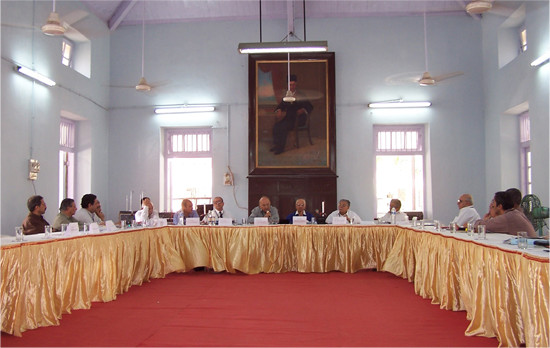
The executive council in session
The meeting was threatened with derailment over the first major item on the agenda — the confirmation of the minutes. Normally a five-minute affair even when delegates had errors to complain of, this time the formality generated accusations and frayed tempers. Khambatta used every opportunity — and created some — to vituperate against the Federation administration and succeeded in raising the heckles of the normally patient president. That anjuman after anjuman reiterated their faith in the integrity of Shroff and joint honorary secretary Keki Gandhi probably accounted for the frustrated Khambatta’s provocative verbal abuse against the BPP administration, particularly its CEO Behram Dastur, after the end of the first day’s deliberations.
The revision of the Federation’s rules and regulations suggested by the Parsi Zoroastrian Anjuman of Secunderabad and Hyderabad (PZASH) was generally welcomed by the delegates in council and several additions suggested. They sought time to discuss the changes further with their anjumans.
The discussion on demography – in particular, the aging of the community and ensuing problems as forcefully depicted in the studies conducted by the Tata Institute of Social Sciences (TISS) – revealed that the community needed more senior citizens’ homes as well as outreach services.
With the passing of BPP trustee Silloo Kavarana the mantle of ‘senior trustee,’ who is ex-officio joint honorary secretary of the Federation, is now borne by Dinshaw Mehta. His entry into the Federation executive team was among the pleasantest parts of the meet. Gandhi welcomed the "efficient and hardworking” Mehta saying "I may be senior in age but he is senior in wisdom. I’ll profit by his guidance.” Mehta returned the compliment: "Frankly, I don’t think I’ll be able to match what Keki Gandhi has been doing for 25 years. Hope he will continue to do what he’s been doing.”
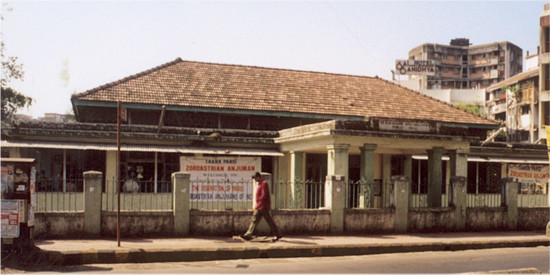
Thana’s Khan Bahadur Bapuji Cowasji Public (Town) Hall
The minutes
Khambatta complained loud and long because it had been mentioned in the minutes that the Supreme Court verdict in his favor — upholding a cooperative society’s right to restrict membership to those of a particular community or way of life — would substantially benefit "his Punchayet.” Khambatta said he had mentioned it would help the BPP and other trusts to the tune of crores of rupees. The advocates charged "a lakh per day…Only seven people footed the cost…The Federation didn’t bother to write to me about it though it was such an important case,” maintained Khambatta, adding, "An entrepreneur makes something new in the world, (Rasna produces) the maximum drinks in the world…Mhow is in receipt of the WAPIZ action regarding mobeds (later questioned by Mhow president Dr Behram Masani)…Demanding only one thing: the membership clause of the world body should be the same as (that of) the Federation. I am prepared to give advance payments to engage staff for the Federation to push for defunct (anjuman) properties…” In the process he denigrated the work of legal counsel Nadir Modi, vice president of the Athornan Mandal who had successfully persuaded the Supreme Court to preserve the Parsi Colony at Dadar against cosmopolitan buy-over in the 1980s as dafance (false claim). When Gandhi asked him courteously, "Tell us what has not been properly recorded in the minutes,” Khambatta referred to his letters to the president, almost uniformly nasty in tone, in which he had pushed his own agenda.
President of the Baroda Parsi Punchayet Jal Patel urged that the minutes, going into 50 pages, be made more concise and be circulated within two to three months of the meet. Bomi Heerjee, president of the Indore Parsi Zoroastrian Anjuman, wondered why the election/selection of executive committee members was not reflected in the minutes to which Gandhi explained that items considered under the Federation’s AGM would be reflected in the AGM minutes at its next meeting. Calcutta’s Bahadur Postwalla suggested that in future draft minutes of the AGM be presented to the executive council for vetting. Khambatta tried to twist the discussion into an aspersion against the secretary: "(The delay is to ensure that) the longer the time taken more people would forget…AGM and ECM minutes are intertwined so we know whether there is heraferi (hanky panky)” and won an instant rebuttal from Postwalla: "I’ve not used the term heraferi!”
Khambatta refused to allow the minutes to be passed until he received the tape recording of the previous meet. Supporting him was Jamshed Mohta, president of the Bardoli Jar-thosti Anjuman. Refusing the persistent demand Gandhi noted, "So many things are said on the floor of the house which are not for public consumption. It is against the interests of the community for the tapes to be publicized…(If you insist) I may have to stop these recordings. Then there will be no record of what is said.” Gandhi explained the delay: the two-day meet generally results in 10 tapes because it is not possible to make such exhaustive notes. From these tapes the transcript running into 500 pages is prepared by his secretary who doesn’t understand Gujarati. The blanks she leaves have to be filled in by Gandhi who added that his efforts to farm out the process of typing the transcript to someone reliable has been unsuccessful.
Should a member have doubts about what is stated in the minutes, Gandhi suggested the chairman would hear that portion of the tape and give a ruling.
The discussion veered toward a letter from Farrokh Rustomji, secretary of the J. J. Trust and honorary treasurer of the Federation, to the anjumans asking for demographic details of the membership in the area, the problems they face, their action plan, etc. Only the Allahabad Anjuman had responded. Rustomji now enquired whether there was any difficulty in understanding the queries, in responding or gathering the information. With a brief nod to Rustomji ["(His) effort is appreciated”] Khambatta returned to his soapbox: "My letters have suggestions. They have not been addressed. It should have been the work of the secretary. The letter should have been passed to you…” Allahabad’s Rustom Gandhi responded sharply: "Stick to the subject. You say the president and secretary have not acted. But have you written to Farrokh Rustomji or not?”
By then Shroff, who has held umpteen positions of eminence in the corporate world, could not contain himself: "He’s calling me untruthful and a liar (in his letters). What issues? Get people married? ...(He is repeating) all we’ve been doing. His letters are most offensive. I’m president of this body. I’ve never been treated like this…Without civility and discipline nothing will move forward…”
"Everyone take careful note that the president’s feelings are offended by correspondence like this…The points made (by Khambatta) may be justified, but the manner in which they are phrased?... Remember what Jamshed Irani said (The corporate bigwig who is vice president of the Federation’s east zone had been shocked at the indiscipline and vulgarity he witnessed at the Bombay meet and had compared it unfavorably with the political meetings of even such unconventional politicians as Jyoti Basu and Laloo Prasad Yadav),” noted Gandhi, adding, "If correspondence such as this goes out of the community what kind of impression will it make on non-Parsis?...A decent letter in decent language can be replied to. In the first couple of cases the president replied. But the same things again and again?”
"I say openly, such letters are not worth replying to. There must be restraint in how we address each other…We are all senior people of the community. Is this how we want meetings to go on? Like a slanging match?”demanded Lt Gen (retd) Adi Sethna, president of the Delhi Parsi Anjuman (DPA) Registered Trust and vice president of the Federation’s north zone. Sethna further registered his dismay at the thought of the current recording "going all over the country.”
BPP trustee Dinshaw Tamboly found the letters "absolutely deplorable, not worth a reply” and promised to start the BPP board of trustees rethinking their commitment to the Federation if such episodes continue. Patel described the letter as "harsh, unparliamentary, (which) should not be accepted.” "All of us have confidence in Minoo Shroff,” declared Jehangir Bisney of PZASH, vice president of the Federation’s south zone, adding that the letter had been discredited at the PZASH committee meeting. "Proceedings should be carried out in the right spirit. Any points should be raised in a proper manner. We may or may not agree. If we don’t, it shouldn’t be taken as an affront,” counseled Postwala.
Heerjee sympathized with Shroff, noting such letters have only one destination. "Focus on issues, rise above personalities,” he counseled the house, adding, "The chairman is a leading member of the community. Our sympathies lie with him.” Expressing "full confidence in Minoo Shroff and Keki Gandhi,” Thana president Rustom Cursetji added, "We are beholden to them. For decades they have provided time and energy (for the work of the Federation). We owe them a great debt of gratitude.” Allahabad’s Gandhi and Mhow’s Masani endorsed the sentiments expressed. Poona Parsi Panchayat’s Tehmasp Bharucha also noted, "There is no denying that dignity should be maintained.”
Wanting "neither praise nor abuse,” Shroff put a lid on the drama by seeking the support of the house for a more disciplined discussion.
PZASH amendments
Parsiana learnt that PZASH decided that the constitution of the Federation needed a revamp when its representatives reported on the unruly meet in Bombay in September 2005 where small anjumans with a handful of families were represented by individuals with a vested interest in derailing the discussion under Rule 6. Among the main changes suggested by PZASH was a tightening of this rule to ensure that anyone representing an anjuman was a resident of the area for a minimum 12 months.
The voting weightage allotted to each anjuman would be based not on the population but the certified fee paying membership over the preceding 12 months. The other major departure from the original was to ensure that the voting structure as also the subscriptions reflected the numerical strength of each anjuman in the general body as well as the executive council. Thus in the executive council the Federation presidency — always held ex-officio by the chairman of the BPP — would command 20 percent of the vote. In addition, each of the four BPP trustees on the council (BPP has a constitutional strength of five, including the president) would enjoy 2.5 percent of the vote aggregating (if they all vote in unison) to 10 percent of the total voting right. This makes a total of 30 percent for the BPP. Each of the five vice presidents would enjoy two percent of the vote while the five coopted members would have one percent each.
In the general body the BPP would command 25 percent of the vote as against its current one vote equality with every other anjuman. This is five percent less than what it has on the executive council.
Anjumans other than the BPP with a community population of 10,001 and above got 10 percent each; between 5,001 and 10,000 got five percent each; between 2,001 and 5,000 were entitled to three percent: between 501 and 2,000 got two percent; between 251 and 500 got 1.5 percent; between 101 and 250 got one percent; between 51 and 100 had 0.5 percent; between 31 and 50 had 0.3 percent; between 21 and 30, 0.2 percent; settlements with less than 20 Parsis would have 0.1 percent of the vote. This voting strength of the anjumans, according to the PZASH suggestion, would hold for the executive council as well as the general body.
The PZASH blue print had been circulated to the anjumans along with the Federation minutes. In his personal presentation Bisney amplified that these changes had been proposed by his anjuman in the interests of "proper representation, transparency and accountability.” The 12-month residency stipulation was merely to ensure that the representative had "a general feeling for the needs of the anjuman” and to eliminate proxies. He justified the change in the voting pattern by a comparison with the United Nations where all countries have a single vote but five countries have veto power. "Anjumans with a handful of Zoroastrians cannot be put on par with anjumans with thousands of members.” Nor can they be made to pay equally, he added. Reiterating that the proposed amendments "were not meant to favor or disfavor any individual or anjuman” Bisney said they were trying to ensure that no group of anjumans dominates the meetings and sought a constructive debate from the gathering. He noted that Thana had requested one representative from each anjuman using the proposed revision of Rule 9.
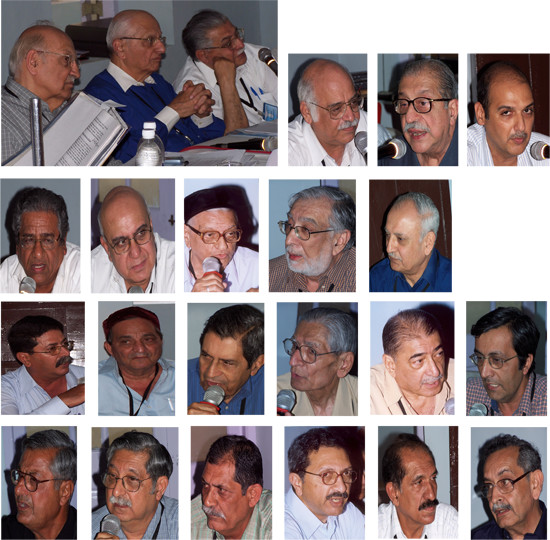
Above, from left: Adi Sethna, Minoo Shroff and Keki Gandhi Below, from left : Rustom Cursetji, Areez Khambatta and Jehangir Bisney ; From left: Dinshaw Mehta, Dinshaw Tamboly, Soli Katpitia, Jal Patel and Bahadur Postwalla; Third row (from left): Pervez Irani, Mehrwan Irani, Bomi Heerjee, Behram Masani, Behram Dastur and Tehmasp Bharucha Fourth row (from left) Jamshed Mohta, Aspi Debara, Omim Debara, Farrokh Rustamji, Pervez Bhesania and Rustom Gandhi
While Mohta asked for the BPP’s reaction Khambatta drowned Shroff’s response: "We are not following the present rules. The membership is open only to Parsi Zoroastrian Anjumans of India. This is not followed. For example Jamshedpur is blatantly going against the constitution…” Khambatta wanted Jamshedpur expelled from the Federation for having non-Parsi spouses as members.
Gandhi laid out the process involved: a resolution from the general body of the Ahmedabad Parsi Panchayat asking for the expulsion of Jamshedpur stipulating the grounds which would be tested for legal validity; the decision of the grass roots members of other anjumans on the issue; a show cause notice to Jamshedpur; Jamshedpur’s reply and its consideration by the executive council before it decides by the necessary majority to expel the anjuman. Asked Gandhi, "If a few non-Zoroastrian spouses are members of an anjuman does it cease to be a member (of the Federation)?...The DPA has non-Zoroastrian spouses since the last 28 years. The heavens have not fallen!”
"One person cannot take action,” supported Shroff, adding in lighter vein, "If someone says Ahmedabad should be expelled because of Areez Khambatta’s bad language, should it be expelled?”
Heerjee referred to point 1(e) where Parsi Zoroastrian is defined as "descended from the original Persian emigrants.” "Can anyone here prove their ‘original Persian antecedents?’” Describing it as a colonial hangover, he advised it be eliminated. He also pointed out that legal stalwarts like Soli Sorabjee, Fali Nariman and others had opined that a Parsi woman who marries out does not renounce her faith. She must be accepted as a Parsi Zoroastrian under the definition of Federation members, he noted, adding, "Splinter groups form because our definition does not include the whole gamut of Parsi Zoroastrians. Once we do that, what Jamshedpur or Delhi is doing will be immaterial.”
Referring to the BPP’s magnanimity in accepting a single vote as per the original constitution, Shroff spoke of the inconsistency in the thinking of people who claimed India would be marginalized without a larger weightage in the World Body yet felt no compulsion to allot the BPP voting rights commensurate to its population and resources. "Let’s not fool ourselves. There is need for change. Do the anjumans whom people represent, know they are being so represented?”
Ascribing the need for change in the current climate of exclusivity — "We don’t want him; we don’t want her. We don’t want Delhi; we don’t want Jamshedpur” — Sethna asked, "Are we debating issues or making points?”
Rustomji suggested that anjumans take up the suggested amendments and respond in a month’s time. "If there is no response, it is agreed that the (suggestions) are accepted. "No constitution is constant,” maintained Dastur while Cursetji hailed the PZASH handiwork as a "landmark” and reminded all concerned that Zarathushtra was a reformer. Urging debate and eventual consensus, Cursetji described the work as touching on "sensitive issues. If it has to be put to the vote, it must be put to the vote at this body. If the general body is allowed to get embroiled, we will not be discussing issues but tangential issues.”
Urging "free and frank discussion,” Gandhi asked the gathered delegates to "give your inputs subject to what your anjumans will say.”
"The power is vested in only a few anjumans. With only a few extra votes the BPP can expel an anjuman (whereas) it needs three-fourths of the vote to be reinstated,” Mohta expressed his fears, comparing the amendments to Indira Gandhi’s proclamation of emergency (in 1975). "The BPP has 20,000 on its voter list, no adult franchise. The Surat Parsi Panchayat has no election and no membership. The Poona Parsi Panchayat has 800 members though its population is 10,000 (the census figures for 2001 place the figure at 4,196 – editors). The rift is created by controversial issues. Don’t bring unnecessary issues. Do good work instead. The BPP’s position is in the 18th century. I am extremely disturbed. Is this democracy?”
"I am giving you your own example on the World Body,” countered Shroff. "What is the BPP getting by expelling any member? Have we ever thrown our weight around?...A lot of people have told us, ‘why are you taking all this nonsense?’”
"There is no fear that the BPP or the Iranian Zoroastrian Anjuman (IZA) is going to dominate. The small anjumans can even wind up the Federation. These are just indicative figures,” Bisney sought to quell Mohta’s fears. "It is not that any president/vice president can highjack a meet. The president, two vice presidents, five coopted members and the IZA would be required to combine for a simple majority,” he noted.
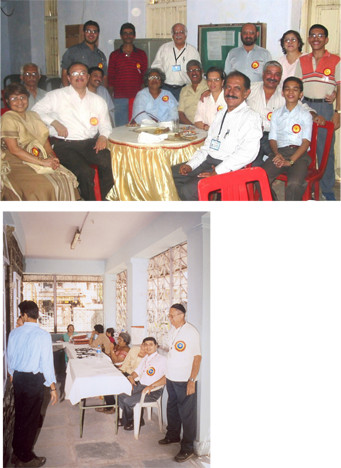
Above: Thana anjuman organizers and volunteers at the two day meet Photo: Zarsis Udhnawala Below: Volunteers at the registration table
Postwalla maintained that the amendments put too much emphasis on the fees and timeliness of payment. He wanted a year’s time to pay the fees instead of two months. Gandhi pointed out that the Societies Registration Act supercedes the Federation’s rules. It is a member’s duty to pay the subscription, he maintained. Thus even if the Federation constitution permitted a member who had not paid his fees the right to vote, that vote would still be invalid. Postwalla also sought a "formal zonal setup” because smaller working groups produce better results. He was also in favor of "a proper secretariat” because, "after Keki what?”
Noting that the Baroda Punchayet had not deliberated on the proposal, Patel accepted the need for change adding that the proposed fees and auditing of members may prove difficult for small anjumans. For example, the Baroda membership is based on families. He supported Postwala’s suggestion for a smaller working body to go into the issues in depth and sought two months’ time to provide feedback from Baroda.
Heerjee proposed two safeguards: that admission or expulsion of members would be by majority vote of all members and that the constitution incorporate a "notwithstanding clause” so that those opposed to a particular measure adopted by the majority can remain unaffected by it. He also noted that matters of subscription are never enumerated in the constitution but left to the executive council to decide as any change would need an amendment of the rules. He also drew the attention of members to the Federation’s bigger role — the custodianship of dwindling anjumans — and the need to incorporate clauses regarding holding and selling lands in view of its work on defunct anjumans. The right to receive and give donations, to enter into lease agreements, etc needed incorporation, he noted.
Cursetji was in favor of preserving the one anjuman, one vote pattern with additional weightage for the main population centers. It was pointed out that Allahabad and Calcutta have no membership and no subscription system. Pervez Irani, vice president of the IZA reminded the gathering that youth cooption, a reality in the Federation, had not been incorporated. Gandhi clarified an amendment already exists giving representation to the Federation of Zoroastrian Youth Associations and would be printed in the next edition of the constitution.
Khambatta "failed to understand” why the PZASH idea was getting VIP treatment. ‘Little anjumans are being shunted out…Why a separate vice president for the east zone? Why can’t east and south be merged? Why does the north zone have eight seats when our anjuman is earning five to seven lakhs a month?”
"The Federation rules were functioning well for several decades. It’s only in the last two years that there has been a drastic change in the way in which meetings are conducted,” remarked Mehta, describing the development as "tyranny of the minority.” He was at pains to urge "not to create a schism in the community. Let’s work for the upliftment of the community than fighting against each other.”
While Gandhi requested "my col-league’s good offices to see that things go back to the way the Federation was functioning earlier,” Shroff emphasized that there was "no intention to dominate, but there is need to change.” Bisney urged each anjuman to send its recommendations to Gandhi so that they can be incorporated.
The report of the Federation deliberations will continue in the next issue.
◆ ◆ ◆
From the archive