
Zoroastrians Abroad
Rashna Writer in Houston
Nearly 110 persons sacrificed their Labor Day weekend to listen to Dr Rashna Writer’s scholarly account of the three Zoroastrian empires of ancient Iran. The three-day mini-series — "When Iran was Zoroastrian: From the Medes to the Muslims” — was the first of the lecture series that the Zoroastrian Association of Houston’s (ZAH) library committee has planned to establish. Noting that the audience comprised not only ZAH members but also representatives of the host community and members of the Press, committee chair Aban Rustomji wrote in an e-mail to Parsiana, "In this day of multimedia, a narrative on three continuous days is a hard sell. Rashna Writer enthralled us. And lastly, it was not about the glorified past alone. It was facts that were presented with a political analyst viewpoint, one that challenged conventional views, and an analysis of empirical data of sociopolitical and cultural networking of ruling dynasties and the community of the time. Parallels were drawn from those days to our present times.”
"We gained incredible insight into the political events, the cultural and social characteristics and, above all, the human behavior that form our roots and made Zoroastrians such an integral part of a glorious era almost 2,000 years ago. Centuries ago, Aristotle had said: ‘If you would understand anything, observe its beginning and its development.’ Thanks to Writer who traced the beginning and development of Zoroastrianism, we are better able to understand our present, and face the future,” noted ZAH member Jangoo Mistry. He added, "For three days Writer transported us back through the ages, as she traced the establishment and expansion of three dynasties (Achemenid, Parthian and Sassanian) that spanned the 1,000 years of a mighty Persian Empire. Almost in story form, she fascinated us with the political intrigue that led to the rise and fall of kings, the wars that Persian rulers fought with the Greeks and Romans as the empire consolidated its power over a vast region, only to lose its grip eventually and crumble.” In the process, Mistry wrote, Writer interwove events in Afghanistan, China and modern-day Iraq (called Mesopotamia in those days) — regions which are now so much in the news.
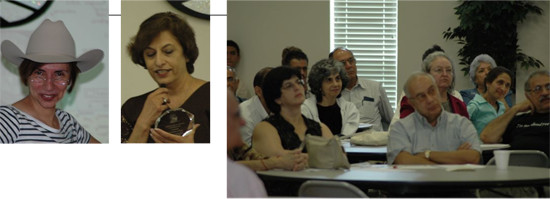
At Houston (L to R): Rashna Writer, Aban Rustomji and the engrossed audience
Author of three prestigious publications — Contemporary Zoroastrians: an Unstructured Nation, The Memoirs of Keikhosrow Shahrokh and From Zarathustra to Muhammad: The Re-Shaping of Iran, the last being currently under print — Writer heads Global Risk and is also a senior assistant director of Merchant International Group in London, England. With a BA in Political Science from Calcutta University, an MA in International Relations from Jadavpur University in Calcutta and a PhD in International Relations from the London School of Economics, Writer is a frequent contributor on CNBC and Bloomberg Television, Reuters Television and the BBC World Service, records Houstonian Magdelena Rustomji. Writer has also served as a research assistant at Manchester University, and has been a lecturer in pre-Islamic Iran at Birkbeck College, London University, and at Richmond College, London.
Writer devoted two sessions a day to each of the three major dynasties, examining their society, administration, culture. "Each dynasty made great and lasting contributions which even now serve as models for social structures such as the principle of women’s rights and the concept that laws are needed to have a functioning society. Each dynasty also advocated Zoroastrian values such as ‘be a friend to right; not a friend to wrong,’ to use Vohu Manah at every step and turn of your life, to practice personal responsibility, and to value truth above all,” writes Magdelena Rustomji.
"Writer is an eloquent presenter with the charm and wit to make what is typically considered boring history lectures, fascinating. She made the topic interesting and held the audience captive throughout the three days. She was asked numerous questions and was swamped during the breaks and unable to get even a few minutes of relaxation in between sessions,” notes Sarosh Manekshaw who had been co-vice chair of the Seventh World Zoroastrian Congress held in Houston. He added, "It is difficult to condense over 1,000 years of history into a three-day lecture series, but Rashna managed to do it by sticking to the high points and avoiding the minutia minutiae. She did, however, present a sufficient number of interesting anecdotes to bring out the character of some of the more important emperors in Persian history.” A common feature overshadowing the end of each empire which emerged from her analysis was that internecine wars and bickering weakened the state.
The Zoroastrian Association of Houston presented Writer with a commemorative trophy, and since she was in Houston, with a Stetson which, it is reported, she proudly wore on her way back to London.
The seminar itself was free and open to all, but there was a charge of $10/day ($25 for all three days) for lunch. Complimenting Rustomji and the entire ZAH library committee on their hard work and dedication to making this seminar a success, Manekshaw notes, "It paid off handsomely!”
Other highlights of the event were a beautiful children’s art exhibit from Vahishta Kaikobad’s Sunday School Class and an announcement of donations to the ZAH Library for this lecture series’ recommended bibliography. Addition of books and artifacts continues to be one of the priorities and objectives of the library committee, notes the report.
◆ ◆ ◆
From the archive