
Religion
"Tradition is not religion"
The 50th death anniversary of Dastur (Dr) Maneckji Nusservanji Dhalla was commemorated by the K. R. Cama Oriental Institute
"Because of his depth of religious knowledge Dastur (Dr) Maneckji Dhalla was often called upon to mediate between feuding groups. In 1936 he visited Udvada with his wife Cooverbai and stayed for several months. He restored peace between the feuding groups in Udvada. The present constitution of Udvada was created under him. It is still in use.”
Dastur (Dr) Peshotan Mirza, high priest of Udvada, thus attested to the great love and respect that Dhalla, the high priest of Karachi, Sind and Baluchistan, commanded among members of the community at the savant’s 50th death anniversary commemoration organized by the K. R. Cama Oriental Institute (KRCOI) in the Dr Sir J. J. Modi Memorial Hall on May 25, 2006. Others who recalled the life and work of this great Zoroastrian priest included Dr Armaity Desai and Dr Hutoxi Bhola, both of whom revived youthful memories of growing up in Karachi in the 1940s and 50s. Sharing the dais were Dhalla’s grandson Dr Viraf Dhalla and Parsiana editor Jehangir Patel. More than 20 years ago Parsiana had serialized Dhalla’s autobiography The Saga of a Soul. KRCOI president Muncherji Cama presided over the function. The speeches were prefaced by a commemorative jashan.
A display of photographs and some personal paraphernalia recalled the niceties of life common to the community in the early 20th century. The exhibition and speeches recalled the remarkable odyssey of a child who rose from poverty by the dint of love and devotion to become one of the most charismatic priests of recent times. And his overwhelming love for all fellow creatures suffused his personality, as attested Desai, the daughter of Gool and Behram Rustomji of Karachi who had translated and published Dhalla’s Gujarati autobiography – Ek Atmakatha – into English. Recalling the Karachi of Dhalla’s time, Desai spoke of the two aspects of his personality: duty and devotion. "As children we were greatly inspired by Dasturji. We had to go to every navjote and lagan and when Dhalla entered the gathering, everyone spontaneously stood up,” Desai remembered the ethos of the community in Karachi at that time. "He believed that a priest must guide the congregation. He would say that he’d pray so that we would be provided with all that we wanted. He would say, ‘Religion is not religion if it does not have devotion and love.’ He lived up to the ideal of devotion. He did not take sides in controversies; he tried to resolve them by understanding… There was a sense of duty in each of his actions. He felt Parsi youth had to be educated in religious matters. When he lectured in Parsi schools, he had the knack of communicating so that the heart of the religion went through. They were simple, sweet, elegant lectures. He educated us in things which touched the heart, inspired us. Simple, beautiful words were put together in song which we sang together. His seven-minute talks brought a sense of oneness, hamazori…”
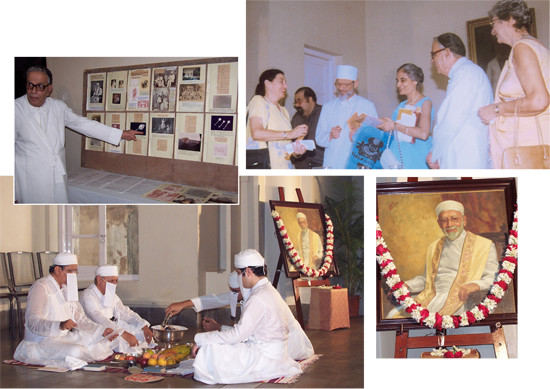
Clockwise from L: Viraf Dhalla with the exhibits; Homai Modi, Muncherji Cama (in the background), Peshotan Mirza, Armaity Desai, Dhalla and Hutoxi Bhola; Dastur Dhalla; the jashan
Bhola, who had also grown up in Karachi, described Dhalla as "the most humane, noble and unpretentious Dasturji” she had ever known and was happy to have imbibed "a minuscule part of his teaching in (her) adolescent and early adult life.” She recalled the 10-minute humbandagi at 7 a.m. during the 10-day muktad when four passages from the Gathas would be sung and a summary of their contents explained in simple, lucid terms. "His books are classic masterpieces, still relevant today. His thoughts were ahead of his time but his opinions were delivered in the mildest manner and in a very compassionate way. He said he had learnt the lesson of tolerance from the philosopher George Santayana.” Bhola further described the man as a sincere servant of God, an epitome of simple living and high thinking, a devoted and caring husband. Towards the end of his life Dhalla was presented with a car. It was also a time when he was suffering from a severe hearing impairment, so he either did lip reading or required one to shout into his ears, recalled Bhola.
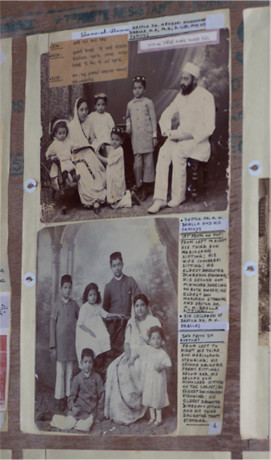
Dhalla family pictures
Dr Viraf Dhalla spoke of the man who "loved everyone, never hated anybody, never hurt anyone.” As a youngster he had seen his grandfather pray early every morning, celebrate his birthday by giving cash gifts to all the mobeds at the fire temple, confer with nassessalars and solve their problems in friendly camaraderie. Viraf also noted that Dhalla had performed the opening ceremony of the KRCOI in Bombay and that he had given evidence at the Bombay High Court as an expert witness in matters concerning the Zoroastrian religion.
When, at the age of 30, Dhalla received a community scholarship to study for his masters and doctoral degrees at New York’s Columbia University in 1905, the scientific method of western scholarship opened his mind so that, as he put it in his autobiography, his life became one of "quest and questioning,” noted Patel, quoting his words, "In 1905 I had set foot on American soil as an orthodox. Now in 1909 I was leaving the shores of the New World as a reformist.” Dhalla came to accept the transience of tradition ("the continuity of tradition has no relationship to virtue or vice. Tradition is not religion”), the primitiveness of belief that a menstruating woman was tainted by evil ("when a woman reaches puberty there is this natural flow of blood. Primitive man, in his ignorance looked upon this as a very serious and dangerous event”), that a custom like the exposure of dead bodies to the sun was "impracticable and impossible in large cities like New York or London with a population of nearly seven to eight million,” said Patel, citing instances from the autobiography.
In later life however, buffeted by community storms, Dhalla’s reformist zeal gave way to an overriding desire for peace of mind in which to continue his studies, observed Patel adding, "What is remarkable about Dhalla’s reformist zeal is that he fought 100 years ago for ideals that still elude us today. He demonstrated great fortitude and foresight, but was it in vain? Was he the right man at the wrong time? Perhaps. But had he not set the wheels in motion, the task of liberalization today would have been even more uphill.”
◆ ◆ ◆
From the archive