
In Memoriam
The diehard dastur
Died: Dastur Nadirshah Pestonji Unvalla, 91, High Priest of the Zoroastrian community, on November 25, 2008 in Bangalore following respiratory complications.
"We have lost an icon… our community has lost a doyen,” summed up a tribute from The Bangalore Parsee Zoroastrian Anjuman (BPZA) signed by trustees Dinshaw Cawasji, Soli Pochkhanawalla, Shereyar Vakil, Cowasjee Dinshaw, Merzi Marker and Naozar Garda. "With his passing away a great era has come to an end. He was an institution in his own right. He was a colossus that strode an arena of religion and its preserve for more years than one can remember. He has served our faith, our agiary and our community with undying affection, loyalty, passion and compassion… We will forever miss his guidance and direction. He has left behind a void that is irreplaceable,” they added.
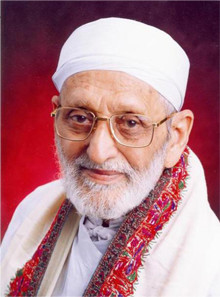
Dastur Nadirshah Unvalla: served with undying devotion and passion
Referring to the dastur’s checkered life, former Anjuman president Phiroze Bharda wrote, "Often controversial, sometimes difficult but at all times on the straight and narrow, this man taught us the virtues of truth, the strength of commitment but above all a deep and undying devotion to our holy scriptures and the beautiful religion of Asho Zarathushtra…How many will delve on his strength of character which he so amply demonstrated when engulfed in flames on that fateful day? …Who will understand his agony and pain as he sought solace through his prayers which brought him through after a long, trying period of recovery?” In November 2004 when performing the masiso (monthly) prayers for an old resident of Bangalore, his jama (priestly robe) accidentally caught fire when it came in contact with the lamp beside him. Within seconds he was engulfed in flames and the arduous road to recovery required a hospital stay of five-and-a-half months.
After his fire ordeal when his Melbourne based grandson Neville Unvalla had asked him, "Do you still believe in God?” he had replied, "Yes. I have survived, haven’t I? God is still giving me the strength to pull through this as I still have some unfinished business here.” Neville gave credit to his grandfather’s "strong mind, will power and perseverance (that) has taught each one of us in our family to never give up, and always be a fighter!” in his tribute read at the condolence meeting convened on December 4, 2008. "Today, I am where I am largely because of my Papa, who believed in me, even when I didn’t believe in (myself). When I was applying for my scholarships, he would always tell me not to worry and say ‘baddhoo thasé,’ meaning everything will happen in time,” added Neville.
"When I was young he always had a joke whenever he saw my cousins or me… Whether he was in the hospital fighting for his life or at home or the agiary he still had his humor and wits about him. That (the humor) and his spirituality is what saw him to a ripe old age,” believed his Toronto based granddaughter Franak Unvalla.
On behalf of the Bangalore Zoroastrian Association president Bahadur Saher wrote, "He will always be remembered by the members as he did not miss any program of the Association and was ever available to guide and encourage us.”
Whilst Dastur (Dr) Kaikhusroo JamaspAsa grieved on the passing away of his "revered colleague,” Dastur (Dr) Peshotan Mirza acknowledged, "The late Dasturji Nadirshah and Manijeh were like parent figures to my family and me… At the time of demise of my dear brother Jamshed and my late father Dastur (Dr) Hormazdyar Mirza, Nadir Uncle (as we lovingly call him) was the first to call, console and advise me as to how to cope with the situation. Also, during our several visits to Bangalore, Dasturji was always keen to advise me… on various religious and socioreligious issues. I used to seek his advice even from Bombay by telephonic calls at any time of the day or night which were of immense help to me. Besides being a father figure, Dasturji was my respected Guru, friend, philosopher and guide.”
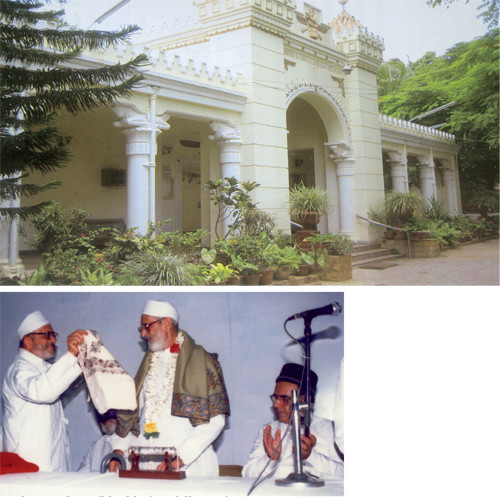
(Top) Bai Dhunmai and Cawasji Dadabhai Daremeher; (above) Nadirshah Unvalla being presented a shawl by Ervad Framroj Sidhwa on being elevated to dasturship
"In these troubled times he was truly a beacon of light to our Parsi Irani Zoroastrian brethren,” commented Dinshaw Mehta, chairman of the Bombay Parsi Punchayet (BPP). "There are few men in this world who would measure up to the high moral and ethical standards that Dasturji set for himself and his community. He was a man unafraid of controversies and was always glad to step in to do what was right for the community and the religion. We hope and pray that his life will serve as an inspiration and a beacon of light to our priests and the younger generation of our community,” noted a supporting resolution from the BPP board of trustees.
Commented co-trustee Noshir Dadrawala in his personal capacity, "I have had my occasional differences with Dasturji but my love, respect and affection for him has remained constant. In fact, within an hour of my winning the BPP elections and despite not having his support, I rang him up to seek his blessings which he readily gave me. I consider myself blessed… We held each other in too much esteem and affection to let rancor ever seep into our relationship. I will miss him and his periodic ‘scolding.’”
There were occasions when Parsiana’s liberal stance too would earn a verbal or written reprimand from the High Priest who did not believe in mincing words.
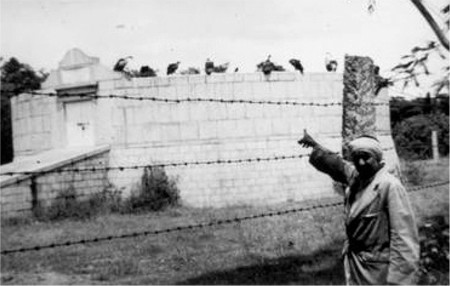
Bangalore dakhma with caretaker Nao-roji D. Todywalla (circa 1960)
Other anjumans too condoled Unvalla’s passing away: On behalf of the Saronda Parsi Jarthosti Anjuman vice president Dinshaw Patel stated, "He had helped us in the past on many occasions in various ways and (had) also given us instructions and guidance from time to time.” The Madras Parsi Association organized an uthamna in honor of the "truly noble soul who was always willing to extend a helping hand to one and all,” as conveyed D. S. Dalal, president of the Madas Parsi Zarthosti Anjuman.
Recognizing Unvalla’s "unwavering support to the World Alliance of Parsi Irani Zarthoshtis (WAPIZ) from the very first day of our formation, to the day he left his worldly abode gives us immense strength to continue with greater vigor the task we have undertaken to strengthen the voice of tradition and to protect and preserve the religious traditions and institutions of our community… A true ratheshtar… he richly deserved the title of ‘dastur’ which his beloved anjuman… had bestowed upon him.”
WAPIZ founder member and currently member of the National Commission for Minorities (NCM), Dr Mehroo Bengalee commented, "I remember my first visit to the (Bangalore) agiary, when I was the vice chancellor of Mumbai University. As I requested him for a maachi, he recognized me instantly and showed me a newspaper cutting (with my photograph) which he had preserved. He was so happy to note that in just a day’s short visit, I still came to the agiary. From then on, he corresponded with me regularly. His telephonic conversations were long and thought provoking and ended with Tandorosti prayer. His joy was unbounded when I became the member of the NCM and insisted that I should visit Bangalore on the release of his book.”
In his book The Bangalore Parsis — their escapades and memorable moments, published in 2007, Unvalla records his "personal and impartial version of events, as best recollected by me, without any favor or prejudice.” He starts with a brief reference to the Zoroastrians of Persia, the early settlement in Gujarat and the state of Mysore. The "rich repository of the community’s history” then narrates how different Zoroastrian institutions in Bangalore came into existence, lauds the vision of Anjuman presidents and the board of trustees, gives credit to the donors for their magnanimity and details the controversies that delayed the progress of some projects.
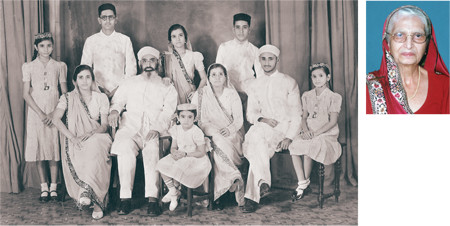
Ervad Pestonji J. Unvalla with family; Nadirshah seated second from right (right) Manijeh Unvalla
Also included is his own biographical account wherein we learn that born in Nargol, Nadirshah was the eldest son of Pestonji and Meherbanoo’s eight children. Soon after his navjote in Udvada, his parents enrolled him at the Dadar Athornan Madressa. He became a navar in 1931 and completed the maratab and samel the next year (passing through this major test which involved considerable cross-examination by senior mobeds). Subsequently, Nadirshah was sent for further studies in Avesta, Pahlavi and Persian to the Cama Athornan Institute at Andheri where Dr Irach J. S. Taraporewalla was serving as principal. But life took a different turn when Nadirshah’s father, finding it difficult to maintain a large family and to save on the salary of an assistant mobed, withdrew his son from the Institute to assist him in running the panthak.
During his 74 years of service to the Bangalore Anjuman — starting as assistant mobed and later being appointed mobed and panthaki before he was conferred the dasturship by the Anjuman in 1996 — he was involved in the celebration of the silver, golden, diamond and platinum jubilees of the Bai Dhunmai and Cawasji Dadabhai Daremeher. Unvalla was instrumental too in the construction of The Lady Jehangir Kothari Memorial Hall Annexe. He had also played a pivotal role in the establishment of the Tower of Silence in Bangalore in 1940, the last dakhma to be consecrated in India, which was mired in legal controversy until it was finally resolved that it was up to the Anjuman members to choose whether to opt for dakhmenashini, or aramgah which was till then the prevailing mode. He personally believed "that dakhmenashini, where available, was the only religiously sanctioned manner of performing the final rites of a Zarathushti’s body,” as noted The Parsee Voice of New Zealand (December 2008). Describing him as a very "choost (staunch) dasturji” the newsletter added, "he never endorsed intermarriage amongst Parsis, whether it be Parsi male or Parsi female. Dasturji was also of the firm opinion that there is no ‘conversion’ to and from the Zoroastrian religion since one’s birth religion is predestined and chosen by divine agents before birth.” Perceiving the Federation of Parsi Zoroastrian Anjumans of India to be a liberal body he sought to distance the Bangalore Anjuman from its working.
Liturgical ceremonies took up a large part of his day but equally committed was he to the community. Besides visiting those ill in hospital, he would attend to the older, infirm members of the community offering his support. Many have acknowledged his invaluable assistance by bequeathing large sums to the Anjuman. Later he started giving lectures on important occasions and at community gatherings to impart religious knowledge to the Parsis of Bangalore. Often he organized sessions to inform and educate Parsi children.
One of the highlights of his life was a trip to Iran in 1970 during the reign of Shahpur Rezashah Pahlavi to celebrate the 2,500th anniversary of the sovereignty of Cyrus the Great. He was happy to offer a maachi at the Atash Behram at Yazd and at all the other agiaries that were operational in Iran. When the group visited Pasargade, he was requested to perform the jashan ceremony near the monument of Cyrus.
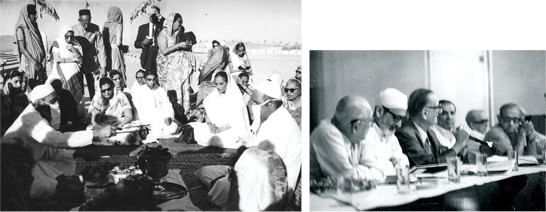
(Left) Unvalla performing a jashan at Pasargade, Iran. (Right) At a Federation meeting in Madras sitting next to then Bangalore Parsee Zoroastrian Anjuman president Behramshaw Sidhwa (center)
Unvalla also believed in maintaining good relations with governors, chief ministers, the police and other branches of government administration in Bangalore. All this proved invaluable to the community whether it was for securing admission for Parsi boys and girls to reputed educational institutions or in times of accidental deaths. Once during the days of the Emergency he succeeded in stopping an Indian Airlines plane by jumping the cordon and kneeling in front of the aircraft readying for takeoff to enable the coffin of a Parsi on vacation to be loaded in time for transport to Bombay where the body could eventually be consigned to the dakhma at 5.30 p.m.
As the religious head of the Anjuman he had blessed several chief ministers of Karnataka — Devaraj Urs, Ramakrishna Hegde, Veerendra Patil, Veerappa Moily, H. D. Deve Gowda, S. M. Krishna. "In his death the community has lost a friend, philosopher and guide,” noted a condolence letter from the present governor of Karnataka Rameshwar Thakur, adding, "He rendered admirable service to the community and became a well-known personality everywhere.”
He was always invited by the governors of Karnataka to participate in major functions held at the Raj Bhavan. "Every year on January 26, i.e. Republic Day, he used to go to the Raj Bhavan to offer his blessings to the governor. When I was old enough, I used to go with him there,” recalls his eldest granddaughter Kainaz Irani referring to one embarrassing incident at the Raj Bhavan when Nadirshah who took pride in his grandchildren’s accomplishments insisted on telling the governor that she was blessed with a sweet voice because of which she had to sing a bhajan for him! She delighted in listening to grandpa’s stories about how his children would try and fool him but he could outsmart them being a super detective: "I am not 007, I’m 009,” he would say.
"One would logically think that, as the grandson of a high priest, my devotion to the religion would be unconditional,” confessed his grandson Shahrukh Unvalla, based in Canada, adding, "Even though I was overwhelmed by his power of faith, my natural instinct was to reject what…one does not understand… In my mid teens I seemed to regain my faith, not because I was forced to by my parents or my grandfather, but because I had matured enough to understand that the power of Ahura Mazda is everywhere and in everything... With the advent of modern physics and modern innovations, one is driven away from spiritual ideologies. At this point I was stuck between the materialistic world in which I live and the spiritual world that I have grown to believe in… I began a correspondence with my grandfather whilst I was in Canada. I asked him questions of fundamental significance. They were questions that could break the very foundations of our belief in God. No matter how serious or how naive my questions were, he always had an answer…sound and logical.”
An avid reader with a large collection of books "he kept abreast of world political and financial events through newspapers and the TV,” mentions his son Ervad Yezdi. Although an unrelenting orthodox he would take an interest in interreligious activities and scholarly discussions. In fact the Ashirvad Inter-Religious Harmony Movement held a condolence meeting for him.
Besides his preoccupation with religion "our father took great interest in the world of sports and was especially fond of cricket and tennis. His love for cricket was legendary among cricket lovers of Bangalore. Even at his advanced age, he would go to the stadium to watch a match, walking in with the help of a walker,” relates Yezdi.
As Unvalla had stated in his book, "My objective has always been clear and well defined — to further the aims and objectives of our great religion. My commitment to our Anjuman has been complete and I have served my community and my Anjuman to the best of my ability. In this I have never flinched nor have I made any compromises.”
The dedicated dastur is survived by his sons Adil, Yezdi and Khurshed, daughter Aban, brother Jamshed, and sisters Nergis Unwala and Banoo Sidhwa.
◆ ◆ ◆
From the archive