
Religion
Apostle of acceptance-II
Dastur (Dr) Framroze Bode often challenged old convictions and beliefs while spreading knowledge of Zoroastrianism in India and abroad
The first instalment of this two-part feature on Dastur (Dr) Framroze Bode carried in the September 7, 2007 issue of Parsiana had referred to his early days and studies as also his performance of the 77 navjotes in Vansda which created history.
Even though I barely knew Dastur (Dr) Framroze Bode, running into him occasionally when I frequented the K. R. Cama Oriental Institute (KRCOI) in the 1950s and being distantly related to him, he went out of his way to help me obtain college funds from various trusts and wrote letters of recommendation for me as was the vogue in India then; even the illustrious Minoo Masani obliged by interviewing me in his office, though somewhat chagrined by Bode’s request.
Bode was a good, forceful and very engaging orator, but unfortunately he was born a generation or so too early for his community to appreciate him. His detractors often angrily greeted him by throwing eggs and tomatoes at him. An orthodox Parsi scholar wrote not too long ago in the Parsi Press that even Professor Mary Boyce had told him (perhaps in strict confidence, if at all) that she had avoided meeting Dastur Bode when he visited London despite his many requests. However, when I personally asked her if it was true, when she was in Chicago, she did not confirm it but was surprised and sad that something like that was even published in the Parsi Press.
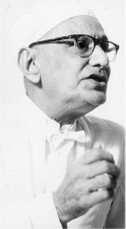
Dastur F. Bode: popular among the upper class
However, Bode’s wife Homai told me that all those who opposed him virulently came to appreciate him when their own children married out, a trend which is so much on the rise today. Sir Rustom Masani, his ardent supporter and a navar himself, tried to mediate between the then 14 high priests and induce them to come to some common agreement on controversial issues. Bode and Dastur K. S. Dabu agreed but most others headed by the late Dastur Mirza opposed it for months in the Parsi Press, especially in the long defunct orthodox weekly, Parsi Awaaz. Masani was himself suspect in the eyes of the orthodox as his children had married out. Nevertheless, well-attired, well-educated and well-spoken, Bode was quite popular among the upper class. Zubin Mehta told me in 1982 that Bode would attend the orchestra conducted by him in Los Angeles where "I used to introduce him to my orchestra as my Pope.”
The Parsis did not fail to criticize Bode for marrying someone who had divorced her well-placed husband for him. But I have it on authority, that the two were not compatible in many ways all through their marriage. Homai was from the Bhownagry family. She was every bit as gutsy and spirited as Bode and supported him in all his moves though she told me she did not view religion and religious views as he did. She was her own person and yet was totally committed to standing by her husband and fully believed in his mission.
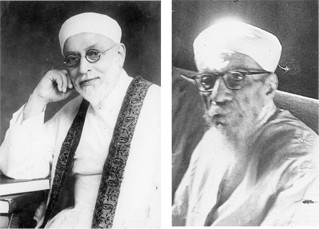
Dasturs M. N. Dhalla (alongside) and K. S. Dabu (right): Liberal ideologies
Like many Parsis of his time, his thinking was colored by theosophy, Vedanta and mysticism, perhaps intensified during his one-year stay at Rabindranath Tagore’s Shantiniketan, working with Mahatma Gandhi at times and certainly during his stay in Los Angeles where he also taught Vedanta, eastern philosophy, etc. I am not sure whether Bode was a formal member of the Theosophical Society, and I will welcome any authentic information about it. He might have worked for the colleges affiliated to the Mazdasnan Movement as well when in Los Angeles, a movement which leaned heavily on eastern philosophy and yoga.
When Mother Gloria of the Mazdasnan Movement in the US and Germany visited Bode in Bombay sometime in the 1940s this attracted much attention as well as criticism from the orthodox Parsis who resented her praying the Ashem Vohu with a piano accompaniment. A friend and supporter of Bode, Ervad Jamshed C. Katrak, one of my school teachers and an Avestan scholar, has written a book on Mother Gloria. He had performed the Vansda navjotes along with Bode, knowing fully that he too would suffer greatly for it. The founder of the Mazdasnan Movement was often alleged to be a fraud which was sufficient justification for those who tried to disparage Bode and to depict him as one too. He seemed rather fascinated by the Movement’s appeal to modern man and times.
For these reasons he, along with Dabu, came under severe criticism at a conference in Israel by Khojeste Mistree who, following Boyce, saw them as straying away from the Zoroastrian tradition. Dastur (Dr) Firoze Kotwal who was present at the conference could not defend his predecessor, Dabu. There may be some validity to Mistree’s thesis. However, Dabu, though a post-graduate in Avesta-Pahlavi, did not have access to Western scholars as Mistree had, and was respected more for his utter selflessness as well as piety rather than for his academic scholarliness, which was however by no means lacking.
Bode often attended oriental congresses in India and elsewhere. He spoke enthusiastically on comparative religion, eastern philosophy, Sufism, Mithraism, etc wherever he went. He traveled widely and I vividly remember as a teenager reading his travel accounts of Norway’s fjords, etc in the Jam-e-Jamshed.
His wife corresponded with me regularly since 1984 and offered me whatever books I wished to have from his library. He had two cupboards full of books. He would sit very quietly in a chair for hours while I browsed through the books. He was then so different from the dynamic man, almost manic in his disposition, that the world had known earlier.
Rampant criticism of his views and actions over a lifetime had not dampened his spirit even as Alzheimer’s was setting in and he proudly spoke about performing the navjote of a Jewish American in Japan and advised Zoroastrians to be open-minded if they wanted to survive in North America.
He was very peaceful, passive, quiet and so easily manageable as a patient, unlike most diagnosed as Alzheimer’s patients I have worked with. Alzheimer’s disease ran wild in his family and affected his brother, a pious and life-long yozdathregar priest at the Anjuman Atash Behram whom I used to know, and some of his cousins as well. And yet many of his critics would not leave him alone even in death and attributed his having the disease as God’s punishment for espousing liberal causes.
Homai later told me that some conservatives were very critical, even threatening, when she tried to fulfill his wish to be cremated, as he did not feel the dakhma system was working as it should in the overcrowded city of Bombay due to various reasons.
As my revered guru Dabu, a staunch theosophist and a rather conservative high priest, aptly notes in his forward to Bode’s book, Man, Soul, Immortality in Zoroastrianism, (a compilation of four lectures at the KRCOI in Bombay in 1958): "The author is well known as an enthusiastic spiritual guide of the Parsis, ever seeking new light and new fields of research; and courageously maintaining an independent attitude in propounding the tenets and principles of the message of Zarathushtra, according to his own convictions based on deep studies. Dasturji Bode has for many decades undertaken (voluntarily and without extraneous consideration of reward or praise) the sacred mission of spreading knowledge of Zoroastrianism in India, Europe, and America. He often challenges old conventions and beliefs, where he thinks it necessary to do so. We admire him for this stand even when we do not agree with him on details.”
Dastur M. N. Dhalla, had even kinder feelings and regard for, as well as greater affinity with Bode as he was the only other contemporary liberal high priest at that time. Bode often invited Dhalla to Bombay to give lectures which were arranged at C. J. Hall, then the biggest lecture hall in the city. The hall would be packed to capacity. I considered myself fortunate for having attended Dhalla’s lectures and could feel his angelic presence in the audience. Later I read all his books. Even as a teenager I often based my compulsory sermons at the M. F. Cama Athornan Institute entirely on excerpts from his autobiography, earning the nickname of ‘Dhalla’ jokingly from my dear classmate, Firoze Kotwal, later Dastur Kotwal.
How I wish these great priests were alive today to guide our young generation which is facing such changes in this modern world as humanity has never witnessed before and is seeking inspiration to survive as Zoroastrians despite it all. Concluded
Ervad (Dr) Kersey H. Antia is a practicing psychologist based in Chicago. He is a priest and had performed the navjote of American Joseph Peterson in the 1980s.
◆ ◆ ◆
From the archive