
Zoroastrians Abroad
Walking the tightrope
The community’s international spread is weakening the glue that holds it together
Everywhere in the Zoroastrian world the goal of individual freedom and quality of life is militating against the concept of community identity. As Zoroastrian families fan out over the world in pursuit of a better life, this dichotomy is especially galling in the old countries of Iran and India. While the Parsis in India and the West debate endlessly on whether and how to preserve the community, for Iranian Zoroastrians the question increases in poignancy as they strive to retain old traditions and customs in a comparatively harsher social milieu. In the process the community is being profiled with increasing interest by the international media.
Robert Tait in Guardian Unlimited (October 4, 2006) reports on the long shadow of Islamic officialdom over Zoroastrian festivity as the community celebrates the annual five-day festival at Chak-Chak, the Pir (shrine) in the central Iranian desert in Yazd.
"Having withstood the ravages of history, the community is now threatened by emigration, which is robbing the Zoroastrians of their precious youth day-by-day. Precise figures of the scale of the exodus are not available but sources in the community estimate that at the very least hundreds of young Zoroastrians are leaving Iran for the United States or Canada every year,” writes Hiedeh Farmani of the Associated Free Press. The report was published in The Middle East Times (October 4, 2006).
In her report dated September 28, 2006 Azadeh Moaveni, TIME’s Tehran correspondent, examines what daily life is really like in Iran.
And Laurie Goodstein writing in The New York Times (September 6, 2006) notes, "There is palpable panic among Zoroastrians today — not only in the United States but also around the world — that they are fighting the extinction of their faith, a monotheisitic religion that most scholars say is at least 3,000 years old.”
"In an isolated and awe-inspiring mountain setting, followers of an ancient faith were communing with God in festive and time-honored fashion… boisterous scenes of wine, unveiled women and song (which) confounded the popular stereotype of religious worship in contemporary Iran,” Tait notes, until the government VIPs arrived. The "normal order — as defined by the country’s stringent Islamic laws — was restored,” which meant that "the merriment ended, women were ordered to cover up — and grumbles of discontent (albeit muted and discreet) began,” he writes.
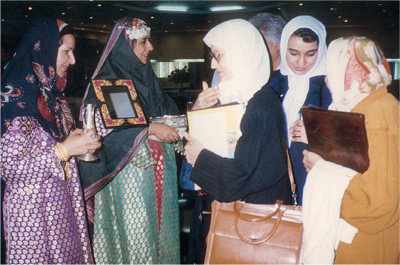
File photo of Zoroastrians in Tehran
The pilgrims had climbed to the shrine where Nikbanou, the daughter of the country’s last Zoroastrian monarch, King Yazdgerd III, is said to have sought refuge in 652AD from the Arab conquerors who brought Islam to Iran. "Lighting candles in line with the Zoroastrian belief that fire symbolizes God’s light, they worshipped the credo of ‘good thoughts, good speech, good deeds’ which the faith’s founding prophet, Zoroaster — also known as Zarathustra — propounded at least 3,000 years ago. They also conversed noisily in a pre-Islamic form of Persian stripped of the modern Arabic loan words used by their Muslim compatriots.
"But the sense of refuge worshippers traditionally enjoy was tested by the unprecedented government attention paid to this year’s event, in the form of a visiting delegation sent by President Mahmoud Ahmadinejad, along with interior and culture ministry officials.
"By requiring worshippers to observe Islamic dress in their own sacred place, the high-level visit illustrated the second-class status of Zoroastrianism — believed to be the world’s oldest monotheistic faith — in its land of origin.”
Koorosh Niknam, Zoroastrian MP in Iran’s parliament, told Tait that the gesture was voluntary: "We just wanted to show respect because it is they who rule and we are living in their community.” Nonetheless, to Tait "it highlighted the difficult plight of Iran’s estimated 25,000 Zoroastrians under the country’s Shia Islamic governing system.”
Officially, Zoroastrians, Jews and Armenian and Assyrian Christians are constitutionally protected religious minorities with guaranteed parliamentary representation. In practice, however, "complaints of discrimination are widespread. Access to high-level posts in the government and armed forces is blocked. Some Zoroastrians say they are pressured to change their religion. A law awarding Zoroastrians who convert to Islam their entire families’ inheritance at the expense of non-converted relatives has caused misery and bitter resentment. Despite legislation decreeing that all religions are entitled to equal blood money (compensation) awards, Zoroastrians say that, in reality, they still receive only half the sums given to Muslims,” notes Tait.
Tait notes that Niknam deplored the lack of a platform on radio or television to speak about Zoroastrianism, adding, "We cannot get any budget for building a new fire temple when mosques are being built one after another.”
Yet Tait found that many Zoroastrians say they feel better treated by their Muslim fellow-countrymen than under the last shah, Mohammed Reza Pahlavi. Paradoxically, they attribute this to the uniform dress code imposed by the 1979 Islamic revolution, combined with a decline in religious prejudice among younger Muslims.
"Before the revolution, all Muslim women in my home town of Yazd wore chadors and only we Zoroastrians didn’t,” Goharbanoo, 40, told Tait. "The Friday prayer leader ruled that on Fridays, Zoroastrian men had to wear white and women traditional clothes. It meant people could recognize us easily and they would be very rude to us. When we went into a grocer’s shop, we wouldn’t be allowed to touch the fruit. We even sat on separate benches at school and had separate drinking water.
"Thanks to the revolution, everyone dresses the same now. People back then were more religious. Today’s generation is ashamed of the prejudice of their ancestors.”
Though some Zoroastrians have sought refugee status in America under an officially backed program to help Iranian religious minorities, Tait found a dissenter in Behzad, 31, an unemployed computer graduate who complained of being denied a gun during his national military service. "Why should we leave? This is our mother country,” he said. "Iranian culture is wonderful. Western culture is stress, stress, stress.”
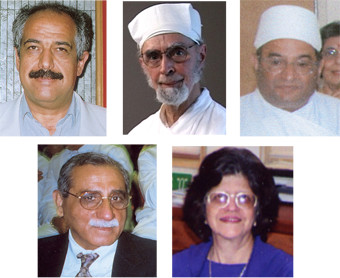
Clockwise from top left: Koorosh Niknam, Jehan Bagli, Kersey Antia, Roshan and Rohinton Rivetna
The Zoroastrians are not allowed to be army officers — despite being required to do the two-year military service — or run for president and say that they face obstacles for promotion in the state sector, notes Farmani. But these are not "as bad as the shrinking of our community,” as 44-year-old Susan Afshari told Farmani while attending the Mehrgan festival marking the autumn equinox and honoring the ancient Persian angel of love, Mithra. "We are the guardians of such traditions and feasts, if we leave, who is going to keep them going in Iran?” said Afshari, who has a sister living in the United States. Watching a group of young girls dancing to ethnic Azeri music on the stage, she hopes that they grow up to "be proud Iranians and be as attached as we are to this land,” writes Farmani.
On the other hand 30-year-old Babak Mostaqni told her, "Many leave for more freedom and better employment and education opportunities. If my Muslim friends had the chance, many of them would go, too.”
Iran’s craze for Caesarean section is so pervasive, "it’s a challenge now to find a doctor who will perform a ‘medieval’ vaginal birth,” writes Moaveni. But an even bigger problem awaits the naming of the child. "When my girlfriends in the US got pregnant and began picking baby names, we discussed whether French names were too pretentious, Indian ones too trendy, and whether originality mattered more than pronounceability. In Tehran, such conversations all lead back to one central question: is the name you like on the banned baby name list? I didn’t even know such a list existed.” Foreign names are prohibited. Someone who tried to register his newborn daughter as Farah Juliette failed to cajole the guy at the records office and had to be satisfied with calling her Farah.
"The tradition of banning names dates to the beginning of the Islamic Revolution in the early 1980s, when Iran’s fundamentalist leaders sought to purge the country of both Western culture and its own Persian, pre-Islamic past. Religious extremists consider it unfortunate that Iranians used to be Zoroastrians, or that the ancient Persian empire achieved its greatest triumphs before Islam’s arrival. To that end, they compiled a long list of forbidden names that included Zoroastrian gods and goddesses, commanders of ancient Persian armies, and other such tainted, best-forgotten figures… Arabic names, except for a handful of Sunni villains, were fine. Persian ones, despite originating from the language actually spoken in Iran, had to be checked against the official list. Along the way, other politically inconvenient realities were fought on the baby name terrain. Wishing to quell an uprising by ethnically Kurdish Iranians in the north, the government banned Kurdish names.
"These days the government has mellowed somewhat when it comes to names. Foreign ones are still out, but in recent years a number of previously banned Persian names have been restored to the official list. Every few years there’s a sudden profusion of now antique-sounding names like Aryo and Armiti, as eager parents follow the de-banning closely. After all, what’s cooler than a formerly banned name? I don’t know yet if the name I’ve picked is banned or not. There’s reason to suggest it is, but similar names are now common and so maybe it will be okay. I could drop by the registry office and check, but I worry if my baby’s name is on the banned list they’ll remember me two months from now and it will be harder to offer a bribe, which of course requires discretion. The other option is to choose an acceptable back-up name, but somehow this feels like I’m giving in. It seems ironic that my own name, which became wildly popular on the eve of the Islamic Revolution, means freedom. Because that’s exactly what I don’t have in naming my child,” notes Moaveni.
Tracking the community in North America through a two-day visit in Chicago over the muktad and a variety of interviews, Goodstein homes in on the crucial issues facing Zoroastrians: "Despite their shrinking numbers, Zoroastrians are divided over whether to accept intermarried families and converts and what defines a Zoroastrian. An effort to create a global organizing body fell apart two years ago after some priests accused the organizers of embracing ‘fake converts’ and diluting traditions.”
Goodstein’s article on North American Zoroastrians titled "Zoroastrians Keep the Faith, and Keep Dwindling” has evoked much praise and interest from the community there.
"Goodstein and a NY Times photographer spent a couple of days in Chicago during the Muktad days and interviewed a lot of people, for this article. Thanks to Tenaz Dubash and Tamina Davar for cultivating the contact with NY Times,” states Roshan Rivetna in an email to the "Zoroastrian Association of Chicago and friends.”
The article quoted several Zoroastrians on the crucial issues facing the community.
"Survival has become a community obsession,” says Dina McIntyre, a Zoroastrian lawyer in Chesapeake, Virginia who is active in community affairs and knowledgeable on the religion.
"They feel that the religion is not universal and is ethnic in nature, and that is should be kept within the tribe,” the article quoted Ervad (Dr) Jehan Bagli, a retired chemist in Toronto who is president of the North American Mobed Council, which includes about 100 priests. "This is a tendency that to me sometimes appears suicidal. And they are prepared to make that sacrifice.”
"In South Africa, the last Zoroastrian priest recently died, and there is no one left to officiate at ceremonies,” said Rohinton Rivetna, a Zoroastrian leader in Chicago, who, with his wife, Roshan, was a principal mover behind the failed effort to organize a global body. But they have not given up.
"We have to be working together if we are going to survive,” Rivetna is quoted as having said.
"Although the collective picture is bleak, most individual Zoroastrians appear to be thriving. They are well-educated and well-traveled professionals, earning incomes that place them in the middle and upper classes of the countries where they or their families settled after leaving their homelands in Iran and India. About 11,000 Zoroastrians live in the United States, 6,000 in Canada, 5,000 in England, 2,700 in Australia and 2,200 in the Persian Gulf nations, according to the FEZANA Journal survey,” noted Goddstein.
She also quotes the Chicago high priest Ervad (Dr) Kersey Antia who told her, "It pains me to say, in 100 years we won’t have many Zoroastrians.”
◆ ◆ ◆
From the archive