
Politics and Policy
Attacking the administration
Indiscipline and uproar mark the two-day meet of the Federation in Bombay
"The world looks on the Parsis as a cultured group, of how they have sweetened life, as a community capable of harmonizing relationships. The last 15 minutes have flown in the teeth of that description. I have dealt with Lalloo Prasad Yadav and others but I have never seen such an unruly meet…The Tatas, the Godrejs, the Wadias have shown what we are capable of. If they are looking from above, they may not approve of what I saw in the last 15 to 20 minutes. We are a reputed community. Let us behave in a manner in which the world expects us to behave.”
The admonition from Dr Jamshed Irani, KT, esteemed corporate personality, former CEO of Tata Steel and president of the Jamshedpur Anjuman who was attending the second day of the executive council meet of the Federation of Parsi Zoroastrian Anjumans of India at the Banaji Atash Behram Hall on September 3 and 4, 2005 in his capacity as vice president of the Federation’s East Zone, unfortunately did little to alleviate the exchanges. Irani stoically sat through the major part of the day, but eventually left just before the meeting closed.
Starting peacefully enough with everyone listening in silence to Federation president and BPP (Bombay Parsi Punchayet) chairman Minoo Shroff’s rational welcome laying down the corporate rules of the game, the atmosphere changed almost immediately the agenda was taken up. Every little formality became an excuse for strident disagreement.
The meeting lived up to all the apprehensions voiced in community circles. The hall was jampacked with anjumans who have not attended in a decade or more, largely represented by members of the orthodox lobby who had acquired their endorsement, knowingly or unknowingly. As is usual in Bombay a number of people attend the event as self-appointed observers. This time the BPP’s lunch count was seriously upset on the first day though on the second there was an attempt at the start of the day to check on the bonafides of those attending.
Non-receipt of minutes on the one hand and of subscription dues on the other, matters which in the past were resolved with goodwill in a trice, required references to the rule book as, in anticipation of further conflict and the need to vote, each side tried to shore up its position. But matters reached an explosive degree as the orthodox brigade led by Khojeste Mistree tried to oust long serving Federation honorary secretary Keki Gandhi — and the liberal Delhi anjuman to which he belongs — from membership of the Federation. A first time ever election of a vice president threatened as Surat Parsi Panchayat (SPP) president Darayas Master and businessman and WAPIZ World Alliance of Parsi Irani Zarathoshtis president Areez Khambatta seemed to vie for the position of vice president of the Federation from Gujarat, termed West Zone B in the Federation’s constitution. A gentler person, Master eventually withdrew from the fray saying, "Mané khabar nahi hati ké aatli badhi maaramaari thasé (I had no idea it would lead to such fighting)!”
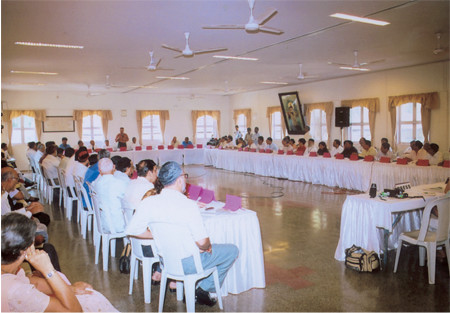
Peace — only at the start of the proceedings
Sohrab Katpitia of Surat, coordinator of the Federation’s defunct anjumans subcommittee, was flagrantly abused by Khambatta and some dissidents from Gujarat for what they conceived as inefficiency on the one hand and abuse of power on the other. The 75-year-old veteran, former chief executive of the SPP and the man once credited with bringing the long stalled accounts of the BPP up-to-date, has been pursuing the thankless task thrust on him by the Federation over the past 20 years. Khambatta often spoke so loud, his words were lost in a blast of sound. Long suffering president Shroff noted at one stage, "In your last incarnation you must have been a tenor or something!”
The orthodox group, known for its antipathy to Dinshaw Tamboly, BPP trustee and managing trustee of the World Zoroastrian Organization (WZO) Trust Funds in India, used an item in the Federation minutes on Udvada as pavitra yatradham, to strafe the Foundation for the Development of Udvada (FDU). The Federation has no jurisdiction over the working of the independent trust, formed in conjunction with the Government of Gujarat (its chief secretary is a member of the board of trustees) which has given a sizable amount, along with the Central Government, for use in Udvada. Tamboly, a trustee of the FDU, had been keeping the all — India body informed of developments in a spirit of camaraderie.
The formation of a world body of Zoroastrians has been the proverbial red rag to the orthodox bull. The single point agenda to stall the creation of such a body and of India’s participation in it, has resulted in the enormous disharmony unleashed by the orthodox group which did not spare the soft spoken Rohinton Rivetna of Chicago, founder president of FEZANA (Federation of Zoroastrian Associations of North America) and originator of the world body movement. Rivetna had come with proposals from other world body participants seeking to address the concerns voiced by dissenting anjumans at the Ahmedabad meet. This, despite the executive council’s readiness to listen to what WAPIZ trustee Homi Ranina had to say on behalf of the conservative Alliance.
So nasty had the atmosphere become on the floor of the house that the first comment of builder-developer Jimmy Mistry who had arrived in his capacity as guest speaker on the first day was, "I’ve been here half an hour. I am quite shocked at the way things go on…”
In fact it is the contribution of the young guest speakers, Mistry and gynecologist Dr Anahita Pandole on the first day and entrepreneur Boman Irani on the second, that helped raise the proceedings to a level of mature debate.
The next executive council meet will be hosted by Ratlam, probably in January 2006, the dates to be fixed later. Ratlam president Tehmton Anklesaria noted that his anjuman would be prepared to host up to two delegates from each member anjuman.
Elections
Every two years the executive council is reelected. Comprising of the chairman of the BPP who is ex-officio president of the Federation plus four additional trustees of the BPP, it has five vice presidents, one from each zone, plus one representative from permanent members Iranian Zoroastrian Anjuman, the SPP, Navsari, Delhi, Poona, Calcutta and Jamshedpur, Hyderabad-Secunderabad, Ahmedabad and Madras. Additionally, five anjumans represent the North Zone, one the East Zone, one the South Zone, two the West Zone A and two the West Zone B. These anjumans are so elected that representation in the council covers a wider area. Over and above the elected anjumans, five individuals are co-opted by the council to serve the Federation, preferably, one from each zone.
In light of the above, Lt Gen (Retd) Adi Sethna, president of the Delhi Parsi Anjuman [(Registered Trust)- DPA in brief] and member of the National Commission for Minorities, and Jamshed Irani were elected unopposed from the North and East Zones respectively. South Zone vice president Nariman Mogrelia stepped down in favor of Jehangir Bisney of Secunderabad (in absentia). As West Zone A vice president Dara Irani of Poona chose to retire and as the Poona Parsi Panchayat’s subscription fees were pending, Rustom Cursetji of Thana came in unopposed.
Master’s nomination had been received in time. Khambatta had nominated himself to continue in the post of vice president of West Zone B but much time and energy was lost in argument as the nomination had not been received by the Federation secretariat in Delhi. Eventually it was acknowledged that a letter dated September 2, 2005 signed by Khambatta had been received in the BPP office at 3.50 p.m. that day but had not reached the president or the secretary until a copy was produced on the floor of the house.
"This is the first time in the history of the Federation that two nominations have been received for any post,” noted Gandhi. Invoking article 11 of the Federation’s Rules and Regulations he declared that the election will be held at the next ordinary general meeting of the Federation, a year hence.
"Fine,” said Mistree. "Till then Areez continues.”
"No,” countered Gandhi. "If the VP cannot be elected, there is a vacancy.” He went on to announce the nomination of Agra, Allahabad, Mhow, Indore and Jhansi — declaring that Jhansi cannot be elected due to non payment of its subscription — as the representatives of the North Zone; a vacancy in the East Zone for want of a nomination; Secunderabad-Hyderabad from the South Zone; Thana and Satara from West Zone A and Bardoli and Baroda from West Zone B. Nargol’s nomination could not be accepted, he said, as its membership fee had not been paid.
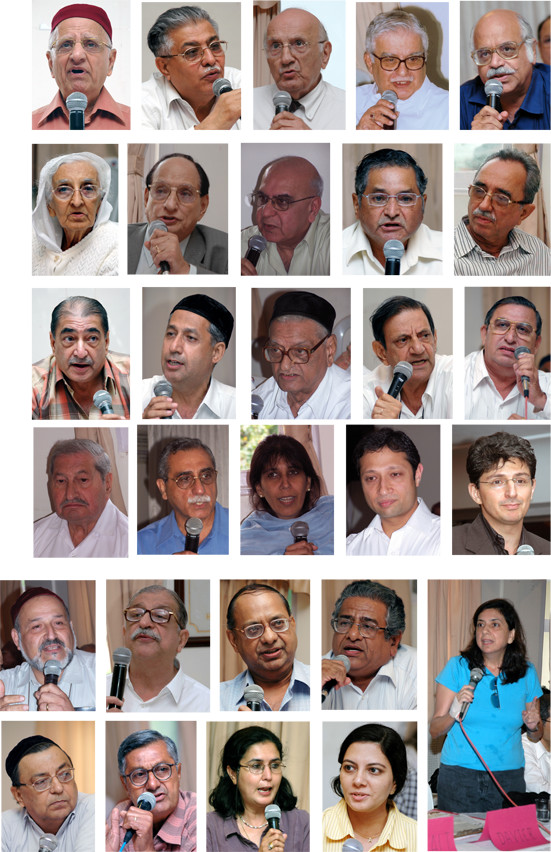
1st row: left to R: Minoo Shroff, Keki Gandhi, Adi Sethna, Jamshed Irani, Rustom Cursetji ;
2nd row: L to R: Silloo Kavarana, Dadi Engineer, Dinshaw Tamboly, Burjor Antia, Maneck Engineer;
3rd row: L to R: Behram Dastur, Tehmton Anklesaria, Sohrab Katpitia, Jamsheed Kanga, Darayas Master
Photos by Sarosh Daruwalla, Mazda Audio Video Lab; 4th row: from left: Jamshed Guzder, Rohinton Rivetna, Anaita Pandole, Jimmy Mistry and Boman Irani ; 5th row: The WAPIZ team (from left) Khojeste Mistree, Areez Khambatta, Homi Ranina, Dinshaw Mehta, Tannaz Parakh (standing) ;6th row: Hoshang Wania, Jamshed Mohta, Firoza Panthakey - Mistree and Anahita Desai
Declaring the annual general meeting concluded Gandhi reverted to the executive council meet to co-opt members: Farokh Rustomji from the North Zone, Mani Clubwala from the South Zone, Mehrwan Irani from West Zone A and Boman Cama from West Zone B.
The protests were thick, fast and loud. Tannaz Parakh representing Khergam and Yezdi Desai representing Jabalpur were on their feet calling on BPP trustee and noted solicitor Dadi Engineer to intervene. "Where in the rule book does it say that nominations have to be taken (We expect ) the newly elected council to co-opt members.” "The Societies Registration Act is silent on the matter. This procedure has always been followed: the nominations received are accepted,” noted Gandhi.
Acknowledging that this was her first experience of a Federation election (she has attended only two meetings of the Federation so far) Parakh asked, "Does Jehangir Bisney have nothing to say in the South Zone?” Replied Gandhi, "The South Zone member has been co-opted according to the nomination received.”
The opposition was becoming increasingly shrill. "Read the rules,” shouted Parakh and Desai. It was obvious that they had counted on the council inducting some members of their group as co-opted members. Their only supportive member of the BPP board, Dinshaw Mehta who is a member of WAPIZ (and incidentally, also of the Association of Inter-Married Zoroastrians) attacked Gandhi: "You do not follow your own rules. Only the executive council can co-opt.”
While Engineer sought time saying the Societies Registration Act/ Representation of People’s Act would not be available on a Sunday, Gandhi noted that the chairman had given his ruling. In the ensuing pandemonium there were allegations of "bulldozing,” "dividing the community,” "inviting litigation.” Desai and Nargol president Hoshang Wania were shouting to the chairman to "countermand the elections.” Dahanu had earlier been precluded from voting or being nominated as its fee had not been received in time (the Dahanu president Firoz Jamshedji argued that he had proof of delivery of his letter and cheque from the courier and Khambatta offered Gandhi cash on the spot which was not accepted). Wania insisted that a demand draft is acceptable even at the last minute.
With corporate etiquette intact, Supreme Court attorney Ranina sushed the shouting brigade to declare Rule 11, which requires the holding of a vice presidential election at the following meet, as "most ridiculous…it is absurd…you cannot allow the vacancy of a vice president to take place…This rule will be challenged…As for filing of fees, you must accept in cash or demand draft. It is a technical lapse. You mustn’t make an issue of it. You are all reasonable people who are elected…I respectfully submit, let the vice president’s election proceed. I am making a request to the chairman as a democratic, humane person…”
Mehta claimed that the rule book "goes on to say that elections can be held just now” but Engineer and Gandhi concluded, "This is not a forum to discuss legal opinion.” Continued Gandhi, "The rules are there. We interpret them according to our understanding. If you feel the rule needs to be challenged, do so. The chairman has ruled.”
However, the confrontation continued until Master got up to say, "I’m one of the candidates as vice president of West Zone B. I stood on the understanding that Areez will not stand as vice president. If it is not like that, I am withdrawing.” (According to an unconfirmed report Master had received threatening calls the previous night.)
Responded Gandhi, "In the same spirit Mogrelia stepped down. It is the duty of anjumans in each zone to come to an understanding. I hope the spirit of understanding you are showing will continue in all cases.”
Master strategist Mistree now interposed: "Hope the same spirit is shown by Keki Gandhi and he also steps down.” Seizing the moment Desai called, "All those in favor of Keki Gandhi stepping down please stand up.” On cue a number of delegates/representatives leapt to their feet. An angry Jamsheed Kanga who represented Satara shouted, "People are behaving like goondas!” Khambatta pointed his accusing finger at him "bahuj goondagiri thaee gaeech.”
By now the patient Shroff had had enough. "I said no personal allegations …You may not like someone’s face (but) he has carried the can for the Federation for 25 years. I have seen you for only two years. You may not like his views. You are all newcomers. What do you know of the Federation culture?... Many directors of a company are not liked by their shareholders… We are looking for light at the end of the tunnel.”
Turning upon a man who continued to shout and disturb the proceedings he demanded to know the anjuman he represented. When the reply was "Thana,” Gandhi noted that Cursetji is the only one who has the right to speak on behalf of the anjuman.
Cursetji intervened to say that Rusi Mohta, brother of the Bardoli president Jamshed Mohta, is a member of their managing committee. " However, the Thana anjuman’s official view has always represented the majority view… Mohta’s view is his personal view.”
"People are jumping up, challenging us. Their attitude is ‘Do it my way or else.’ We are elected people. Is it right that the BPP has accepted only one vote (like every other anjuman the BPP has a single vote on the general body of the Federation)? How many of you would be willing to accept that? Everybody wants to express his right!” continued Shroff.
Even as the hullabaloo continued, Jamshed Irani took his place at the main table. While Engineer made a plea for bonhomie Parakh countered with an apology for "loud voices” and directed a request at Kanga and others: "Don’t use words like goondagiri and dadagiri...” In the ensuing din Mistree wanted the chairman to announce that Khambatta had been elected from the West Zone B.
Ignoring Mistree, Shroff introduced Jamshed Irani, "the distinguished Zoroastrian in our midst, recently chairman of the Company Law Review Committee who carries his accomplishments in his stride, without pomp or hauteur,” and requested him to say "a few words of wisdom.”
"My wife Daisy asked me ‘Where are you going?’ She said, ‘Don’t get involved with them.’ (I came) because I was not only elected unanimously but almost pressurized into accepting. The first 15 minutes have been very revealing. I have to admit my wife was right. She keeps in touch with various publications and newsletters mailed by Khojeste and others…” said Irani, adding with a smile that he does not always accept what she has to say. "The corporate world addresses the chair and speaks to the chair – not across at each other. It is quite possible to disagree but we should disagree without being disagreeable, go on the offensive without being offensive. The fair sex are supposed to be timid and obedient. I don’t subscribe to that view but what I see here is the opposite…I am proud to be a Zoroastrian. I have done everything possible to help Parsis. I believe they have certain important genes…”
Accusing J. Irani of being "sexist” Firoza Punthakey-Mistree complained, "We as women should not be seen or heard? You should welcome women when they talk.” "Madam, I said nothing of the sort. What you said convinces me that women imagine more than there is. I believe in women’s equality, not in their dominance,” came Irani’s riposte.
"What has been happening over the last few meets is that people are taking undue advantage of Rule 6. (Rule 6 permits an anjuman to accredit by resolution or by writing under the hand of its authorized attorney one or more persons, preferably members of that anjuman, to represent it.) Quite a few people here are from anjumans to which they do not belong. When the anjuman has defaulted (in payment of subscription), they are not prepared to play by the same rule book. You are asking me to step down? We Gandhis are in the habit of being assassinated. We don’t step down. We don’t walk out. The more opposition there is, the more we become strong!” Gandhi challenged his detractors.
The appointment of office bearers continued: BPP senior trustee Silloo Kavarana and Keki Gandhi as joint honorary secretaries, Farokh Rustomji and Mehrwan Irani as joint honorary treasurers and Cawas Panthaky of the BPP as executive secretary.
"I was late so I don’t know. I want a clarification,” began Parakh. " The Delhi anjuman was thrown out. On what basis is Delhi a member of the Federation ? If it is not a member, Keki Gandhi’s nomination does not stand.”
Gandhi retold the story of the BPP walking out of the Federation because then chairman B. K. Bomanbehram had construed DPA president Shiavax Nargolwala’s criticism of the BPP’s electoral system as an insult. While the BPP was out of the Federation the DPA had altered its constitution to admit the spouses of interfaith couples. Thus, when other people tried to work out an agreement between them, Bomanbehram saw this as an impediment. To enable the BPP to rejoin he asked Nargolwala whether Delhi had a trust which could replace the DPA on the Federation. The DPA passed a resolution at its general meeting that it be represented on the FPZAI by the DPA (Registered Trust) but Bomanbehram went back on his own proposal and other anjumans like Madras and Hyderabad insisted that the DPA withdraw from the Federation but eminent counsels Soli Sorabjee and Fali Nariman who were consulted had said any such withdrawal would be "disgraceful.” In the ensuing years the Adoption Bill came up and different groups of the community approached the government with differing demands. Then Prime Minister Indira Gandhi summoned Dr Aspi Golwalla, who had succeeded Bomanbehram as BPP chairman, and urged on him the necessity of the community "speaking with one voice.” It made Golwalla decide that the BPP should return to the Federation and on the basis that the DPART replace the DPA the BPP rejoined the Federation.
Turning from the narration of past events to recent ones, Gandhi noted, "Our opponents have only one agenda: that the world body should not be formed. The leader of the opposition has said, ‘I was not involved, I was not consulted.’ He has been opposing us tooth and nail. On a boat you take on people who will not torpedo the boat. There has been an attempt, under Rule 6, to take over the administration of the Federation. That is why we are also becoming technical.”
Notwithstanding the explanation Parakh was again jumping up. In the uproar that followed, it was only Sethna’s experience as a commanding officer that enabled him to be heard above the noise. "There are attempts, allegations…If you see the registration form, I have stated that we are representing the DPATrust. It is a different legal entity…DPA was not thrown out; the BPP withdrew. Understand the difference. For the past more than 20 years we have been able to work together. The DPA has represented the community at the national and international level. We DPAT are a valuable part of the Federation and the Federation is a valuable vehicle for the projection of the community to the nation and the world.”
Even while Sethna was speaking a restless buzz and raising of hands demonstrated lack of interest or concern for the facts. Khambatta referred to the meeting held by the National Commission for Minorities (NCM) on Bombay in December 5, 2006 voicing his displeasure that "the representation had been made by a panel of speakers known for their reformist agenda…” The purpose of the meet had been to acquaint the community with the continuous decline of its population trends.
When Shroff ruled that discussion on the NCM meet was not on the agenda, Parakh challenged, "Election is on the agenda. Is there any provision in the rule book who can be a member? We are challenging Gandhi’s election.”
Returned Gandhi: "Rule 9(iv) says DPAT is a legal member of the Federation. If you want to challenge, choose the right forum.”
"Eminent personalities, see rule 14: The executive council may appoint from among its members…Dadi sahib vaacho. (Dadi, Sir, read) Clean bowled or LBW?” asked Khambatta tauntingly. (The cricket lingo was a spillover from the Federation Awards function the previous night when Keki Doodhwala, a cricket umpire, was one of the awardees. Engineer had jested, "Areez is so vociferous at Federation meetings, we need an umpire to say ‘out.’”) Rejoined Engineer, "Not LBW. You are clean bowled. Please note that rule 14 says appoint, not elect. Delhi is a member.”
Addressing Engineer again Khambatta thundered, "How can the elections go on withour your decision. You are fooling us like you have been fooling us about the world body!” Engineer cited a case law in justification of the events: "Pranlal Vora vs the Bombay Municipal Corporation.”
Kanga once again insisted that the chairman make a decision. "In the corporate world people would be thrown out,” spoke a visibly distressed Shroff. "This is no discussion. Rules are being redesigned, rethought. The office bearers have been appointed,” he declared.
Defunct anjumans
"The general difficulty is that trustees (of various defunct or dwindling anjumans) have not complied with the statutory requirements. We procure documents, take time and trouble and when all things are (ready), the trustees say they will take care of their properties themselves,” stated Defunct Anjumans committee coordinator Sohrab Katpitia of Surat. At the start of his presentation, a voluminous report documenting the current position regarding 33 locations where Parsis once lived and prospered but where only a handful of survivors remain, prepared by Katpitia, was distributed to the delegates.
"The only course to take is legal action, exert the right of the Federation on community properties,” continued Katpitia, adding that such properties spread out in the various states of India fall within the ambit of at least nine different laws. "Our expenses are capital expenses. We will be rewarded later,” the 75-year-old veteran noted with cautious optimism as "litigation is a slow process, the official documents are couched in local languages.” So far the expenses, mainly legal fees, have amounted to about 15 lakh rupees against which they have received offers and are in the process of negotiation in various areas amounting to substantially more than the incurred expense.
Indore’s Bomi Heerjee, a former IAS officer, informed the gathering that in Madhya Pradesh the law requires that charitable properties must be endowed in public trusts. In Bhopal, which has a large floating population, "there is a large piece of very valuable land.” In Neemuch, which has a stationary population, it should be easier to ensure that a public trust is set up, he maintained. "What happens if the last man dies? Safeguard the property and the established trust,” he advised.
Gandhi reminded the council that Neemuch and Bhopal have registered the Federation as custodian trustee of their anjumans and that the Federation will help Neemuch to register as a public trust.
"I do not agree with Katpitia,” shouted Khambatta, criticizing him most uncivilly for "not coming for the last two to three meetings. The report — which he described as "all negative” and "shameful”— should have been forwarded a few days earlier, he maintained. Despite the fact that the Federation was established in 1970 i.e. 35 years ago and the defunct anjumans program only began in the mid 1980s, he charged, "For the last 40 years there have been no results despite having the best solicitors in the community. Parsis are always respected. There is no Parsipanu!”
Katpitia gently reminded the assembly that he has been working since 1984, that "litigation takes years and is not an easy job. We have to go according to the courts’ orders…” but Khambatta continued to strafe him until BPP trustee and noted solicitor Burjor Antia intervened: "We are speaking of cooperation, coordination. By speaking so loudly we are spoiling the atmosphere. We can convey anything we want but coolly, calmly. Regarding the defunct anjumans representation, in our community people don’t work and those who work get the bamboo!” Claiming that the effort had netted 76 lakh rupees so far "and that is the starting point,” Antia suggested a solution to the disaffection voiced by Khambatta by involving local anjumans. "Involve Baroda, Ahmedabad, get their assistance, assign work,” he told Katpitia. Turning to Khambatta he said, "It’s your property, our property. Take it over. We will guide and help you, but you will be disgusted,” he prophesized. "Trustees sell off trust property and we have to fight them…It is a Herculean task. Don’t run down the report or Katpitia. You deliver the goods…”
While Gandhi urged the members present to consider the detailed report and write to him with constructive suggestions, Kanga chastised Khambatta for "monopolizing the mike…Some people are only interested in finding fault…Give responsibility to Mr Khambatta so next time he doesn’t make a speech but gives a report.”
Not to be silenced Khambatta harangued the gathering, loudly reminding them how he had fought " all the way to the Supreme Court” in defence of the right of communities to restrict housing to specified categories of people. He claimed that the court’s order had helped the BPP preserve its housing colonies for Parsis.
Hardly had Khambatta ceased fulminating when a totally extraneous matter was raised by Olpad Anjuman representative Zarvan Patvi, accusing Katpitia of having ordered an agiary locked in Surat when the boi and maachi were about to be performed. According to Patvi, Antia had had to intervene to let the ceremony continue. Suddenly a number of orthodox representatives were on their feet shouting allegations of misconduct in Surat and had to be commanded to sit down by the Federation secretary who reminded the delegates to address their suggestions and criticism to the chairman.
When order was restored, Ratlam’s Tehmton Anklesaria related how Behram Masani of Mhow and himself had settled out of court with an encroacher in Khandwa when the case might have been lost (because the original local resident who had brought the matter to the Federation had been coerced into silence and refused to testify). Starting from Rs 50,000 they had negotiated the settlement of two lakh rupees, he noted. "Sometimes legal remedies are futile. Set up local representatives with the authority to settle on the spot. But unless a person comes forward to offer help, you can’t tell him to do anything,” conceded Anklesaria.
"The second aspect is that even when there are only two Parsis left, they say the property is mine, not the anjuman’s,” noted a disgusted Sethna who as member of the National Commission for Minorities had had a substantial part to play in seeking government aid and redress to secure encroached properties. Speaking of the Srinagar anjuman land in the cantonment area there, Sethna, the Federation representative on its board, noted, "The property is saved but we won’t get any money for it. I had suggested that one or two couples go there to cultivate the land but people are unnerved by the hostilities in the area. In Amritsar there is no one left. Ahmedabad is closest to Deesa. Let someone from there take it over. There are no documents, no trust deeds, no revenue records (in Deesa). Get the money out of there and give it to the Federation,” he challenged.
Offering his help Masani reviewed the scheme of the Federation’s custodianship of dwindling anjumans, specifically in regard to Mhow, Neemuch and Bhopal. Expressing his concerns, Masani noted, "Suppose the Mhow anjuman falls into wrong hands when only 15 members are left. How will the Federation know? What will it do? What can it do? Custodianship is a futile exercise. Regarding Neemuch, I’ve been appointed to represent the Federation there. I have not received a single notification regarding meetings or accounts. Bhopal has no rules and regulations of its own. I have suggested bylaws. They have not been established so far. No one is interested in getting the trust registered.”
(The report on developments in individual anjumans, youth activities, world body discussions, guest speakers and Federation Awards will feature in subsequent issues.)
◆ ◆ ◆
From the archive