
Zoroastrians Abroad
"Religion is a private matter"
Life for Zoroastrians in Iran must be lived under political restraints, notes member of the Majlis Koorosh Niknam
According to Mobed Koorosh Niknam, the current Zoroastrian member of the Iranian Majlis, there are just under 100,000 Zoroastrians in Iran, of whom around 30,000 belong to their local anjuman. Life expectancy is about 70 years and there are two to four children per family.
Niknam’s responses were to the point when Parsiana spoke to him in the aisles of the Eighth World Zoroastrian Congress in London in June 2005. Representing an official position as member of the Iranian parliament together with a certain reticence in the use of English – we spoke to him through the courtesy of Firooz Khosraviyani who functioned as interpreter – Niknam refrained from expressing his personal opinion on any subject.
What we learnt from him is that now there is a high percentage of professionals among the Iranian Zoroastrians who until 50 years ago were largely agriculturists. Their subsumed position in society is reflected in the law that permits a Muslim murderer to pay a fine whereas the Zoroastrian one pays with his life. "A Zoroastrian can’t be witness in court. His word is not accepted,” said Niknam. However, the question of blood money – Muslim families had the right to monetary compensation from the killer, not so the minority communities – has now been sorted out so that everyone is entitled to claim "blood money.”
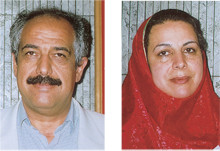
Koorosh and Parimarze Niknam
In the Majlis he has been pursuing a change in the unequal inheritance law which entitles anyone in a Zoroastrian family who has converted to Islam to inherit the entire family property on the death of the patriarch, irrespective of the claims of the next of kin. The issue has been agitating the minority communities for a long time, but Niknam would only say he was "optimistic” about the outcome.
"There is nothing official regarding conversion,” Niknam parried. "Religion is a private matter. It is not on the birth certificate. Therefore the government is not involved. It is not issuing a decree. But if anyone speaks against Islam, the penalty is death.”
In the course of the debate on the World Body (WB) Niknam was more forthcoming. Tersely reviewing the history of the community in Iran subsequent to the Muslim conquest, Niknam said the event had been a watershed in the development of the community. Remarking on the deep bond with the country that its people had, he noted that those who valued it greater than their religion converted to Islam. Those who valued their religion more than their motherland, left Iran in search of asylum elsewhere – the forebears of the Parsis of India. Those who had affection for both remained in Iran and continued to profess the Zarathushti faith. "They have borne the brunt of trouble.”
Professing himself in favor of such a body, he had sought a Farsi translation of the proposed by-laws for the Iranians to study it. At that point he had noted, "From the social point of view we don’t have the freedom of others. We need help in this direc-tion…to strengthen ourselves... Islamic by-laws may need to be recon-sidered…There are certain formalities, it (WB constitution) has to go through certain channels. It will take time. There will be delays.”
On the subject of accepting Zoroastrian converts into the World Body, he had noted, "Zarathushtra preached freedom of choice. For anyone who accepts his teachings, there should be no restriction. If the acceptance of the religion by others is done with knowledge, they should be accepted. At present there is an awakening to Zoroastrian teaching. Many people would like to accept the Zoroastrian religion. After ascertaining that they are truthful and would truthfully follow the Zarathushti path, we should accept them.” Niknam stated that when Iranian ayatollahs ask him how many Zoroastrians are there, he had said two billion, responding to their disbelief with the explanation that anyone who acts with a good mind and treads the path of truth is a Zoroastrian. Otherwise, even if there are four billion who claim to be Zoroastrian but are not honest, they are not Zoroastrians.
A teacher at the Firouze Behram High School, Niknam is a member of the Iranian Mobed Council whose current president is ophthalmologist Dr Ardeshir Khorshidian and of the Tehran Anjuman whose president is Alayar Daneshmund, an engineer by profession. Niknam is currently midway through his four-year term as MP.
Married to Parimarze, a prominent member of the Iranian Women’s Association, the Niknams have four children: Niloufer, 24, is a graduate in graphic design, Nauzanin, 22, is an undergraduate in English, Faredoon, 17, had just finished high school with a diploma in music, and Pedram,15, who is in high school. We learn that Faredoon has a talent for music, plays the sitar, guitar and piano and hopes to pursue a career in music in Europe.
◆ ◆ ◆
From the archive