
Religion
Bharuch, Colaba, Madras, and Mhow fire temples
Bharuch: At a price
Members of the Ginwalla family have been trustees of the Homawalla Agiary Fund and have been looking after the Homawalla Daremeher since the agiary was started. As per the inscription the Agiary structure was completed in 1760 AD and it was the second fire temple in Bharuch. The padshah was consecrated and enthroned at that time. In that era Bharuch must have had a Parsi population of around 7,000 people and there were plenty of local mobeds. Today we suffer from a lack of mobeds (the Parsi population must be totaling 150), hence it has become difficult to manage this fire temple as well as the three other agiaries in the vicinity. Younger mobeds do not wish to leave the larger cities and come to smaller towns. Now even the properties surrounding the agiary are being sold by the Parsis and are being purchased by people of other faiths.
Kathi is purchased from the local wood merchant and is procured through the Trust funds or through donations. Sandalwood normally comes from Surat or Ujjain, wherever the order may have been placed.
The corpus of the Trust fund is around seven-and-a-half lakhs and the amount is invested mostly in fixed deposits of nationalized banks yielding monthly income of around Rs 4,600. As against this the monthly outflow is much more — salaries, wood, maintenance, etc so at the end of the year we try to break even by getting some funds from other trusts. As far as donations are concerned there are very few in Bharuch who can donate and those who can, wish to take over the running of the agiary. Apart from annual expenses, funds are also required for long-term upkeep — repairs, painting, etc.
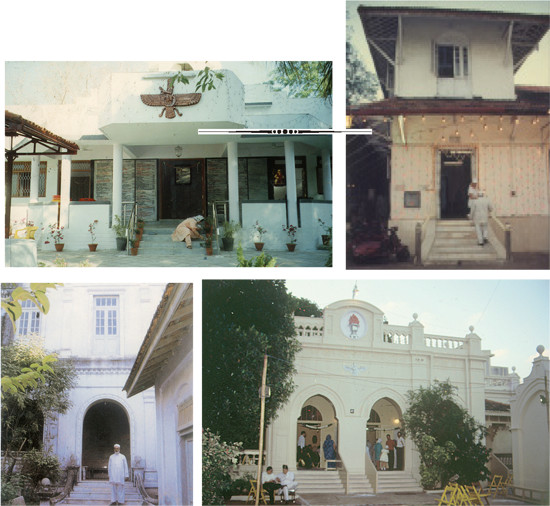
From left (above): Mhow’s Anjuman Daremeher and the Seth Jeejeebhoy Dadabhoy Agiary at Colaba. (Below): Homawalla Daremeher at Bharuch and the Jal Phiroj Clubwala Dar-e-Meher in Madras
We do not have a panthaky system and there is a dearth of mobeds in Bharuch. The muktad tables and vases have not decreased radically because the various families have left it to the mobed whose family is from Bharuch. For this reason any new mobed coming to do service in Bharuch is not likely to get much work at the time of muktads. After the present mobed of our fire temple retires, a big question will arise regarding his successor. The fire temple has no boiwallas and chasniwallas are available, but only at a price.
Being a very old structure there are no specific safeguards against fire hazards. The only security is that the entrance is kept locked during certain hours, but since the mobed’s house is across the street a devotee can request him to open the entrance. Sarosh Ginwalla
Colaba: 24-hour security
Seth Jeejeebhoy Dadabhoy Agiary situated at Pilot Bunder Road, Colaba, near Afghan Church, Bombay was established in 1836 AD. It’s a 170-year-old structure comprising of ground and upper floor with a boundary wall facing the sea from one side. This is the first home of the holy fire enthroned on March 15, 1836.
We obtain our kathi form M/s H. Sidhwa and Sons who are the prime suppliers of kathi to Bombay’s agiaries. We generate our income from donations given to us from the patrons who book our baug for their navjote and wedding ceremonies. The main objects of our trust, Seth Jeejeebhoy Dadabhoy Charity Funds, are to help the poor and needy of our community. We give donations mainly for medical and educational objectives. We also provide mid-day meals to students of the Byramjee Jeejeebhoy Parsee Charitable Institution and distribute food grains to almost hundred poor families once in a year.
We have one panthaky and four other priests to tend the holy fire and for performing day-to-day rituals like baj, afringan, farokshi and boi ceremony in the fire temple. The mobeds and chasniwalas are appointed by the panthaky himself. The panthaky performs other ceremonies like uthamna and four-day rituals of departed souls. Our panthaky has also performed navar ceremony of young boys in the recent past.
On an average 15 to 20 devotees visit our Agiary daily. During muktad days, 40 to 45 tables are booked every year. The number of devotees has certainly decreased over the past 10 years, mainly because of the Karani Agiary, which is situated in Cusrow Baug and is easily accessible to Parsis residing in Colaba. There are no Zoroastrian families residing in the vicinity as our Agiary is situated in the army cantonment area.
To safeguard our premises from thefts and other antisocial elements, we have security round the clock. We also have fire extinguishers to safeguard against fire hazards.
Kersy G. Mistry
Madras: Fiscally sound
The Jal Phiroj Clubwala Dar-e-Meher was built in 1910. This was mainly due to the munificence of Phiroj Muncherji Clubwala who offered to provide a building on the Main Road in Royapuram, Madras on condition that the Anjuman collected a minimum of Rs 30,000 for its maintenance. The community readily came forward with the funds.
The fire was consecrated on August 7, 1910 (roz Marespand, mah Bahman, YZ 1279). Ervad Hormasji Adrji Gai became the first panthaky of our Dar-e-Meher. Prior to this, there was no atash adarian in Madras. This is the only Dar-e-Meher in Madras.
From its inception, the entire management of the Dar-e-Meher was entrusted to five trustees, namely P. M. Clubwala and thereafter his legal heir, the president of the Madras Parsi Zarthosti Anjuman, one nominee of the Clubwala family and two members of the Anjuman. This continues to be the case.
Thanks to the efforts of the trustees down the years and especially to the efforts of Mani and Jehangir K. Clubwala, the Dar-e-Meher is in a comfortable financial position for the present. The Dar-e-Meher’s corpus has been built up largely by way of donations. All our income is from the interest earned through our investments. Donations to the Dar-e-Meher have reduced considerably over the last few years.
The main items of expenditure are purchase of kathi, maintenance of the building and salaries/wages. Kathi is procured locally in Madras. Our panthaky purchases sandalwood from Bombay.
We have had the panthaky system from the inception of the Dar-e-Meher. As it is very difficult to locate mobeds, our panthakies have managed single-handedly for many years at a time. Our trustees have made every effort to get suitable help for the panthakies and whenever possible, a mobed has been appointed. At present, however, our panthaky, Ervad Kaikhushru Laskari is managing on his own. We do not have any boiwalas though we do have a chasniwala, Zarir Daruwala. Both the panthaky and chasniwala have quarters in the agiary compound. There is also a flat for the assistant mobed.
The Jal Phiroj Clubwala Dar-e-Meher is very special to the community in Madras. However, considering our numbers, approximately 250, and the fact that the agiary is at a distance from the center of the city, we have about five to 10 persons coming daily. The number of devotees has marginally increased over the past 10 years. Around 35-40 Zoroastrians reside in the vicinity of the fire temple.
Two muktad tables are set up every year. One is for the Clubwala family and the other is the anjuman table where there are five-six vases. The number has more or less remained constant.
The Dar-e-Meher Trust’s annual income is approximately four lakh rupees. Our monthly expenditure is in the region of Rs 30,000 and interest earned is sufficient to cover the expenses at present.
The entire property is adequately insured against fire and other hazards. Security is needed to guard the premises and necessary action has been taken in this regard.
The community looks forward to celebrating the centenary of the Dar-e-Meher in 2009-10 and the main objective of our efforts is to maintain and strengthen the corpus so that the agiary is self-sufficient even against falling interest rates and can meet any contingency in the future.
Zarin Mistry
Mhow: A major difficulty
With the advent of British troops in Mhow in 1818, Parsis followed from Gujarat for purposes of trade and commerce.
A building to house the sacred fire was constructed before 1840, when the dakhma was consecrated.
On March 5, 1846, the fire was shifted to a new building, and in 1857, the Anjuman Daremeher was consecrated. In 1896 and 1916, the structure had to be renovated and considerably altered.
A portion of the building collapsed in 1995. The sacred fire was shifted to an adjacent hall. An entirely new building houses the adaran since March 21, 1996. The building was constructed with the help of donations. Jehanbux Billimoria of Bombay was the architect and Adil S. Marfatia of Indore, the engineer.
A major difficulty in maintaining the only adaran in the whole of central and north India is the unwillingness of priests to leave big cities. One of our past priests, Ervad Ardeshir Dastur, could not attend his own father’s funeral at Udvada.
In a small place like Mhow there is not much work for priests, hence the unwillingness of the panthaky to pass on some benefits to an assistant who is, in any case, difficult to find.
For a chasniwala, we have to make do with whoever is available.
Baval trees have been planted on about 10 acres of dakhma land, but we still have to purchase about eight tonnes from the local market. Sandalwood is procured from Ujjain. While donations are always gratefully accepted, we are fortunate to be able to manage our adaran within our means.
The main item of expenditure is salaries, including salary for the agiary gardener, watchman, sweeper.
During muktad we have seven private tables, and one anjuman table with about 30 vases.
With diminishing population, the number of devotees has lessened. About two-third of the Parsi population of Mhow resides within a stone’s throw of the agiary.
The nearest dadgah is at Indore, 15 miles away.
Dr Behram M. Masani
Sarosh Ginwalla is a trustee of the Bharuch Parsi Panchayet, Kersy Mistry is chief executive secretary of Seth Jeejeebhoy Dadabhoy Charity Funds, Zarin Mistry is honorary secretary of the Madras Parsi Association and Dr Behram Masani is president of the Parsi Zoroasatrian Anjuman, Mhow.
◆ ◆ ◆
From the archive