
Scholarship
A clearing house of ideas
The K. R. Cama Oriental Institute has published the papers presented at its third international scholars’ meet
The arrival of Parsis in India was "one of the earliest known instances of official asylum being granted to foreign political refugees,” retired Supreme Court judge Sujata Manohar had noted in her inaugural address to the scholarly Third International Congress, hosted by the K. R. Cama Oriental Institute (KRCOI) ere proceeding to the many similarities and cross-fertilization of Indian and Iranian cultures that characterized the first and second millennia AC.
The proceedings of the Congress (Bombay, January 6-9, 2000) with the theme "Indo-Persian Cultures: Their character and impact on civilization,” were published by the KRCOI in October 2001. Containing the 33 papers presented at the Congress by 16 national and 17 international scholars, the 386-page publication also records the main speeches at the inaugural and valedictory sessions. The papers may roughly be classified, according to their basic themes, into philosophy/theology, scriptures, religion, history, language and literature and socio/economic influences though several papers hyphenate two or more of these categories. Some of the papers were presented in absentia and two contributions were received later.
KRCOI president Sir Jamsetjee Jejeebhoy had welcomed the delegates to this "clearing house of ideas,” and presented shawls, flowers and mementos on behalf of the Institute to outstanding contributors — scholastic and financial. These included Dasturs (Dr) Hormazdyar Mirza and (Dr) Kaikhusroo JamaspAsa who have been long-time mentors of the Institute as had noted its dynamic trustee-secretary Homai Modi; Iranian philanthropist Mehraban Zar-toshty whose family has provided the funds to enable the KRCOI to reprint rare books, and who ceremonially released the third in the series, The Laws of the Ancient Persians by Sohrab Jamshedji Bulsara; the venerable Ratamai Peshotan Peer who has spent a lifetime in the religious education of Zoroastrian youths in Bombay; and that indomitable octogenarian Behram Rustomji, formerly of Karachi now living with his daughter in Bombay, who continues to participate in the various essay competitions held by the KRCOI.
Religious philosophy
"What is the human spirit looking for in religious belief? The self is seeking a religious vision by which one can live without the feeling of pointlessness,” noted nuclear physicist turned philosopher Prof Kaikhosrov Irani in his paper on "Early Enlightenment in ancient Indo-Iranian thought.” Describing the fundamental principle of the Enlightenment that shaped intellectual and social consciousness in 18th and 19th century Europe as the "non-acceptance of the Irrational,” Irani characterized religious vision as "an internal act of the believer” based on intuition. Irani argued that the Gathas of Zarathushtra and the Upanishads of India had preceded the philosophers of the Enlightenment by approximately three millennia. Zarathushtra had presented the world as a "field of moral conflict capable of being improved... One who does not grasp this cannot be a Zoroastrian,” he emphasized. This same transformation through individual insight is the forte of the Upanishads, he noted.
Vice president of the Centre for Ancient Iranian Studies at Boston Keki Bhote too spoke about the Gathas and the Upanishads. He presented the hymns of Zarathushtra as a legacy that the Upanishads inherited and contrasted the latter with the Vedas: "The Vedas look outward in awe of the physical world. The Upanishads look inward to the awe-inspiring powers of human consciousness.” He also pointed out the divergence between the Gathas and the Upanishads. "The concept of ‘dharma’ — obligation and the discharge of one’s duties to oneself and others — is enjoined. But the Upanishads do not stress service to society, the hallmark of Zoroastrian ethics. This inward-looking individualism has atrophied the social outlook in India to this day.”
President of the Association pour l’Avancement des Études Iraniennes Prof Philippe Gignoux turned to the Denkard III in his paper "On the notion of Good Measure (payman) and other related philosophical concepts.” He provided the theological underpinning of the code of "the golden mean” by which many a Zoroastrian household has lived: "The establishment of the sovereignty of the good men is based on Good Measure, on the pure Law. Even a little of excess and deficiency shakes that which is in the human world.” Gignoux explained the sovereignty of bad men as an excess or a deficiency, resulting in the destruction of all that is good. As an example Gignoux noted, "The man who takes justice to one who has no need, possesses the costume of excess. He who does not help the man in need, possesses the costume of deficiency. Both of these costumes are the Law of demons and the adversary of Justice. Contrariwise one who comes to the man in need and does not come to another who has no need, possesses the costume of Good Measure.”
In "The Zoroastrian view of ecology,” Avestan scholar Dr Homi Dhalla notes, "Among the first prayers taught to Parsi children is the Confession of Faith (Jasa mé avanghé Mazda), which emphasizes the principle of non-violence toward all living creatures. These values are embedded in the Zoroastrian psyche: man is a trustee of nature; he should not violate that trust.”
The dualism of light, spirit and goodness versus matter, darkness and evil — Manichaeism as taught by prophet Mani — abjured sex and procreation as completely linked to matter and all evil. It was believed that the good and evil got mixed in the world because of events precipitated by the evil principle and salvation was thought to occur through their separation, noted Dr Jamsheed Choksy, director of the Middle Eastern Studies Program at Indiana University. Examining the "Dualism of the feminine in Manichaeism: the Mother of Life and the Demoness of Concu-piscence,” Choksy writes: "The Mother of Life thus became an important feminine symbol — one which embodied both creation and protection of all entities that were good. She also represented loyalty and steadfastness by serving as a redeeming divinity... the Mother of Life, like the Father of Greatness, did not create the First Man or the other deities through any physical or sexual process... Her creations were summoned forth in absolute chastity and purity; i.e. creation by speech rather than actions, from piety rather than sexuality... complete abstinence from sex, marriage and procreation, had been prescribed as a prerequisite for salvation from the cycle of rebirth...
"In stark contrast to the Mother of Life, stood the demonic female... Az (who) was feared as the diabolic feminine manifestation of lust and avarice... a prime mover in the (devil’s) attempts to imprison the soul within matter and thus prevent salvation.”
For the sake of the continuation of the human race and Manichaeism, the lay community (not the elect) could have sex, marry and bear offspring but were required to abstain from all material acts, including sex, on one day each week. Choksy sees here the influence of the emerging cult of the mother of Jesus as Virgin Mary.
While Dr M. A. Mehendale of Poona’s Bhandarkar Oriental Research Institute presented a philological interpretation of four Gathic passages, the paper of Dr Sam Kerr of Sydney integrated human rationality and self knowledge with the concept of consciousness in Zarathushtra’s teachings.
History of ritual
The Zoroastrian religion in its history and ritual were dealt with by JamaspAsa, archeologist Dr Katy Dalal, practising mobed and Avesta-Pahlavi lecturer Ervad (Dr) Rooyintan Peer, and Ervad (Dr) Ramyar Karanjia, principal of the Athornan Boarding Madressa. Discoursing on "Fire in Zoroastrianism,” JamaspAsa noted, "Traditionally, (the early Zoroastrian) man established his own hearth fire when he established his own home and household,” offering to it "a portion of the sacrificial animal” along with dry wood and sweet smelling herbs. JamaspAsa notes: "The three holy fires mentioned in the Khshnuman of Adar, the dedicatory formula in the Avesta in honor of divine beings, are the Fire of Khvarrnah — dedicated to Iranian glory: the fire of Kavay Haosravah (Kai Khusro), of the enclosure of Haosravah, on Mount Asnavant, and of the Enclosure of Caecista dedicated to the Kayanian glory. The third fire is the Fire of Mount Raevant, also dedicated to Kayanian glory. In the Pahlavi version of the Atas Niyayis, the names of the three holiest fires become Farnbag, Gusnasp and Burzinmihr...
"During the Sasanian period the two other fires Farnbag and Gusnasp, thus far resident in Pars and Media, gained prominence and popularity. The Parthian partiality towards Burzinmihr for all the long years of Parthian dominance, had endowed Burzinmihr with a strong following and the priests of Pars and Media could not break the deep rooted reverence the people had for this fire, ever mindful of Burzinmihr’s role in the legends of Zarathushtra and Vistasp. Nevertheless, a bid was made to downplay the dominance of this fire and give Farnbag and Gusnasp some of the limelight. It is assumed that it was at this time that the three fires were linked to the three classes of Iranian society and Burzinmihr was assigned to the lowest social level.”
Unlike the swoop of Alexander that terminated the Achamenid empire, "Islam took close to 300 years to take firm root in Iran,” says the Dastur. With the coming of the Mongols conditions deteriorated further and the Zoroastrians withdrew into the deserts around Yazd and Kerman, taking the surviving fires of Farnbag and Istakhr (which had been enthroned by the Sasanians in the temple of Anahita and was said to be dedicated to Anahid the Lady) to the village of Sharifabad where "these two fires remain till this day, although at the beginning of this century, they were amalgamated into one fire.”
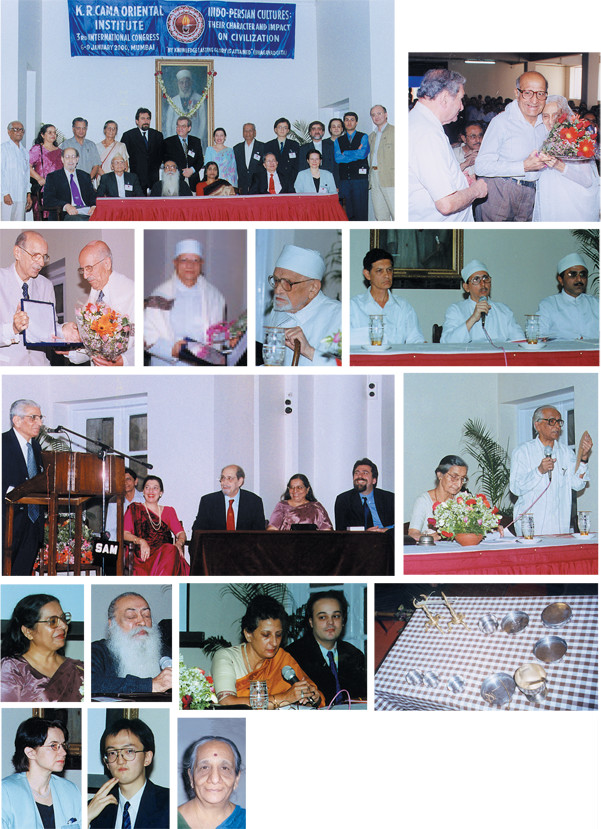
From left: (1st row) The scholars with KRCOI trustees Justice (retd) Dinshaw Mehta and Modi (standing, 3rd from left and center) and Jamshed Guzder with Nani Palkhivala; (2nd row) Jejeebhoy with Zartoshty, JamaspAsa, Mirza and Dhalla, Peer and Bajan; (3rd row) Fredie Mehta (at mike), Modi, Irani, Havewalla and Cereti and Kamerkar with Gorekar; (4th row) Havewalla, Upadhyaya, Nawaz Mody with Phalippou, some implements for the ijashni ceremony; (5th row) Hintze, Aoki and Desai
Referring to the 16 fires that comprise an atash behram fire JamaspAsa describes how they were purified by holding a perforated ladle full of fuel over the flames. It is interesting to note that the fire from a burning corpse — one of the constituents of an atash behram fire — needs to be purified 91 times while that from the home of a Zoroastrian needs 184 consecutive purifications. Even the fire from lightning needs 90 purifications as versus that from the home of a shepherd which needs only 33!
Discoursing on "The sacred white bull — varasiaji — and his position in the life of every Parsi Zoroastrian” Dalal describes the importance of the nirang produced in the course of long prayers over the bull’s urine (gaomez) accompanied by the mandatory rituals. This resulting fluid is one of the basic elements in other purificatory and pav mahal ceremonies. "Actually we have no literary evidence in our ancient books for a white varasiaji — but then white is the color of the Zoroastrian faith,” notes Dalal, elucidating how the animal must be free of bodily defects and in perfect health before his tail hair and his urine can be utilized.
Identified with the star Sirius in the constellation of Canis Major, the advent of "The rain-maker Tishtrya,” one of three divinities presiding over water (the other two being Avan-Ardvisura Anahita — and Haurvatat/Khordad), was avidly awaited each year over the Iranian sky as the agrarian economy was dependent on the monsoon. According to Rooyintan Peer’s rendition of the Tir Yasht, the way it rises could denote to the astronomers of ancient Iran whether the ensuing year is one of fertility or famine. While Tishtrya brings water his opponent Apaosha brings drought. The tussle between them is part of the Yasht wherein the worship of Tishtrya is cited as humankind’s duty to strengthen the rain god. "This aspect is very significant and echoes the concepts of ecology and environment in the matter. It tries to show that ultimately the cycle of rainfall (lies) in the hands of the people, and how they co-ordinate with the forces of Nature,” notes Peer.
Karanjia’s "Notes on the baj-dharna (Dron Yasht) ritual” discusses the importance of the ceremony which is known to most Zoroastrians as part of the quartet of prayers recited on death anniversaries but which also forms a component of other larger ceremonies like the visperad and the videvdad wherein the dron (or darun — the saltless, flat bread) is required. Karanjia notes that "the practice of performing the baj-dharna ritual goes back at least to the Sasanian times.”
The scriptures
Dr Carlo Cereti, a research fellow at the Kommission fur Iranistik der OAW and lecturer at the University at Wien, and Dr Almut Hintze, trustee and research associate of the Ancient India and Iran Trust at Cambridge, UK, discuss the more scholastic aspect of Zoroastrian sacred literature. "On the manuscript tradition of the Bundahishn” Cereti compares and contrasts six manuscripts in an effort to ascertain the coherence, structure and integrity of the original thesis. Hintze looks at the arrangement of the Avestan Yasna and the position of the Yasna Haptanghaity (YH) numbered after the first Gatha Ahunvaity and followed by the remaining four and argues that "the YH is the liturgical center of the entire ceremony, and probably has always had this function... cross-references between different Gathas indicate that the actual sequence of the hymns is not fortuitous, but has come to us in the way it was originally intended. If this is so, however, the question arises as to how this arrangement of the Gathas relates to the YH (now better known as the Haptan Yasht), which is placed in their midst.” Hintze noted that the compositional structure of this central, Old Avestan, part of the Yasna has often disconcerted scholars, who have found it difficult to account for the presence of what was deemed to be a later text. The YH seems to interrupt the flow of these most exalted and sacred utterances. As a result of Johanna Narten’s ground-breaking work, however, Hintze argued that it has become clear that the YH and the Gathas are best considered as texts which complement each other. The divergences between them have been explained on the basis of their different literary genres: While the Gathas are poetic hymns, the YH is liturgical rhythmic prose. There is no evidence contradicting the assumption that the YH was composed at the same time as the Gathas, and presumably by the same author. If so, i.e. "if the YH and the Gathas originate from... Zarathushtra, then it appears less surprising that, in the liturgical arrangement of the texts, the YH is inserted into the Gathas,” noted Hintze.
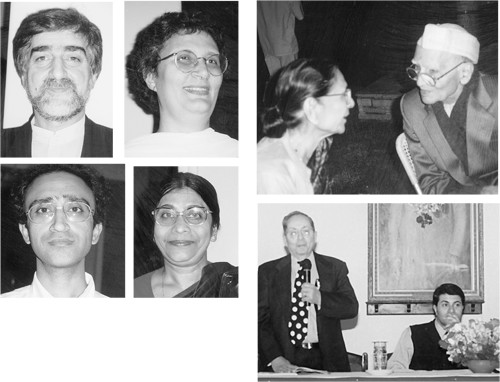
Clockwise from top left: Borujerdi; Dhunjisha; Ms Mehendale with Mehendale; Waghmar with Bhote; Mazumder and Rajgor
Historical vignettes
In the historical purview Aspi Moddie’s paper, "Toynbee and the historical lessons of the Sasanian state-church” refers to the "evolution from sustaining tolerance (of the Achamenians) to the self-destructive intolerance” of the Sasanians.
"Toynbee compares the success and failure of the Sasanian state-church, Zoroastrianism, with the coercive policies of the Maccabies in Judaism. Both failed to survive. Sasanian Zoroastrianism he says, ‘was never able to make (its) forcibly established church secure against raids on the part of Nestorian Christianity and other non-Zoroastrian faiths from beyond the frontiers,’” notes Moddie, a management expert with a flair for history.
Scholar-translator Farrokh Vajifdar’s "Kirdir, founder of Sasanian orthodoxy” revisits the priest who oversaw several coronations, acquiring almost a Rasputin-like influence on the royal Sasanian family. Attributing the current knowledge of the historical Kirdir, Mobedan-mobed enjoying supreme judiciary status, to Gignoux and Prof Oktor Skjaervo,Vajifdar noted that with the ascension of Bahram II to the throne, persecutions began with the imprisonment and death of Mani, the founder of the eclectic faith known as Manichaesim. "We should note that nothing less than forcible conversions to Mazdaeism were being performed amongst Jews, Buddhists/Shamans, Brahmans/Hindus, Nazareans, Christians, Baptists and Manichaeans. Idol-temples were destroyed and heresies and heterodoxies were extirpated — this, says Kirdir, wrought havoc among Ahriman and his demonic horde, and in turn brought great satisfaction to the Mazdaean religion and its priesthood, to the fires, the waters and to the cattle. With pride he reminds us that he piously performed many religious services (were these full-scale Yasna ceremonies?) and encouraged close-kin marriages.”
"Neo-Zoroastrian Hellenism in 15th Century Byzantine Empire: The Case of George Gemistos Plethon” traces the life of Plethon who according to Dr Michael Stausberg, research fellow at the University of Uppsala, was born in Constantinople in the second half of the 14th century and died nearly a century later in 1454. Plethon’s work dealt with finding "a universally accepted path to truth.” In his search for teachers from the past he chose none from the Judeo-Christian tradition but a number of Greek philosophers and a couple of Brahmans whose ideas harmonized together. "First in Plethon’s list of wise men stands ‘the most ancient of the lawgivers and wise men who is known to us,’ Zoroaster, who, according to Plethon, in a supreme way, had emerged as the interpreter of the gods and most other things among the Medes, the Persians and other ancient nations of Asia... In his appendix, Plethon explicitly states that one should follow Zoroaster’s teachings because they alone hold out the prospect of purest blissful happiness due to every human being. All the other teachings, on the contrary, that deviate from the teachings of Zoroaster and his followers from Plato down to Plethon, also swerve from blissful happiness, and the more they deviate from it the more they approach unhappiness, ignorance and deepest darkness.”
Though Plethon is "considered as the founder of a neo-Zoroastrian, Hellenic religion,” his religion is "quite a private affair,” notes Stausberg. "There are no traces of any attempts on Plethon’s side to spread the religion.”
In "Samba and the Hinduized Magi: fiction or history?” linguist and Gathas’ translator Prof (Dr) Helmut Humbach notes, "one could hypothesize that it was at the time of Alexander the Great that the first Persian Magi were invited to come to Multan to establish there a Sun sanctuary with a sort of an astronomical observatory. As a consequence the Samba legend would reflect a sequence of scenes at the margin of world historical events.”
In his "Note on Parsi Islamology” Burzine Waghmar examines the three Ahd namehs — two in Arabic and one in Persian — which the Zoroastrians claim were granted by Prophet Mohammed’s son-in-law Ali, giving the community the rights enjoyed by other "people of the book” viz the Jews and Christians. Questioning their veracity Waghmar, who is working towards a doctorate in Iranian and Central Asian Studies at SOAS (School of Oriental and African Studies), London, says that the Arabic Ahd nameh is written in a script which came into being much after the time of Ali. Apart from stylistic weaknesses Waghmar argues that the date of the Arabic Ahd nameh in 660 AC places it just a year before Ali’s murder. "The period between the Battle of Siffin in 657 AC and his assassination in 661 AC was the most turbulent period of Ali’s career as he was engaged in preserving unity as the caliph among dissenting tribal factions, both of Shi‘i and Sunni allegiance. It is all too unlikely that Ali would have expended time during a period of civil war, an era in which the future of the nascent Islamic community was at stake, towards fulfilling socio-legal formalities.” Quoting Abu Yusuf, Waghmar writes, "Due to a lack of a Quranic precedent for treating them as one of the scriptuaries, (Caliph) Umar was in a fix as to ‘how to treat these people who are neither Arabs nor People of the Book.’ However, they were grudgingly accepted based on a tradition preserved by ‘Abd al-Rahman b. ‘Awf that the prophet had accepted tribute from the Mazdeans of Hajar. Also, in a missive to Mundhir b. Sawa, the ruler of Bahrain, he had permitted them to practice their religion upon payment of the jizya (poll tax), and had declared, "treat them as you treat the people of the book,” with the caveat that meat slaughtered by them or marriage to their women was forbidden for Muslims.
"The grimmest commentary on the irrelevance of these Ahd namehs is evident in the observations of European researchers and travelers,” states Waghmar, arguing that unlike Jews and Christians who became rich and even briefly flourished in Moorish Spain and (Ottoman Turkey), the hazardous survival of the Zoroastrians remains "a sombre testimony of their fidelity” to their faith.
The possible reflections of Zoroastrian time reckoning in poet Jalal al-Din Rumi’s Masnavi-ye Ma’navi (the spiritual couplets) were explored by Dr Gernot Windfuhr, Michigan Univer-sity’s professor of Iranian studies.
"The role of Azar Kayvan in Zoroastrian and Islamic Mysticism” by Takeshi Aoki, a student of Islamic Zoroastrianism at Tokyo University, examined the role of one whom he estimates "an eccentric Zoroastrian priest.” Kayvan may have performed Zoroastrian ceremonies but had no rapport with other Zoroastrian priests, noted Aoki adding that Kayvan’s philosophy treads the path of the Sufi mystics rather than Zarathushtra.
In contrast to Aoki’s abstruse subject, Dr Eric Phalippou’s "An Indian conquest: the tale of M’mselle Menant” takes a dispassionate look at the middle aged French lady who spent nearly eight months in the city and province of Bombay 100 years ago and authored The Parsis depicting her as a victim of gentle manipulation.
With quiet humor Phalippou, who received his doctorate from Sorbonne University, delves behind the controversy regarding the pioneering of female education between Dosebai Cowasjee Jessawala, the first girl sent against great odds to be educated in a school by her mother Bai Meherbai in 1841 and Manackji Kharshedji’s founding of the Alexandra Girls’ English Institution in 1859. It is Kharshedji who is credited as pioneer of English education for girls by Menant. Phalippou indicates the pressures on Menant through her Parsi host Behramji Malabari who introduced her to K. R. Cama, Kharshedji’s son-in-law. It is significant too that Menant’s book and articles were translated by M. Murzban who was married to Cama’s daughter Freny, one of five young women admitted to the Grant Medical College of Bombay at the age of 20. After her initial medical graduation Freny Cama had proceeded to Paris with her lawyer husband Murzban to garner further knowledge at the Institute Pasteur, returning to India to provide the Cama Hospital with her new knowledge of vaccines. That is when the couple met Menant. Phalippou’s paper abounds with such vignettes of recent Parsi history.
Dr Kalpana Desai, director of Bombay’s Prince of Wales Museum further developed the theme she has been working on — the impact of the Parsis on the development of Bombay.
Linguistic impact
The many presentations on language and literature examined the impact of translated Indian literary pieces into Persian and vice versa. Persian’s long innings as an official language of India (from early 13th century until the defeat and externment of the last Mogul Emperor Zafar Shah by the British in 1857) led to large-scale borrowing of the Persian vocabulary by the Indian languages and the birth of the gentle hybrid, Urdu. It also led to an exchange of proper nouns and the movement of scholars and litterateurs between the courts of Iran and India leading to "intellectual development, enlightenment and refinement,” as notes Prof Nizamuddin Gorekar of St Xavier’s College, Bombay.
"The bilateral relations of Iran and India go back to the prehistorical period and the ethnic, racial and linguistic similarity and unification of these two Aryan nations could be observed within the texts of (the) Vedas and (the) Avesta which reveal similar thoughts and myths,” noted Abdulhadi Borujerdi, consul-general of Iran in Bombay. "Through India, glimmers of this cultural light reached other parts of Eastern and South-Eastern Asia. Thereafter India’s gates were opened (on her) western borders to let Islamic scientists and the educated elite find their way to the people of Asia and Farsi became the common language of all Asian Muslims,” he added.
Dr G. D. Shukla, retired head of the postgraduate department of history at Gujarat’s Sardar Patel University, made a historical appraisal of Persian literature during the Mughal rule in India. "The installation of Mughal rule in India was earmarked by two distinct phenomena. Sanskrit had more or less spent its force and modern Indian languages were then too weak to be effective... In due course of time, the Persian language slowly and steadily took the place of Sanskrit as a cementing force of the country and it held its own until it became effete and was given a violent jerk by the English language. The Hindus and the Muslims, during the period under study, vied with each other to learn this language and its literature. India thus produced Persian literature in all its branches and varieties which can be compared well with the literature of Persia. The Persian language contributed innumerable words to the vocabulary not merely of Hindi and Urdu but also of Bengali, Marathi and Gujarati languages,” he noted.
Dr Kulsum Abul Bashar Mazumder of Dhaka University and Dr Umme Salma further elaborated this influence of Persian on Bengali language and literature. Professor and chair of the Centre for Persian and Central Asian Studies at the Jawaharlal Nehru University Dr Sabar Havewalla related how King Nosherwan-e-Adil sent his scholarly and wise physician Borzuyeh to India to seek a herb for immortality. Borzuyeh could find no herb but he found a couplet of the Panchatantra. (One who reads, appreciates and follows this Nitishastra regularly, becomes undefeatable. Even Lord Indra cannot defeat such a person.) He translated the Panchatantra into Sasanian Pahlavi under the name Kartak Va Damanak which not only enthralled generations of Iranians but found its way to the west in the guise of The Arabian Nights and Aesop’s Fables. Later, when Emperor Akbar set his scholarly courtier Abul Fazl to the task of writing a fresh version of the Panchatantra in simple Persian to be understood by all readers, there emerged the Eyar-e-Danish. This was part of Akbar’s project of translating Sanskrit masterpieces into simple Persian, noted Havewalla.
Avesta Pahlavi scholar and practising mobed Ervad Parvez Bajan discoursed on the influences of Ferdowsi and the Shah Nameh on the Iranian nation. "His poem became like Divine Comedy, not merely a record of life but a critical insight in all elemental forces that sway it. The simplicity and majesty of Ferdowsi’s style, eschewing Arabic elements led to the rejuvenation of the Persian language; the magnanimity, gentleness, generosity, spirituality and lofty patriotism of the poet rubbed off on generations of his readers.”
Dr S. A. Upadhyaya, a director of Bombay’s Bharatiya Vidya Bhavan briefly surveyed the contributions of Gujarati writers to Persian literature.
Trade and currency
"Persia’s trade with T’ang China (618-907 AC)” was discussed in considerable detail by Dr Soonu Dhunjisha, a reader in history at Bombay’s S. N. D. T. College of Arts. Canton had a special office for the registry of ships, the control of exports and the collection of duties to cope with the large ships of Persian, Arab and Indian merchants, noted Dhunjisha. Not only were embossed vessels of gold and silver, clear glass in indigo and pale green, imported from Persia but Persian artisans and their Chinese counterparts produced Iranian style ceramics, textiles and a wealth of other crafts and artefacts. Persian exports set the style in China for clothes, food, music and household objects at the time, noted Dhunjisha.
Numismatics specialist Dr Dilip Rajgor spoke about the Sasanian elements in Gujarat numismatics. "Gold and silver coins of the Sasanians circulated within Indian borders and were legal tender for centuries.” Moreover, these coins became the prototype for successive currency in western India for over 700 years, he noted.
Valedictory observations
Taking off from Manohar’s inaugural remark about the Parsi boat people, noted economist Dr Fredie Mehta, presiding over the valedictory session, referred to the case of Cyrus who went to war to liberate the Jews. "The Old Testament speaks of not a single non-Jew with reverence, but Cyrus is spoken of as God’s Anointed.” Recalling Hitler’s Aryan pretensions he wondered "what would have happened if somebody had caught hold of Adolf Hitler in 1929, just before he ran amuck, and told him ‘please, are you aware that you are proclaiming that as an Aryan your duty is to wipe out the Jews.’ This is interesting because the letter which the Jews wrote to Cyrus says this: ‘O great Aryan, we call upon you to liberate us because you are a great Aryan.’ Hitler murdered the Jews whereas Cyrus looked upon liberating the Jews as an act of Aryanism because Arya means ‘noble.’” Paying tribute to the tolerance taught by Hinduism, Mehta noted, "Many of us Parsis cannot but recognize that it is this tolerance that has kept our temples alive. It is the tolerance of the Hindus who have never attacked our religion in spirit or in word. They have not really interfered with us in any way.”
In his address at the inaugural function the late chairman of the House of Godrej Sohrab Godrej had noted, "To me it comes as no surprise that Mahatma Gandhi thought highly of the Parsis, particularly of their philanthropy. How many in the century just past can claim to have lived up to the Zoroastrian dictum of good thoughts, good words and good deeds more than the Father of the Nation?” Developing the theme at the valedictory the late veteran Gandhian Dr Usha Mehta observed, "Mahatma Gandhi perhaps was one of the greatest apostles of peace and one of the greatest communicators and integrators who accepted and practised the virtue of non-violence... His non-violence was not merely a negative concept. It was not merely absence of violence, but it stood for love. Love that is pristine and pure. Love that stands for spitelessness and hatelessness. He tried to see that all communities received his love and affection.”
The large spectrum of topics discussed at the Congress had lent it a somewhat rambly air. As Irani noted in his concluding remarks, "I thought that we could be focussing on the Indo-Iranian influence upon the world, but instead most of the focus turned out to be either a focus on India or on Iran or the influence of one on the other. And when you talk of the influence of one on the other the most natural thing is language. And so we get a large number of very interesting papers on linguistic influences. This is what had happened at the last conference.”
In his vote of thanks on behalf of the foreign scholars Cereti said, "It is always an emotion for us to come to meet the community, to discuss with them, even if many times we have different views. And it is an emotion because coming here from Europe we meet a sort of miracle which is what you are. We meet a history. We meet ideas which have survived the fall of the Sasanid empire and we come from afar and we meet something which is a part of our history, our philosophy, our ideas... it is us! So far apart, but it is us! And it is something which has survived only because it came to India and it found a world which was more tolerant than what it was at that time in other parts of the world.” On behalf of the Indian scholars Havewalla noted, "Conferences teach us how to be patient, listen to each other and communicate. And this conference gives me great pleasure because without talking of national integration and international understanding, we do observe both of them with the utmost sincerity.” With floral tributes, mementoes and effusive thanks to all those who had had anything to do with the organizing of the Congress — especially Firoze and Katy Dalal who had not only provided lunch over the four days but also hosted a dinner at the Ripon Club — Modi declared the Congress closed.
◆ ◆ ◆
From the archive