
Events & Personalities
LSE honors Pandole
Noting that Dr Anahita Pandole "personifies the principles dear to the late Minoo Masani – a non-conformist conscience, courageous articulation and constructive citizenship,” the Leslie Sawhney Endowment’s (LSE) Programme of Training in Citizenship, Leadership and Public Service presented her a special award in memory of Masani on May 16, 2006 at the Indian Merchants’ Chamber in Bombay.
Pandole’s dogged fight to save old trees from the depredations of hoarding owners and advertisers who think nothing of hacking away at trees to increase the visibility of the advertiser’s message began with the filing of a public interest litigation in the Bombay High Court in 2002. What began as Pandole’s lone fight has since found support of various citizen organizations such as AGNI, Citispace and others, notes the citation, adding that the Court is yet to decide finally in the matter. The citation, read by LSE honorary advisor Arvind Deshpande, adds that Pandole has become "conscious of the essential contradiction between hoardings and trees.”
The gynecologist who is doing sterling social work for the Zoroastrian community via the Bombay Parsi Punchayet’s fertility clinic, helping couples initially unable to conceive to experience the joys of parenthood, was presented the award by the evening’s speaker, member of the National Human Rights Commission Justice Sujata Manohar. The former judge of the Supreme Court of India, and Chief Justice of the Bombay and Kerala High Courts who later addressed the LSE members and guests on the subject of reservations and affirmative action, congratulated the organization "for finding a really worthy recipient” and Pandole "for taking on such public duty apart from her busy professional work.”
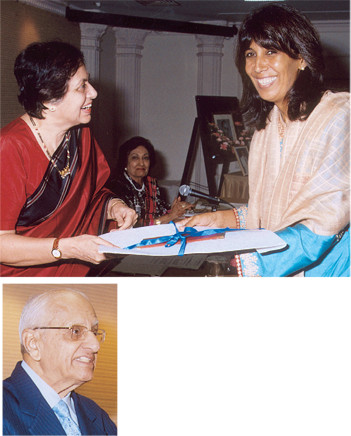
Manohar presenting award to Pandole (right); Shroff (left)
Photos: Taj Memories
Pandole noted that she had nothing against hoardings per se but when she found 50 trees hacked to improve visibility and got no response from the police or the municipality, she turned to the court. "Thanks to the judiciary and the legal system we have got so far.”
In his welcome address LSE president Minoo Shroff recalled the vigorous personality and managerial qualities of the late Col. Sawhney who was wed to J. R. D. Tata’s sister Rodabeh. Masani was a lawyer and economist who had originally dallied with communism "but later loathed state control,” recalled Shroff. Masani had seen the need for a viable opposition party at a time when the Congress seemed all powerful and helped form the Swatantra Party under Raja Gopalachari — the first Indian governor general after independence — familiarly known as Rajaji. He also introduced Manohar — an LSE participant in her time like the union railway minister Laloo Prasad Yadav – complimenting her for her "glittering career and unique achievement in a male dominated society.”
Ruing Masani’s absence, "for his willingness to listen to other points of view would have shed new light on this subject,” Manohar noted, "Any special provision (e.g. reservation) is against the concept of equality…There is clear recognition that the provision is a departure from the principle of no discrimination.” The founders of the Constitution had meant it as a short-term measure but they had failed to provide an inbuilt program for the reduction of reservation or for programs with a focus on empowerment, she observed. And politicians had taken the "easy path” of continuing and widening the policy of reservations for their own benefit. Referring to the program of human rights favored in the US where "benefits must be proportional to the restrictions imposed,” Manohar said, "I am not sure our policy of quotas would pass this test.” Noting that "equality, freedom to know, to express opinion are cherished values,” she added that "the spectacle of a lathi charge on young (medical) students was shocking.”
Referring to the high drop-out rate of students in primary and secondary institutions — 67 percent by class X, according to Manohar — and the question of reservation in private employment, Shroff noted, "employability is a crucial issue… India needs to take affirmative action in its own interests.”
A. S. M.
◆ ◆ ◆
From the archive