
Welfare
“Let’s do something positive...”
Schemes for the community’s physical, mental and reproductive health are being implemented by the Bombay Parsi Punchayet
With increasing awareness of the toll that stress takes of even the most natural human functions, the Bombay Parsi Punchayet (BPP) has launched a clinic cum counseling service to assist young couples plan their families.
The program was born of a fortuitous meeting between the BPP chairman Minoo Shroff and gynecologist Dr Anahita Pandole who says she volunteered to help when Shroff suggested "Let’s do something positive for the community.” Pandole and psychiatrist Dr Pervin Dadachanji constitute the professional team appointed by the Pun-chayet to help the community.
Given the Parsi proclivity to marry in their thirties rather than their twenties, four or five years of waiting for conception to occur could severely reduce the ability to generate a healthy family. Instead, the few short years of fertility left to the bride can be best availed by professional counseling of contraception procedures to ensure optimum spacing between children and early medical investigations, says Pandole. Preliminary meets with resident representatives at the Cusrow and Rustom Baugs have resulted in officials like Rustom Sethna, Naval Surti, Porus Turner endorsing the idea, states Shroff.
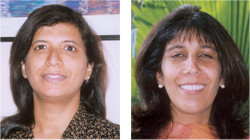
Dadachanji (left) and Pandole
In this first ever initiative in the domain of reproductive health, the BPP is aiming to help couples overcome problems that may stem from sociological, psychological or medical causes. According to its press release, the scheme will focus on
¤ Conducting initial interaction of young couples with a counselor and a gynecologist to make out any cause of male or female infertility;
¤Ensuring basic examination which will include sonography, semen analysis and requisite blood tests;
¤Evaluating and carrying out procedures to correct problems, if any;
¤Assisting couples to have healthy families.
The write-up states that the expenses incurred in providing these services to the community will be borne by the Punchayet. Its appeal to specific donors to sup-port the endeavor has already received a positive response from the Bai Maneckbai Jeejeebhoy Trust which has agreed to provide case by case support, BPP trustee Dinshaw Tamboly informs us.
According to Pandole, the basic investigations to ascertain the incidence of fibroids, endometriosis and other such conditions in females, varicocele, diabetes, smoking, etc which affect the quality of semen and impede fertility could cost anywhere between two to three and a half thousand rupees. Surgical or medical intervention, drugs to increase the count and quality of the sperm would be additional costs. Where all parameters seem all right but the lady still does not conceive, the gynecologist needs to resort to intrauterine insemination of the husband’s sperm, says Pandole.
Née Minina, the J. B. Petit School, St Xavier’s College and T. N. Medical College alumnus acquired her MD in gynecology in 1994. Married to Darius, a scion of the family that gave Bombay its prized Duke’s cold drinks for over a century, and mother of two school-going boys, Pandole has been a part of Bombay’s consciousness ever since she took up her pro trees, pro heritage sites struggle against the Bombay Municipal Corporation (BMC) which has been cynically flouting its own rules by permitting the construction of giant hoardings and willful hacking of trees to ensure visibility. Pandole’s dedicated and elaborate documentation of evidence helped noted senior counsel Iqbal Chagla convince the Bombay High Court to set aside and quash the report of the Municipal Commissioner and direct the BMC to remove all hoardings from Grade I, II and III heritage buildings and precincts within four weeks. The struggle, however, is not yet over, says Pandole.
The counsellor’s role
"My role is basically one of support,” says Dadachanji, as an alleviator of the stress that impedes conception, whether the cause be marital strife, the prospect of conceiving/not conceiving, relations with the extended family, etc. For example, when a supposedly childless couple adopts a child, the relief from stress could lead to normal conception, she notes. The role of the psychiatrist/counselor is even more crucial when a childless couple has no option but to opt for in vitro fertilization (IVF). When that fails, as it sometimes does, the financial drain coupled with the crash of expectations can be devastating, she tells us. Unfortunately, says Dadachanji, many middle class Parsis seem unaware that their problem may be one of blocked fallopian tubes, for example, and may be easily treatable, that IVF is not the only option when conception does not occur in the normal course.
One reason why Parsi couples remain unperturbed by the prospect of no children — and may even opt to avoid children — is that the community attaches no stigma to barrenness whereas even highly educated, successful professionals of other communities react to the social pressure with trips to the gynecologist within a couple of years of marriage. Also, the idea of children as an investment for the future is not a part of the Parsi ethos, notes Dadachanji.
The psychiatrist discounts the common concept of Parsi boys as "mama’s boys” and of Parsi women as aggressive. "The mother fixation is rampant in our country...the universal Indian thing,” she notes. "The mother tends to be more controlling of the single child, whether it’s a boy or a girl.”
Daughter of Gool and the late Behram Bharda, Pervin studied at the J. B. Petit School, K. C. College and acquired her MD in psychological medicine from the G. S. Medical College/K. E. M. Hospital in 1992. After brief stints as lecturer at Nair Hospital and work in the child and adolescent psychiatry department of London’s Royal Free Hospital, she set up her private practice eight years ago. Married to merchant marine chief engineer Darius Dadachanji, they have two school going children, Rehan (10) and Roshni (eight).
Shroff credits noted senior gynecologist Dr Mehroo Hansotia with initially acquainting him with the problem of infertility in the community. She had told him some years ago that the majority of cases coming to her to seek abortion of the first child were Parsis. An abortion reduces the future chance of having healthy babies. Shroff says Hansotia had told him that Parsis do not avail of professional advice to plan their families, wait too long for economic reasons. Genetic problems add to complications when pregnancy is sought at a late stage. Shroff hopes the BPP team (Pandole may be contacted on 9820130284; Dadachanji on 24924068/24946046) will be able to impress on couples the costs and benefits of having planned families.
Youth oriented policies
The BPP service, which will be open to Parsis from all over India, is a product of the Punchayet’s pro-youth policy slant, says Tamboly. Recently, at the Ness Wadia Club’s athletic camp where 300 youths participated, the BPP has committed five lakh rupees towards a year round athletic training camp for about 50 young Parsis, he notes, adding that a weeding out process will enable the more promising candidates to be identified for further grooming.
Apart from the problem of involuntary childlessness faced by a number of couples is the rising rate of divorce among intramarried Parsis. Statements by community lawyers specializing in divorce have led Shroff to believe that the community’s divorce rate is higher than 10 percent. Shroff notes that Justice Kety Bam, counsel Armaity Khushroshahi and others have told him that in the case of divorce proceedings in other communities marital counseling is compulsory. They have impressed upon him that though the Parsis do not face a legal compulsion, the community needs the provision of such a facility.
◆ ◆ ◆
From the archive