
Politics and Policy
The medium & the message
A double billboard erected near the main Doongerwadi entrance has sparked off a major community controversy with allegations of impropriety
For the double billboards put up this June at Doongerwadi, the controversy surrounding the advertising medium has overshadowed the products being promoted. More than increasing the Bombay Parsi Punchayet (BPP) coffers or advertising Maruti Suzuki cars, the two hoardings have raised the ire of community and environmental activists.
At a public meeting on June 18, 2007 at the Dr Sir J. J. Modi Memorial Hall at the K. R. Cama Oriental Institute gynecologist, nature lover and social activist Dr Anahita Pandole launched a broadside at the BPP stating, "Doongerwadi is a designated green belt which has to be maintained... (It) should not be seen as a commercial goldmine because it is not meant to be a profit making commercial enterprise… We shall battle in all legitimate ways and through all forums available to us to secure justice.”
Accordingly a petition was filed in the Bombay High Court by Pandole against various government authorities, the trustees of the BPP and hoarding contract winners Lewis Advertisers.
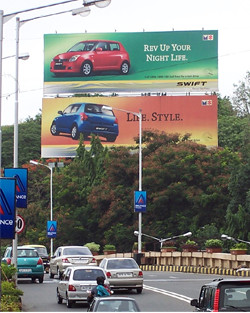
Hoarding at site
The court hearing on June 20, 2007 resulted in the judges ordering the Bombay Municipal Corporation (BMC) to file a reply by July 4, 2007 whether permission had been granted in consonance with recent Supreme Court and High Court judgments regarding erecting hoardings on heritage sites, among other requirements.
An evening prior to the court hearing the BPP trustees at a board meeting reportedly decided to abide by the court decision. Trustee Dinshaw Tamboly favored an "impartial inquiry” to be conducted into the awarding of the contract. It has been alleged the rate cited and the terms and conditions are all unfavorable to the BPP. Thirty lakh rupees income is expected in the first year.
The Jam-e-Jamshed Weekly of June 24, 2007 headlined their story on the controversy "The Great Doongerwadi Hoarding Scam!?” and went on to allege that Lewis Advertising run by BPP trustee Dinshaw Mehta’s friend Adi Davar had paid "a pittance of the market rent to BPP. A massive fraud has been perpetrated on the community!?” The article went on to claim that the agreement was printed on a stamp paper in the name of Vihang Advertising which is run by Amit Chandole of Thana. The Jamé further alleged that the agreement is signed by the BPP chief executive officer (CEO) Behram Dastur and not by any of the trustees.
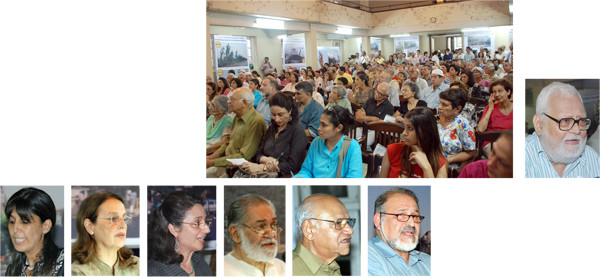
Above (L to R): Anahita Pandole, Pheroza Godrej, Meher Rafaat, Gerson da Cunha, Julio Rebeiro, Khojeste Mistree
Top: (L) Audience, (R) Adi Davar.
A Parsi executive in a leading billboard company who wished to remain unidentified stated the BPP should have received rupees seven to eight lakhs rent per month for the top hoarding alone. The lower one would fetch less as it was partially covered by trees. He was peeved that no opportunity was given to Parsi firms to bid and queried why an open tender was not called for. Though he had been in the hoarding business for many years he had never heard of either Lewis Advertisers or Vihang Advertising.
On the WAPIZ Page in the Afternoon Despatch and Courier of June 28, 2007, WAPIZ (The World Alliance of Parsi Irani Zarthoshtis) trustee Yazdi Desai called upon the six trustees "to step down gracefully before they are forced to leave the BPP board.” He also asked the Dastur to resign for allegedly signing "a one-sided 10-year hoarding agreement with an automatic renewal clause.”
Mehta refutes the allegations of fraud claiming that the details have been "twisted and distorted.” Permission was sanctioned in 2005 "by the whole (BPP) board,” he states. Other agencies were approached but only Lewis Advertisers could obtain permission from the Heritage Committee, he states.
The original rate agreed on was Rs 800 per square feet per annum which was subsequently raised to Rs 1,200. The amount will subsequently increase to Rs 1,600, says Mehta.
Lewis Advertisers reportedly applied to put up 13 hoardings from Doon-gerwadi to Khareghat Colony in 2002. Of these, only the one at Doongerwadi was granted permission.
The man behind Lewis Advertising, 63-year-old Adi Davar states the Jam-e-Jamshed and WAPIZ write-ups and Pandole’s charges are a "glaring distortion of facts… They are all biased one-sided… I am fed up.” In response to allegations that he corrupted people to obtain the government permissions, he states that it is not possible to bribe 15 people of stature on the Heritage Committee. "After two years I got permission.” He mentions that there are several bureaucratic layers in the BMC that have to grant permission aside from the Heritage Committee.
"All thought it was impossible,” he says. Once the Doongerwadi-Khareghat Colony precinct was declared a heritage area most hoarding companies gave up trying. Davar also hit a road block and turned the contract over to Chandole who managed to clear the final BMC hurdles.
"What is wrong if a contract is assigned to somebody else?” he asks. "One has to be practical… Don’t just sit and talk.” As regards the charge that the price is low Davar terms the allegation "as ridiculous.” The steel structure alone cost Rs 25 lakhs, he avers. As the Doongerwadi ground is rocky, drilling had to be done and the whole process of setting up the hoarding took around three weeks. "Chandole will sue (the BPP) for damages” if they renege on the contract, he remarks. As the matter is in court it will "take years and years for the board to come down.”
"Not a single tree will be cut,” Davar promises. But in order to "look after the trees” they may have to be "trimmed.” As regards the hoardings coming up before July 1 from when the "bhara (rent) starts,” Davar asks, "Is it an offence if it is ready before time? What is the crime? The rent will be paid for the whole of June” even though the advertisement on the hoardings was not displayed for the full month.
Davar states the Doongerwadi hoarding is not at a "premium” site. "Below the Kemps Corner flyover you can’t see the hoarding. From Peddar Road there is a 50 yards visibility.” A premium site requires "a very long range,” he says.
After spending so much money, time and effort surely the hoarding contractor is entitled to a profit? he asks. He notes the contract has "an escalation clause.” Permission for four hoardings at Doongerwadi was applied for but only one was granted.
As regards the billboards being on sacred grounds, Davar notes that social functions are held on a plot of land between Godrej Baug and Doongerwadi and there is a thoroughfare where the hoarding is erected. Isn’t all this sacrilegious, he queries, when people allege he has violated the religious sanctity of the area?
A chartered accountant who never practiced but made his living on the race course, Davar says he was not in the hoarding business but his friend, Tony Lewis, a wealthy man, was. When Lewis met with no luck in getting consent for the hoardings he asked Davar "why not get me the permission?” As Lewis Advertisers was a proprietary concern Davar saw no harm in using the name as his own. He says that "Dinshaw Mehta is my friend of 45 years but he has not helped me in any way.” Mehta wanted to augment the BPP coffers and pressured Davar to hasten the process, as the no objection certificate was given in 2005. At some stage Mehta told him to give it up as the Punchayet was not benefiting. But Davar persisted. He now believes that despite his efforts to transact a fair business deal "a big fraud has been played on me.”
The controversy over the hoarding first arose when Pandole was alerted about the billboard structures being raised at Doongerwadi. She rushed to the construction site and started to make inquiries on whose authority the hoarding was being erected. Mehta arrived at the scene and he and Pandole reportedly had a heated discussion on the subject. Pandole took umbrage at Mehta’s tone and manner noting that she had put in honorary work for the BPP’s fertility clinic and was endeavoring to preserve greenery and the sanctity of Doongerwadi.
In a letter dated May 28, 2007 to BPP chairman Minoo Shroff she alleged "the BPP had made crores of rupees through the sale of development rights” on its properties. She further stated that if the Doongerwadi deficit was annually a crore of rupees she would be willing to "to solicit funds on behalf of the BPP as has been suggested to me by one of the trustees… Doongerwadi cannot be turned into a commercial money spinner… I will urge you and your board members to reconsider your decision.”
In her notice of motion dated June 18, 2007 Pandole prayed the chief Justice S. C. Dharmadhikari "to set aside the permission granted... for putting up the double decker illuminated hoarding (and) take all necessary steps to ensure the removal of the hoardings.”
An affidavit filed by Pandole supporting her notice of motion states "no license has been issued and a hoarding has been illegally put up pursuant to a ‘no objection letter.’ The same is plainly illegal and liable to be revoked.”
Pandole went on to claim, (the BPP) "is one of the richest Trusts in the country and has no shortage of funds.”
* * *
"Inappropriate”
At the June 18 meeting at the K. R. Cama Oriental Institute representatives of several non-governmental organizations such as AGNI, Clean Air, Citispace, National Society of the Friends of the Trees addressed the gathering. "We now have hoardings in our city that deface our precincts, destroy the sanctity of our gardens, degrade the environment and worst of all trees continue to be hacked only to increase visibility of hoardings,” said Pandole.
"A number of favorable orders have been passed by the Bombay High Court and the Supreme Court which have resulted in over 150 hoardings being brought down from heritage buildings and precincts, the most conspicuous area being Flora Fountain ... However, implementation of each order is an ordeal in itself. More often than not the concerned authorities have shown reluctance to implement orders both in their letter and in their spirit…
"Despite protests to the BPP that it is inappropriate and I stress — inappropriate to construct a hoarding at the Towers of Silence, the response of the BPP has been that all the requisite clearances have been obtained. Our view is that this is not enough.”
President of the National Society of the Friends of the Trees Pheroza Godrej said, "I speak for the preservation of the greenery of Doongerwadi... For its sanctity, I speak as a member of the enlightened Parsi community that is known to be compassionate towards all living creatures of the earth, including trees...
"It is indeed noteworthy that we have gathered here today to protest against the hoardings erected (at) Doongerwadi. We do this out of a sense of duty, in the light of the natural scenic beauty which is being marred and barred from sight as also because of the trees that will eventually, as has happened in numerous cases, get chopped to enhance visibility of the hoardings…
"From the longtime point of view... we must systematically work together, to make Bombay hoarding free, just as Delhi has succeeded in doing through legislation.”
"Bombay, the commercial capital of India, is abjectly poor in open spaces,” stated social activist Meher Rafaat. "Whereas prescribed norms speak of four acres per thousand citizens in urban areas, we have — hold your breath — 0.03 acres. Open spaces in a city are directly linked with the physical and mental health of her citizens. It is unfortunate that crass commerce should outweigh health every time. That is why buildings grow, greenery dwindles and hoardings are allowed to gobble up trees and destroy visual vistas… (The trees’) ability to act as sponges and absorb excess rain water could avert the disasters of flooding…
"Let us send out a clear message that we the citizens of Bombay will not, in the words of the urban anthem Sounds of Silence, ‘Bow and pray to the neon gods’ of advertisement hoardings.”
Social activist and former advertising professional Gerson da Cunha told the gathering that "Hoardings have become a plague in Bombay. Nobody seems to realize that vistas, perspectives, a view of the sea and of precincts and buildings that give our city its character… all these are a citizen’s right. If we have a right to public space on the ground, the same must be true of the space immediately overhead…
"My first job in advertising was in J. Walter Thompson, Bombay. Its head, Peter Fielden, resolutely stood out against advertising use of the wall along the crematorium on Queen’s Road, now M. Karve Road. He said that it would be an offensive thing to do and that no advertiser could possibly expect consumer goodwill from use of such macabre media.”
The advertisement on the hoarding for Maruti Suzuki cars stating "Rev up your night life” planted in this place of repose for the departed would be hilarious if it were not also tragic,” he noted.
"Private property cannot be used to give public offence,” da Cunha said calling upon the BPP to cancel the contract and asking for evidence of the financial deficit the BPP was incurring.
Former director general of police Julio Rebeiro earned a round of applause when he volunteered to give Rs 1,000 from his own pocket to the BPP, if as the body claims it is "fund starved.” Rebeiro said that the hoarding at Doongerwadi was not an issue for the Parsis alone. "It concerns everyone of us who wants to see Bombay clean and green.”
WAPIZ trustee and community activist Khojeste Mistree though not among the slated speakers requested to address the gathering. He termed the issue a moral and ethical one. Aside from the threat to the environment from such hoardings he noted that "50 trees had been earmarked for destruction (at Godrej Baug for construction of a residential building) three of which are rare Egyptian branched palms.” He added that the BPP had agreed to try to save as many trees as possible.
◆ ◆ ◆
From the archive