
Books
Behind the baton
Leadership: Field Marshal Sam Manekshaw by Maj Gen (Retd) Shubhi Sood. Published in 2006 by SDS Publishers, 1709 Sector-29, NOIDA 201301 Pp: xx+290. Price: Rs 795.
Leadership: Field Marshal Sam Manekshaw by Maj Gen (Retd) Shubhi Sood. Published in 2006 by SDS Publishers, 1709 Sector-29, NOIDA 201301 Pp: xx+290. Price: Rs 795.
India’s first Field Marshal is a subject of abiding interest. There is no denying that the man behind the baton of the Field Marshal has undoubtedly been one of the most interesting and at times controversial figures in the history of the armed forces. Leadership: Field Marshal Sam Manekshaw is the second biography on one of India’s greatest military heroes. The first Field Marshal Sam Manekshaw: Soldiering with Dignity by Lt Gen Depinder Singh was published in 2002. Both biographies have been written by persons who knew the Field Marshal intimately: Singh was his military assistant and Sood was his Aide de Camp (ADC). Dr Samuel Johnson would have been pleased (even though he considered the writing of biographies a waste of time).
The latest offering by Sood is a charming account of the professionalism, easy demeanor, compassion and above all the sense of humor of Manekshaw, the hero of India’s victory over Pakistan in 1971. Manekshaw is a man with vision, competence,
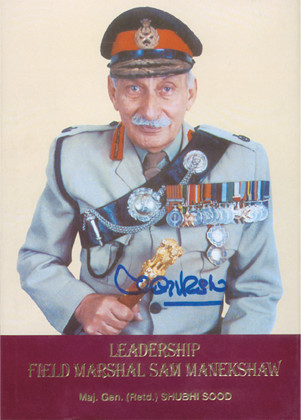
compassion and courage. That his ability to develop an instant rapport with his troops proved invaluable in raising the spirits of his soldiers and officers at a time when their morale was at its lowest after the 1962 debacle is well known. Sood writes: "He was humane and approachable and had time for all. He took great pains to ensure that no one in his command was harassed.”
Sood also tells us of his care and concern towards all those who had worked with him. He narrates the incident of his treatment of Mitha Singh who had imparted weapon training to Manekshaw in his youth when he came to meet him just as he was he was leaving to attend the governor’s ‘At Home.’ Manekshaw asked him to relax in the guard room saying that he would attend to his needs after he returned. Manekshaw was very respectful to officers and men, believing that the dignity of human beings must be maintained and respected irrespective of their station in life. Sood recalls being ticked off when he shoved an ex-serviceman who had pushed Manekshaw in the rush to meet him outside his office: "Do you not realize that one day you and I will also be in this plight!”
Sood who was posted as his ADC in September 1968 recalls how he sat in the seat next to the driver only to be told by Manekshaw: "You are my ADC and not my driver’s.” He further recalls how at the same time four dogs also got into the car. Manekshaw’s fondness for dogs was legendary. They would accompany him to the office and return home in the afternoon.
The book is an interesting anecdotal account of the career of an Indian military icon. Manekshaw’s various postings are dealt with in detail and it also contains details of the 1971 Indo-Pak conflict. There is also a reference to the incident with Lt Gen B. M. Kaul and Krishna Menon, which nearly destroyed his career on trumped up charges. Some of the details are to my mind superfluous. For instance there was no need to reproduce Manekshaw’s 1994 interview with Prem Shankar Jha on the Indo-Pak conflict in 1947, or Bangladesh’s proclamation of independence or the correspondence between Indira Gandhi and the Prime Minister of Bangladesh Tajuddin Ahmed. Similarly there are other military details which could have been avoided without detracting from the main narrative.
Apart from the well-known anecdotes about Manekshaw, Sood also comes up with some lesser-known anecdotes of a more personal nature in which he himself was involved. Manekshaw was very sensitive to people’s feelings. On December 9, 1971 Pakistan sank the INS Khukri. It was under the command of Capt M. N. Mulla who was related to Indira Gandhi and was the Research and Analysis Wing chief R. N. Kao’s brother-in-law. When Kao asked Manekshaw about the details Sood, proud of his information, butted in saying that Mulla had gone down with the ship. Manekshaw told Kao that they were not sure and later blasted Sood for being so insensitive.
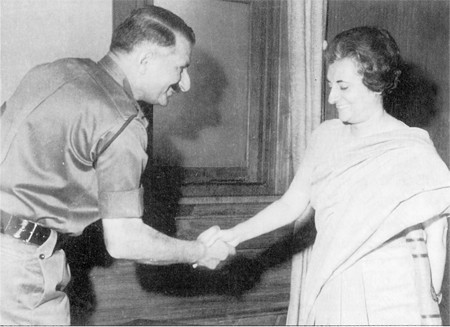
Indira Gandhi congratulating Manekshaw on the Pakistan army’s surrender in Bangladesh
Manekshaw was famous for his sense of humor and there are countless tales in circulation. While serving with his unit in Burma two of his men were caught by the Military Police in a house of ill repute. They were marched up to Manekshaw, their company commander, who found that only one was guilty while the other was just a sidekick. After berating the guilty party he dismissed him from his presence. A little later feeling that he had been too harsh he sent for him and asked him: "Tumhara paisa vasool hua (Did you get your money’s worth)?” When the soldier replied that the Military Police had landed up before anything could happen both had a hearty laugh. On another occasion a young officer missed an appointment with the area commander whom he was to escort into Manekshaw’s brigade sector in Firozepur because he was detained by his girlfriend. Manekshaw after giving him a piece of his mind softened the blow by saying that at his age he would have done the same! The pattern continued throughout his career: there was informality off the parade ground but an unprofessional attitude at work was anathema.
Maj Gen Shubhi Sood
But the best was reserved for the Australian officer when Manekshaw at the behest of Field Marshal Lord Claude Auchinleck undertook a lecture tour of Australia. After having heard Manekshaw praise the Indian army the officer remarked: "Colonel, I appreciate all you’ve said about how good the Indian army is but I wouldn’t want you to go away thinking that we Australians are anything less, in fact we are very proud of ourselves and our ancestors.” Manekshaw’s reply was devastating: "So you should be, you were selected by the finest judges in England.”
Manekshaw, known for his quick wit, also had the ability to say the right thing at the right time. When President de Gaulle died, Indira Gandhi went to attend his funeral. On her return, the three service chiefs had gone to the airport to receive her as was customary. When Indira Gandhi came to Manekshaw, he complimented her on her hairdo. She smiled, and said, "You are the only one who has noticed it.” His rapport with Gandhi was good and probably this is why he could get away with telling her that he was not ready for war when she wanted him to deploy his troops in April 1971.
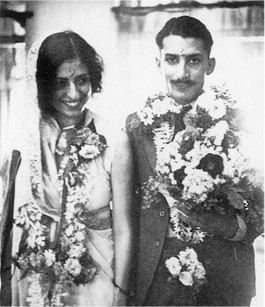
Though Manekshaw and Indira Gandhi shared a warm relationship, his relations with Jagjivan Ram was a little strained. When Jagjivan Ram tried to raise the issue of reservations in the Army, Manekshaw refused. He sent a reply saying that action should first be taken against him as the chief since he had not only failed to implement the policy but also was in full agreement with the actions of his predecessors.
It is quite apparent that this book is a labor of love. Though the biographer makes no bones about the fact that he is an admirer of the subject of his biography at no time does the biography degenerate into hagiography. The book however could have been better edited. The indiscriminate use of inverted commas is curious to say the least. On the whole Sood’s book makes for lively reading and is a welcome addition to the literature on a man whose first annual report read, "This officer, I beg his pardon, this man, may one day become an officer.” Manekshaw used to joke that not only did he make an officer but that they even made him chief. (He was not a Field Marshal then.)
◆ ◆ ◆
From the archive