
Events & Personalities
Vulture woes
Diclofenac, a widely used pain killer and an anti-inflammatory drug, used to treat both humans and cattle in India, is indirectly causing the death of Gyps vultures, according to research presented at the Sixth World Conference on Birds of Prey in Budapest and reported in The Bombay Samachar of June 1, 2003.
"Because of this problem I am sad to say that the Parsis would be very unwise to continue to consider using vultures to consume their dead. It may even turn out that the people who have been devoured have in fact added to the decline of the birds in that area,” conveyed Jemima Parry-Jones under whose guidance the Bombay Parsi Punchayet (BPP) was planning to proceed with its aviary project to breed vultures in captivity at the Doongerwadi. She emphatically added, "If you build avairies now and put vultures in them, unless you are absolutely 100 percent sure that no drugs containing Diclofenac have been used in the people who have died, your vultures will die within about 36 hours of eating the dead people. Not only would this mean that you are going to waste large sums of funds, it also means that you will add to the decline of the vultures and that would be completely irresponsible. Therefore I suggest that until we have the facts completely at our fingertips you hold off any building of pens to keep vultures...”
"Tissues of 23 vultures that had died with the gout symptoms all contained Diclofenac; none was present in tissues of vultures that had died of other causes,” conveyed Bob Risebrough’s missive, reporting on the Sixth World Conference of Birds of Prey, which was carried in The Samachar of June 15.
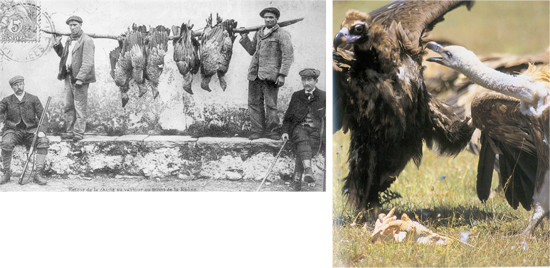
(Above left) Vultures hunted in France a century ago (Courtesy: Belvédère des vautours). Above: A Griffon vulture (recognizable by its long neck) sparring with a European black vulture (Courtesy: J. F. and M. Terrasse)
Michel Terrasse, another specialist on vultures whose 35 years’ efforts to bring back to France the Griffon vulture and the European black vulture was extensively reported in The Rolex Awards for Enterprise Journal (Summer 2003), wrote in response to Parsiana’s queries: "In reality I never believed that this kind of (aviary) project could work successfully when you know the great ability (of) vultures to forage very far in search of a lot of food and not only human corpses.”
In its May issue Parsiana had carried an article: "Taking wings: The aviary project for breeding vultures is once again on the anvil” based on the inputs received from BPP trustee Maneck Engineer, executive committee member of the Bombay Natural History Society (BNHS) Rishad Naoroji and Zoroastrian Studies founder Khojeste Mistree. Following the Diclofenac revelation Naoroji had promptly issued a clarification on his website: "the project is presently on hold.”
In the meantime, Parsiana readers keep sending us news clippings of the latest developments in this field: K. B. Antia of Hyderabad sent us a report from The Deccan Chronicle of September 16 which states that the scientists at Hyderabad’s Centre for Cellular and Molecular Biology are close to achieving artificial insemination in the White-backed vulture after taking time to distinguish a male vulture from the female and extracting the first semen sample!
On May 7, 2003, The Indian Express reported that an Indian Airlines flight was scheduled to carry a rare cargo: three long-billed vultures which were ailing at the Uttara’s Animal Rescue and Rehabilitation Centre in Katraj Zoological Park, Poona to Haryana’s Vulture Care Centre in Pinjore. Since the vulture population in India has fallen by 95 percent in the last decade, the BNHS is trying to save as many of these birds who are often found sitting glum and motionless at high altitudes for days after which they just drop dead. Starting with five vultures the facility hoped to increase the number to 40 in a few months. They were also planning to radio-collar five birds in an effort to identify their migration patterns and for this they are using an American satellite to track their movements.
The £ 148,000 Vulture Care Centre in India is supported by the Royal Society for the Protection of Birds, mentioned London’s The Times, noting that the facility was inaugurated by visiting British conservation minister Elliot Morley.
"Vultures in India used to be as common as pigeons in Trafalgar Square,” states the news report referring to the disappearance of vultures as causing "problems for the Parsis who dispose of their dead by leaving them on top of towers...The shortage of the birds has left strict adherents of the faith...in a dilemma.”
◆ ◆ ◆
From the archive