
Institutions
Dakhma despair
Dhun Baria's criticism stings the BPP into discussions with high priests and others
The community’s most emotive issue threatened the peace of the Bombay Parsi Punchayet (BPP) once again — the third time in six years. As noted the Punchayet chairman Minoo Shroff, "Everybody wants to know about the doongerwadi — even CNN and BBC. They are not interested in the positive work we are doing!”
The BPP is under frontal attack from the volatile Dhun Baria who storms the trustees’ board room and their private offices with impunity [unlike the high protocoled professionals of the Disposal of the Dead with Dignity — Action Group (DDD-AG) who confronted them in 2001]. Armed with much determination and photographs that she allegedly claims reflect the conditions within the dakhmas, Baria, like the DDD-AG, is gunning for an aramgah and the use of a bungli at doongerwadi with full funerary rites for those opting for cremation or burial.
Simultaneously, solicitor Berjis Desai’s Parsi tari arsi column in The Bombay Samachar is keeping the issue in focus since March 2006. Thus beset, the BPP summoned the clergy, led by the venerable Dastur (Dr) Kaikhusroo JamaspAsa, its doongerwadi committee members and the Parsi Press to its aid at short notice on May 3, 2006. What transpired was a dignified description of the problem of human disposal at the towers of silence and a restrained and practical approach adopted by the High Priests and other scholarly clergy aimed at maintaining the institution, except for Baria’s noisy but relevant interruption: "Today’s meeting has no meaning. It was called because of me but I was not invited to the meeting…I had told Mr Shroff, ‘Let us sit together…’” In Shroff’s phrase, Baria, who was eventually bundled out and the door bolted, is "on a rampage to reform” the system.
In its heyday, dakhmenashini was an ideal mode of human disposal. The vultures picked the flesh clean, the bones dried out in the sun on the pavis (open slot) and were then shifted to the bhandar where they remained until its capacity was reached. Thereafter the bones were buried in special pits in the vicinity, traditionally known as astodans, note old texts.
However, as the community is well aware, the dakhmenashini system has been increasingly jeopardized over the past 15 years or so (and even earlier as the late S. R. Vakil had found) by the decimation of the vultures in India due to the widespread use of the anti inflammatory drug diclofenac. Though supposedly banned in India, it continues to be available in the market. Shroff attributed its continued availability to the working of the drug lobby and said that the BPP had joined the Bombay Natural History Society in filing a public interest litigation in the Bombay High Court and had simultaneously sought Congress president Sonia Gandhi’s intervention on the executive front. "It will take time,” he admitted.
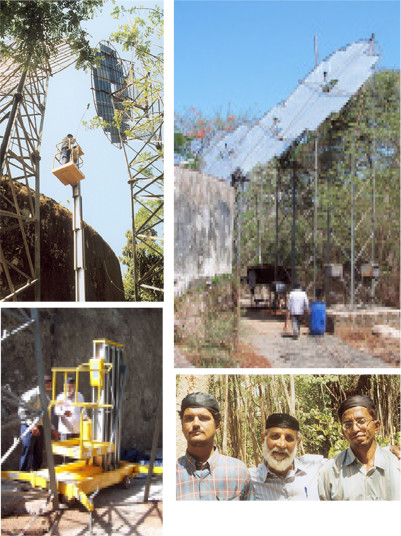
Since the controversy first erupted in 2000, the BPP is said to have installed 10 solar reflectors in three dakhmas to concentrate the rays of the sun to dry out the dead bodies. There are four in the Bisney dakhma, two in the Anjuman dakhma and four in the Sethna dakhma of which the position of one is said to be ineffective. (The huge Banaji dakhma has been out of use for over two decades or more as its contents are visible from the Grand Paradi apartments as also from a newer structure in the vicinity.) Installing a solar concentrator is said to take three to four months.
Placed on a gheyan (latticed metal bier) over a pavi, under the focus of a solar reflector, a body, depending on its size, is said to take three to five days to dry out under optimum conditions of clear sunlight and well maintained reflectors in perfect repair. However, as senior trustee Dinshaw Mehta informed the meet, ever since their dakhma overseer Cyrus Siganporia had an accident, there has been a decline in the efficiency at doongerwadi: "Things are not up to the mark. Six solar concentrators are working effectively. Two are closed for cleaning and two are having problems…The idea is to get the maximum utility of the sun’s rays… In the Anjuman dakhma we cannot get more than two solar spots.” He was optimistic however that "things will improve.”
Scholar Dr Homi Dhalla, who had been the initial proponent of the reflectors, noted that five or six weeks ago when he had taken an inspection, he had found that the reflectors had an accumulation of bird droppings which reduced their efficiency. Until a fortnight ago the Anjuman dakhma had been out of use (since November 6, 2005) for cleaning and installation of the solar panels, he added. "It is not possible to operate the solar panels when there are three funerals a day. Also, the dakhmas have to be periodically closed for cleaning.” If the Banaji dakhma is put back into use, there would be three dakhmas operating at a time while one is closed for maintenance, he suggested.
Pointing out that the cleaning has been done, BPP trustee Maneck Engineer wondered, "How effective are the panels? They have to be shifted manually (the reflectors need to follow the declination of the sun). Where do we find the manpower?” Shroff admitted the crux of the problem: "There is a serious difficulty in operating and maintaining the reflectors because an adequate number of Parsi staff is not available for the job.”
Moreover, with an average of three deaths a day, not all bodies can be accommodated under the reflectors. According to doongerwadi manager Jimmy Poonawala, bodies that are left to dry out without the aid of a reflector take 15 to 20 days after which they are removed to the bhandar. With the increasing concrete jungle around doongerwadi reducing the penetration of direct sunlight so that the natural drying process is no longer as effective as it used to be, and the regular evacuation of the pavis to accommodate new bodies, it was admitted that the earlier ones contain a residue of leelo naso (flesh) when they are shifted to the bhandar. There, with the weight of new additions, they tend to coagulate together until the bhandar is full, when they are removed to the astodans.
The trustees tabled a suggestion from Ervad (Dr) Ramiyar Karanjia, principal of the Athornan Boarding Madressa at Dadar, to create and use a chotra (unconsecrated dakhma) where more solar panels can be installed.
Illm-e-Khshnoom scholar Ervad K. N. Dastoor reiterated his request initially made in the Parsi tari arsi column: "Is it possible to tell the community what is really happening? Some people are creating doubts in the minds of the community regarding the trustees themselves. A sentence from you that all of you are committed (to upholding dakhmenashini) will help. Tell us what happens after the entry of the body in the dakhma…Do you (the Punchayet) ask people to opt for the solar spots or otherwise?”
"All of us are unanimously in favor of maintaining dakhmenashini,” responded Mehta. "We have given no instructions to ask (the community) to make a choice,” added Shroff.
Dastur Khurshed Dastoor, High Priest of Udvada sought the total number of pavis available to the Punchayet and was informed by BPP trustee Dinshaw Tamboly that the Bisney dakhma had 78, the Anjuman 87 and Sethna 67. A further 78 lay unused in the Banaji dakhma. The High Priest contended that with more than 180 pavis available, even without the solar panels, a high average of 90 ravans per month would get up to two months to dry out.
Reports of what happens elsewhere as well as some practical suggestions came to the fore. Dhalla informed the gathering that seven anjumans in India had installed solar concentrators and one of them was placing two bodies per pavi and the system was working. However, the anjuman in question was not placing the bodies on a gheyan. It would not be possible to accommodate two gheyans per pavi, Dhalla noted. The system of placing the body on a bier under the solar concentrator was evolved when it was found that the ravan’s body fat, melting under the heat, resulted in it getting stuck to the pavi – an eventuality that occurred even in the natural process of dehydration during the intense heat of summer.
"Use narrower gheyans inside the dakhma,” proposed noted counsel and vice president of the Athornan Mandal Ervad Nadir Modi. "Use lime or teflon to prevent sticking,” suggested Jimmy Mistry of Toronto who was invited to the meet. "We used a chemical powder but it created sludge and the khandhias started slipping and refused to go in,” Tamboly explained the genesis of the use of the gheyans. "Many pavis are not usable because they have become slippery,” added Mehta.
BPP CEO Behram Dastur said he had learned from Karachi Anjuman president Byram Avari that they were using four feet by eight feet mirrored stainless steel plates suspended over the walls of the dakhma. Installed by their civil engineering department, the system takes four days to totally dry out the body, he noted.
Ascribing the idea to Jimmy Mistry, Dastur (Dr) Peshotan Mirza suggested the installation of solar cells to conserve solar energy which could then be used at night. To ensure that no flesh remained on the skeletons that were placed in the astodans, Mirza also suggested that the bhandars of the operating dakhmas be emptied into those of non-operating dakhmas where high level concentrators could be installed to increase the heat. Shroff was aware that with adequate tuning the concentration of solar energy would pulverize bones in three hours, "but we’re not allowed. Another big constraint is finding Parsi volunteers.”
Everyone seemed to agree that the solution lay in more up-to-date technology. Extending the principle of the timer system governing self-cleaning ovens, Mistry asked, "Why not harness solar energy? Utilize it when the temperatures are lower. You don’t have to increase the heat. Allow the body to cool and then warm again to accelerate the drying process…The technology is here right now. There are very competent Parsi engineering companies. The same technology is used worldwide in the production of fertilizers.”
"We used the first flush of technology. Now it’s time to move on. If we can store the energy and work the system 24 hours, it would be a boon,” Shroff breathed more easy, though still worried about finding Parsi volunteers to train.
The three High Priests and other senior clergy present made no demur about any of the suggestions and practices cited. The lone objector was The World Alliance of Parsi Irani Zarthoshtis (WAPIZ) founder secretary Khojeste Mistree. As against the general trend of trying to solve the problem of human disposal at doongerwadi, Mistree felt, "We’re trying to press the panic button…It is theologically wrong to use the chotra instead of a dakhma.” He suggested an investigation of how Baria got her information and photographs (according to K. N. Dastoor she had told him that someone had left them in her post box). "Baria needs to get a legal notice. I’m sure there are laws to prevent people from creating disharmony… Where does she get the money to do all this?...” But the response was negative. "Everything is like a sieve in our community,” noted Shroff, adding that the photographs have been around a long time. Also, someone ventured that during the 26/7 Bombay floods of 2005, there were a lot of bodies floating around the city which may have been photographed. Seconding the approach of the BPP, Modi suggested that the Punchayet "ensure that the matter does not go into the hands of lawyers.” "We will go by the senior counsel’s advice,” stated Mehta.
The priests — with the exception of K. N. Dastoor — were however more cautious about informing the community of the nitty gritties, fearing it will become, in the words of Mirza, "a sentimental and emotive issue.”
Referring to the confrontation with Baria witnessed that evening, Modi asked, "It is a question of timing. Do you want to get in the Press before her or after?” An early statement to the Parsi Press (see "The BPP clarification”) to catch the Sunday columns was advocated by solicitor and BPP trustee Burjor Antia. While Shroff remained perplexed by Baria’s motives Ervad (Dr) Rooyintan Peer declared that the lady is "not interested in improving the system. She wants a bungli (for funerary rites for the cremated/buried)” and reminded the Punchayet of his written suggestion to provide such a place anywhere in Bombay for the purpose. Sighed Shroff: "She wants to become a martyr. She has nothing to lose…”
Baria’s crusade followed the death of her mother who was consigned to the towers. Being greatly attached to her mother she became a regular visitor to the doongerwadi premises where she used to sit and pray. Talking to people at doongerwadi she was informed that the bodies lay exposed for long periods of time as the solar concentrators were not effective. That galvanized the former Qwali singer to take up the cause. In a qwali performance, two teams sing in turn, each raising a question the other must counter. In her tussle with the BPP and the orthodoxy Baria has been putting her debating skills to good use.
◆ ◆ ◆
From the archive