
Environment
The vulnerable vultures
Whether left in the wild or reared in captivity, vulture chicks face a dismal future
"Thanks to a sharp-eyed local forest warden, we do find a nest — a haystack of twigs in a tall tree. Richard Cuthbert (a biologist with the United Kingdom’s Royal Society for the Protection of Birds) and Richard Wesley (manager of the New Zealand Alpine Club) toss a line over a branch, jousting amicably over who gets to climb. A (vulture) chick makes the question moot when it flaps nonchalantly over to join its parents on a neighboring tree. This chick has fledged; they’ll never capture it now. We watch the youngster in silence. It has escaped capture and a life of tedium in a breeding center — and fled to certain death,” writes Susan McGrath in an incisive article in the February 2007 issue of Smithsonian, sent to us by a thoughtful reader.
"Time is not on the researchers’ side as they race to capture vulture chicks before the birds die in the nest, poisoned by contaminated carrion. The odds of any young vulture living to breeding age in the wild is almost zero,” adds the author.
Although Cuthbert and an associate Shanmugam Saravanan, a biologist from the Bombay Natural History Society had permits to take eight long-billed vulture chicks from the Bandhavgarh Tiger Reserve in central India for conservation breeding, locating nests and retrieving the young ones was posing a challenge. The experts lay their sights on young birds as they adapt more readily to captive conditions than adults and also because once these birds start flying they are almost impossible to catch.
International conservation groups advocate the capture of long-billed, white backed and slender-billed vultures for conservation breeding. Ideally the recovery plan calls for a minimum of 25 pairs of each vulture species to be reared in each of the three breeding centers in northern India. But with nearly 99 percent of these wild vultures now gone, conservation experts fear their captive breeding goal is unlikely to be met.
"Just 15 years ago Indian Gyps vultures were thought to be the most numerous large raptors on the planet. In a single decade they’ve undergone the most rapid population collapse of any animal in recorded history,” Cuthbert was quoted in the Smithsonian.
With fewer vultures around, dogs are multiplying in India as they have more than enough to eat at dump sites where carcasses lie. Their numbers registered an increase from 22 million in 1992 to 29 million in 2003. And rabies, mainly caused by a dog bite, takes an annual death toll of 30,000 in India, more than any other country.
Another concern to the public health officials is the increasing rat population which shares the bounty of abandoned carcasses with feral dogs and raises the probability of outbreaks of bubonic plague and other rodent transmitted human diseases.
There is a fear of livestock diseases like anthrax and brucellosis increasing too in the absence of vultures which, being resistant to them, would earlier consume the contaminated flesh and thereby remove reservoirs of infectious organisms.
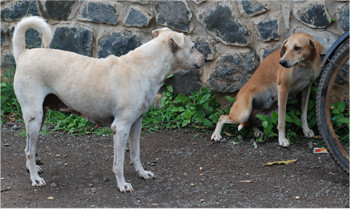
The absence of vultures has led to an increase in the dog population from 22 to 29 million in 11 years
That vultures feed in groups, nest in flocks and fly long distances was known to ornithologists. However it was with great difficulty that they were able to determine that visceral gout — a whitish paste of uric acid crystals covering the internal organs of the dead vultures — the cause of their mass destruction, was triggered by diclofenac, a pharmaceutical drug manufactured in veterinary doses by at least 40 companies in India. Diclofenac, a nonsteroidal anti-inflammatory drug used as a painkiller for decades in the West but only recently licensed for veterinary use in India, Pakistan and Nepal, was being freely used by herders to treat pain, inflammation and fever in livestock.
Once it was established that diclofenac was causing the death of vultures, Nepal banned the manufacture and importation of the drug in June 2006. In May 2007, India’s drug controller general directed pharmaceutical companies to halt production and sales of diclofenac within three months and Pakistan did so in September. Considering that vultures take five years to reach reproductive age and lay only one egg per season, "even if we got rid of all the (remaining) diclofenac tomorrow, the recovery would take decades,” explained Cuthbert.
Now that the big Gyps vultures are no longer around to elbow away the weaker birds from livestock carcasses, it is the smaller Egyptian and red-headed vultures whose numbers have started showing a significant decline as also the steppe eagles, kites and other scrawny avian scavengers who are believed to be poisoned. Why the deadly diclofenac kills birds but not mammals is yet not known.
Nature’s effective scavenger system now being wiped out, municipalities are per force resorting to burying or burning of carcasses, expending precious land, firewood and fossil fuels.
◆ ◆ ◆
From the archive