
In Memoriam
Through Tata's lens
Died: Sam Bejan Tata, 93, extraordinary photo journalist, after a series of strokes in Sooke, Canada, on July 3, 2005.
Tata’s arrival in Montreal, Canada in 1956 "coincided with a revival of the local artistic scene, especially in letters. He became the era’s unofficial chronicler,” writes Tom Hawthorne in The Globe and Mail (August 29, 2005), tracing the many achievements of the iconic photographer:
"Over the years, his work was displayed at countless shows, including at the George Eastman House at Rochester, New York. The Canadian Museum of Contemporary Photography held a retrospective exhibition in 1988 called The Tata Era/L’Epoque Tata.
"His images have been featured in several books, including A Certain Identity (1983), which took its title from the writings of (great French photographer) Henri Cartier-Bresson. A collection of 40 Tata photos formed an exhibit titled Portraits of Canadian Writers at the National Library of Canada in 1991. A book of the same title was published that year,” adds Hawthorne.
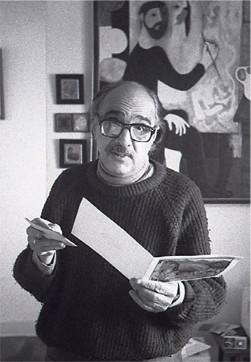
Tata was presented an honorary degree from Montreal’s Concordia University in 1982, states the obituary, adding that eight years thereafter he was conferred a prestigious lifetime achievement award from the Canadian Association of Photographers and Illustrators in Communications (CAPIC). He was also feted by the Canadian Center of Architecture in 1992.
After shooting freelance assignments for Maclean’s, Time and Weekend magazines, Tata went to work for the National Film Board, notes Alan Hustak in his tribute in the Montreal Gazette. "His first book, titled Montreal, was published in 1963. It featured a series of informal street scenes.
"Where the police photographer makes any man look like a criminal and where a portrait photographer can make any subject look important, Tata allowed his subjects to speak for themselves,” states Hustak quoting photographer Geoffrey James.
It was a technique he had learnt from French photographer Bresson, who became a friend and mentor and persuaded Tata to turn to photojournalism, says Hustak. Tata himself described what he learnt from Bresson as training "my lens on the world and (making) it my canvas... Bresson taught me to forget preconceived notions of photography, which was the same as telling me to throw out everything I had ever learned, and my previous success with it.”
"A reader with even a fleeting interest in Canadian literature has likely admired a Tata photo on a poster, dust jacket, or Leonard Cohen album cover,” writes Hawthorne. Even as Tata clicked his portraits of poets, artists, singers, writers and fellow photographers he built up a rapport with his subjects. Hawthorne quotes writer Mavis Gallant who spoke of Tata as "‘the most agreeable man I’ve met in years,’ while Hugh Hood noted his ‘extraordinary capacity for friendship with his subjects.’” In an essay about Tata’s portraits by John Metcalf titled Conversations Without Words the author wrote, "This is not to suggest that Sam is taciturn or laconic. While this silent conversation is going on between photographer and subject, Sam will be talking. He rarely stops. Sam is a Vesuvius of conversation, a walking compendium of quotation and reference, a cornucopia of anecdote.”
The eldest of Bejan and Naja Tata’s sons, Sam was born in Shanghai where Bejan managed a textile mill. Hawthorne pictures the opulence of the Tata household with its myriad servants where Sam was happy to remain until he married at the age of 40. He took up photography at age 24, snapping shots of the Chinese countryside with a box camera. A portrait of his brother taken with his father’s Graflex won second prize in a newspaper contest. By 1936, he had begun the formal portraiture and studio work that would occupy the next decade, Hawthorne informs us. He used a single floodlight in the studio, avoiding multiple lighting. "I had the idea that you have one sun, and that’s all you need,” he told Ovo Magazine in 1981.
The diminutive Tata, described as "quiet, unobtrusive, discreet,” made his way through the streets of Shanghai, documenting the Japanese occupation.
"His first visit to India from 1946 to 1948 was pivotal in many ways,” notes Sam Kanga of Montreal, a devoted admirer for whom Tata was a family friend. "The country was in upheaval, the transition from colonial rule to independence had been traumatic, and in 1948 Mahatma Gandhi was assassinated. It was in India that Tata’s attitude toward photography underwent its own revolution. His friend Kekoo Gandhi insisted he view an exhibition in Bombay by... Bresson,” Kanga describes a turning point in Tata’s professional life.
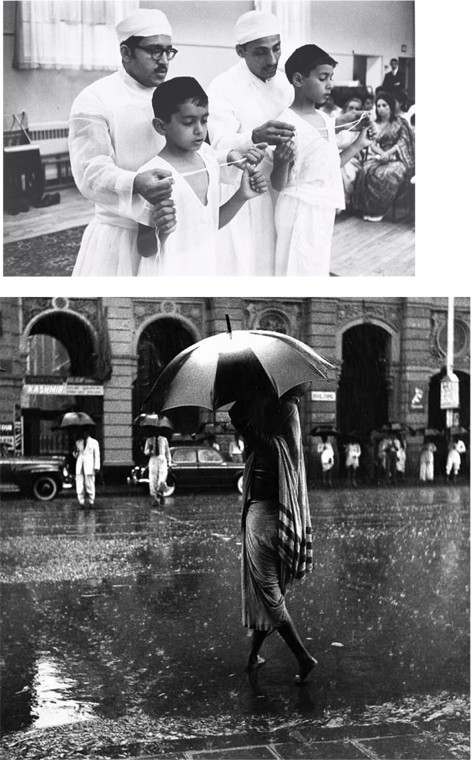
From top: Tata and his photographs of a navjote in Montreal (1969) and a coolie woman in Bombay (1948)
"The influence of Bresson was absolute. His method of photographing — quickly, decisively, and yet with sensitivity toward his subject, appealed immediately to Sam and he soon dispensed with his lights, large cameras and academic studio techniques. He had found his style,” states Kanga.
Tata returned to Shanghai in 1949 and remained there to document the fall of the Kuomintang, the takeover of China by Mao Zedong’s peasant army and the first years of Communist rule. Some memorable photographs, later published in his book, Shanghai 1949: The End of an Era, chronicles the human toll of revolution. "You know, the single person in the city is a lonely person,” he once told Ovo Magazine, writes Hawthorne. "Being lonely is one thing, but being alone is another. You can be alone and not be lonely. And I find that very often I am attracted to a situation where my eye picks out that one person — whether he is solitary, or in a crowd.”
In 1952, Tata married Marketa (Rita) Langer, a Sudeten Czech. (Their union would end in divorce many years later.) That October, the couple fled to Hong Kong. Four years thereafter they migrated to Canada.
"Tata called on his considerable charm to coax memorable portraits from even the most reluctant subjects. Tata liked shooting in a setting that put his sitters at ease, preferably at their home, amid their furnishings, using available light,” writes Hustak. Tata’s arrival in Montreal with his wife and young daughter Antonia, had marked a new phase in his life, one which registered increasing recognition as a professional and a man but, according to Kanga, less than he deserved.
"Being a Parsi, he was also involved with the Zoroastrian Association of Quebec, and often initiated discussions about the future of the Parsi community worldwide. It is because of Tata, that a photograph of a navjote is in the permanent collection of the Canadian Museum of Contemporary Photography,” writes Kanga who remembers Tata’s advice: "If you want to be a good photographer, not only must you know what is going on in the world, but you should know about painting, music, poetry and literature.”
Four years ago, suffering a series of strokes, Tata moved to Sooke, near Victoria on Vancouver Island to be close to his daughter. He is survived by his daughter Antonia, who is known as Toni. He also leaves a sister, Aloo Daver, of Hong Kong, brothers Phiroze Tata of London, England, and Jangoo Tata of San Francisco.
◆ ◆ ◆
From the archive