
Professions
Capture in color
Offering the latest in technology with good customer service, Parsi photographers have become household names in the community
"Usually the first person who comes to the function is the photographer and the last person to leave the venue is also the photographer,” observes Sarosh Daruwalla of Mazda Audio Video Lab who has been pursuing this profession for 23 years, commenting on how the photographer is entrusted with "a big responsibility to cover a function” like navjote or wedding which usually comes but once in the life of a person. But fortunately "the rate of a photographer messing up a function is not even 0.1 percent,” he clarifies referring to their commitment to give the best professional service to the clients.
"At the end of the day the couple may not be able to enjoy the function, lamenting that ‘mè aai nai joilu, né té nai joilu (I did not see this…that)’… A photographer has to make sure that nothing is missed out; that he captures all the memories — the attire of the bride and groom, the ceremonies by the priests, the hospitality of the relatives, the food in the patru, the bar, the band and the dancing,” stresses Homyar Mistry of Homz Prints who has been in the field for the last 28 years.
While competition among professionals is inevitable, there is considerable cooperation too and it is not uncommon to see a Parsi photographer being requested by another comrade who has two engagements on the same day to shoot and expose the rolls for him/her. "Everyone is doing well in the profession,” maintains Daruwalla and there is room enough for fresh entrants. Many don’t advertise but they are not lacking in patronage. The toils of the first generation are already being enjoyed by the second generation when photographers have offspring who choose to continue the vocation of their parents. When those established in the profession engage young Parsi boys as assistants to handle the lights and other equipment it could serve as an income avenue for those not academically inclined; almost like a cottage industry for prospective photographers to simultaneously learn and earn.
Photography for festive occasions being "seasonal work,” as remarks Armaity Bamanbehram who has completed 25 years in the profession, they are all very busy in the four winter months after Diwali. Thereafter examination schedules followed by the summer heat and monsoons force celebrations to take a backseat in Bombay. Having joined this profession when her husband Rashid was already an established press photographer, a camera constantly slung over his shoulder, she remembers those early days of their marriage when leave alone a mobile phone they did not have even a landline telephone connection. A business agreement today may begin over the phone but the Bamanbehrams make sure they meet both the parties (for a wedding assignment) in person to understand each others’ expectations. Unlike other communities Parsis are cost conscious so the ceremonies on the days prior to the wedding are usually shot by some family member. "With every Tom, Dick and Harry owning a video camera today, people prefer shooting themselves,” says Bamanbehram.
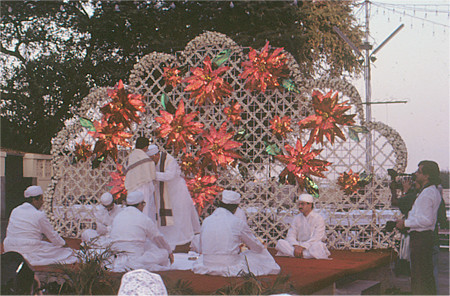
"One of the things I missed most at our marriage is a great professional photographer,” says Nazneen Khurshed Vajifdar of Spectravision Labs. This was way back in 1978. Realizing this importance, she began her career as a photographer in 1986. "Presently as technology advances, business gets better. We are able to give a lot more for a lesser cost,” she rationalizes.
Earlier when film rolls were in use a photographer would be very careful about wastage. With the arrival of digital cameras and the long-lasting chip, the cameraman is able to shoot many more frames for the client to sift through. Besides mixing images where the best combination from different frames can be put together, Mistry says that he offers his clients poster-like prints and superior quality studio pictures for which he specially carries a portable backdrop and studio lights to ensure that the final clarity is similar to the one obtained in a professional studio which in earlier days was visited by couples soon after their wedding. "The advent of digital photography has given a boost to the photography industry but it requires three times more effort in terms of time, knowledge and money,” conveys Mistry. Investment of one lakh rupees in upgraded technology would last for three years at the most. Not only should the photographer be familiar with the latest software he should have the time to blend the visual and sound tracks so that the customer gets a perfect package.
"The sky is the limit for creativity” but it is only during off-season time that professionals get a chance to concentrate on their editing work at the computer. The DVDs therefore are delivered months after the assignment causing annoyance to many customers who feel the interest in the subject has waned by then. Depending on whether a customer is based in India or abroad, a photographer has to offer a different video format to make it compatible with the client’s playback system.
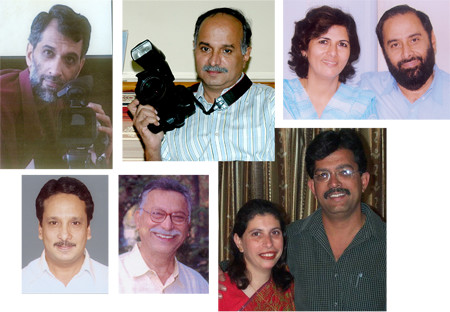
From left (top row): Homyar Mistry, Rustom Havewalla, Armaity and Rashid Bamanbehram; (below) Cherag Mevawala, Farrokh Hathiram, Shernaz and Temton Dumasia
"Earlier I was at the mercy of the laboratory. Now I can get what I want. Each photograph has to be edited and corrected for a digital camera can give a fairly good picture but not a perfect one,” states Rustom Havewalla of Fram’s Photos and Video. "Matt finish is never used for industrial or commercial photographs; it is always glossy. I offer a special album using polypropylene instead of PVC plastic sheets. This ensures that oil/moisture from the plastic does not create bubbles and cause the photograph to stick to the plastic sheet.” He takes a lot of care over his photo albums on CD too where a CD commences with the opening of an album and the pages turn automatically. Besides showing the navjote invite and the parents of the child, photos of the initiate as an infant and during the formative years serve as a prelude to the navjote. When presenting a navjote CD which can become boring, without disturbing the prayers in progress, there is a voice-over explaining the significance of the navjote and prayers, the importance of certain rituals, the stress on ecology in Zoroastri-anism…and after the gaiety and revelry, ending with gratitude to all those who have contributed to the success of the function. Believing that the rules of the religion should not be broken when the situation is not in favor of photography, he maintains, "I don’t want it to be a documentary or a home video. I go through a lot of pain…sweet pain which gives me rewards.”
"We shoot on HD (high definition) cameras which open up a world of possibilities in terms of colors, sharpness and resolution. A backup of the data on DVD-9 allows us to put three hours of video onto one disc. Besides our own proprietory web system known as Photo Net permits clients to see their pictures even before we give them prints,” according to Hutoxi Bomi Patel of Superstar Video Labs who has been in the business for the last 20 years.
Using software like Studio 9, Pinnacle, Vispi Tumboli of Roving Eye who has been shooting since 1986 says the editing and dubbing facilities now are infinite. With features like superimposition and sound-on-sound mix, his digital albums offer an interesting mix.
"We have to keep up with the times,” states Temton Dumasia who with his wife Shernaz has been running Foto Flash Video Labs since 1992. Besides shooting on a digital camera they also feel the need to use the best of lights unlike "the harsh lights earlier which got people agitated and made them conscious when shooting was on.” The personal presence of a photographer being necessary, he mentions how he does not believe in subletting for an assignment and despite a back problem insists on accompanying his cameraman.
"I don’t do digital photography,” candidly confesses Farrokh Hathiram of Galaxy Videokrafters maintaining, "I’m comfortable with a film camera and can give better results than digital shooting.” Being in the field for the last 26 years, when he is not busy with his own engagements he undertakes assignments for other photographers on a commission basis. Under the banner of Galaxy Digital Photos he uses his son Hormazdyar’s computer hardware knowledge to design and produce Zoroastrian photos and artifacts.
Most of the Parsi photographers have a large clientele from the community with whom they enjoy almost "a family relationship.” Whilst the cameramen believe in customer satisfaction, in return they are able to ensure photographer loyalty as invariably the person shooting for the parents’ wedding is approached for the children’s navjote too. All the photographers are happy that the Parsi ceremonies do not drag on endlessly. Among non-Parsis, a videographer and a photographer are among the first to be booked for a function. Non-Parsi clients who expect a wider range of service are usually very hospitable, insisting "aapri saathé jami léjo (dine with us)” lest you have no time later on; Parsi hosts would usually say, "tamé jami né jajo (dine before leaving)” — a subtle difference. Notwithstanding such minor irritants, the photographers vouched for the cooperation of their Parsi clients, were appreciative of the respect they earned, their prompt payments, and summed up: "Parsis are the best.” "Parsis are a class apart.”
With a largely non-Parsi clientele ever since he shifted base from Bombay to Poona, Cherag Mevawala who operates in the name of Dolly Photo Studio elaborates, "As paymasters there is a difference among Parsis and other communities. Parsis usually set a budget for the photographers” but non-Parsis will not restrict themselves and allow their bills to tot up high amounts. Payments then get delayed.
For a video shooting assignment the charges may vary from Rs 4,000 to Rs 15,000 depending on the videographer and the features he/she offers – CD, DVD, digital album… For print photography the rates may vary from Rs 18 per print to Rs 30, depending on the size of the print, the number of rolls used, the quality of the album and the reputation of the photographer.
Gone are the darkroom days and chugging of heavy video equipment and keeping a ready stock of film rolls. The usual query to novices, "Film chhè ké camera maa (is there a roll in the camera)?” was earlier considered a joke but has now become a reality. This constantly evolving preoccupation brings in "good money, contacts and satisfaction,” sums up Daruwalla. "What starts as a hobby, becomes a passion and ultimately a profession.”
Digital Dilemma
In response to a query whether it is safe to go 100 percent digital, Rohinton Mehta, technical editor of smart photography, advises in the wedding photography special issue (November 2006): "If something has to go wrong, it can… Is it 100 percent safe to cross a road?...
"Accidents do take place even with film cameras — a film could be bad, a lab could process the film in wrong chemicals, the film could get scratched while drying, the processing machine could physically break down or develop some fault in the middle of the processing, electricity supply could shut off leading to wrong development of the film, stray light could hit the exposed film before processing or worst, the film could get lost.”
For a digital camera, "there are image retrieving software available. (With a damaged film negative, chances of image retrieval are very remote.) Using such a software, you could retrieve the lost images. Of course there is no 100 percent guarantee but then, is there a 100 percent guarantee to anything in life?
"Always use a genuine memory card. Since it is difficult for an end-user to know whether the card is genuine or not, buy it officially (with a bill) from an authorized distributor. Make it a point to ‘format’ any card after inserting it in the camera. A card formatted in an ‘X’ brand of camera should not be used in a ‘Y’ brand camera unless it is ‘re-formatted’ in the ‘Y’ brand camera.
"When transferring images to your computer, make sure that the battery has sufficient power. If the battery dies down in the middle of a transfer, it is possible for the card to go bad. Also ensure that the connecting cable does not come off either end during data transfer.”
◆ ◆ ◆
From the archive