
Books
A homage to values
Horizons: The Tata-India Century, 1904 - 2004 by Aman Nath and Jay Vithalani with Tulsi Vatsal. Published in 2005 by India Book House, Mahalaxmi Chambers, Bhulabhai Desai Road, Bombay 400026. Pp: 358. Price: Rs. 3,000.
Horizons: The Tata-India Century, 1904 — 2004 by Aman Nath and Jay Vithalani with Tulsi Vatsal. Published in 2005 by India Book House, Mahalaxmi Chambers, Bhulabhai Desai Road, Bombay 400026. Pp: 358. Price: Rs. 3,000.
Horizons: The Tata-India Century, 1904 -2004 is a comprehensive and sparkling record of a hundred years in Tata and Indian history. Authored by Aman Nath and Jay Vithalani with Tulsi Vatsal, this lavishly illustrated coffee-table tome narrates the Tata history year by year for 100 years — from 1904 to the present — interspersed with rare archival photographs as well as spectacular panoramic vistas by photographer Amit Pasricha.
The year 1904 holds special significance for the House of Tatas. It marked the death of the founder and visionary Jamsetji Tata, and the birth of two successors who built it into India’s largest industrial house, J. R. D. Tata and Naval Tata. The book commemorates the death centenary of Jamsetji Tata and the birth centenaries of J. R. D. Tata and Naval Tata. It interweaves their industrial struggles and achievements with their constructive philanthropy and social commitment. It also contains lighter moments in the form of personal anecdotes and memories. Most importantly, the Tata story is directly juxtaposed with the history of modern India also presented annually, allowing the reader to make connections between two parallel narratives.
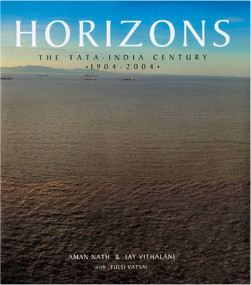
Business histories tend to be boring affairs but Horizons is different. Both in content and presentation, the book matches the best of international standards. The real value of this lavishly produced coffee-table book lies in its breathtaking photos and visuals. Each year from 1904 to 2004 has been discussed separately on a double page spread — the page on the left highlighting the important events in India that year, while the one on the right traces the history of the Tatas. Though the narrative in parallel juxtaposing Indian and Tata history is initially appealing, after a while I found it a trifle tedious and distracting. I read only the Tata history abandoning the Indian bit for later. It would have been nice if an attempt had been made to link how certain developments in the history of the country affected the Tatas.
The language of the book is simple and lucid, and the book should interest every type of reader, not just one interested in corporate history. It is competently researched but anyone who has read R. M. Lala’s books would find very little that is new in Horizons as far as Tata history goes. Enchanting as the book is, I spotted a few mistakes, which with a little more care in the editing stage could have been obviated. The authors have miss-spelt Bhikaiji Cama’s name as Bhikaji Cama. It is a common enough error but unpardonable in a book of this class. Another careless slip is the reference (in the photo caption on Rajkumari Amrit Kaur) to Nehru’s year of birth as 1887. One would have thought 14 November 1889 a famous date, at least in India. And it is K.S. Duleepsinhji and not M.S. Duleepsinhji.
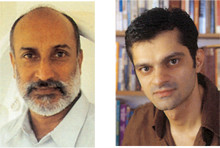
Nath (left) and Vithalani (right): a lavish Tata tome
Also, I was a little surprised at a reference to the eminent engineer-statesman M. Visveswaraya as an industrialist. To say that J. R. D. Tata was the second industrialist after M. Visves-waraya to be awarded the Bharat Ratna is incorrect. JRD was the first, and remains the only industrialist till date, to win India’s highest civilian award. But the most inexcusable error is turning Hindi cinema’s most famous villainous character Gabbar Singh (of Sholay fame) into Gabbar Khan. A quibble perhaps, but it is slips such as these that prevent a good book from becoming a great one.
The book which is a fascinating account of what is unarguably India’s most revered brand name, has numerous photographs that most will never have seen before. Some of the ones from JRD’s flying days are charming (and if I am not wrong have been reproduced here for the first time). Some rare photos of the Tata family are also reproduced in the book. There are images of the one anna coin introduced in 1907, of English women in sola hats on a cheetah hunt, of Gandhi as a barrister, the 1911 Delhi Durbar, the delightful Maharaja advertisements for Air India, the Tata boardroom, of the Ratan Tata collection at the Prince of Wales Museum (now the Chhatrapati Shivaji Vastu Sangrahalaya) — the list is endless. Some of the panoramic views are also breathtaking — dams in the Western Ghats, tea estates in Munnar, the Howrah Bridge and the salt works at Mithapur. The book has visuals of letters, documents, plans, newspapers, cartoons, will and codicils which bring a delightful authenticity to the text. (In one of the letters Indira Gandhi thanks JRD for sending her some Lakme perfumes but makes the rather dishonest admission that she normally never uses perfume!)
The Tata name has over the years come to be known much more as a synonym for trust than wealth, and this finds ample reflection in the book. The spirit of this remarkable industrial house that invested in humans more than perhaps any other gets reflected in the numerous incidents and anecdotes mentioned in the book. Jamsetji Tata had once said: ‘If you want to plan for 30 years, plant trees; if you want to plan for 100 years plant men.’ Jamsetji Tata, JRD and Naval Tata among themselves shaped a destiny that not just affected the Tatas but millions of Indians. The history of the Tatas runs parallel to that of India’s not just because they manufactured steel, and much else later, but also through institutes they helped set up — Indian Institute of Science, Tata Institute of Social Sciences, Tata Institute of Fundamental Research, and National Centre for the Performing Arts. Each is a pioneering effort that has helped set a benchmark for the rest to follow.
Ultimately, Horizons is not a book about the House of Tatas. Nor is it a chronicle of a century in which India gained political and economic freedom. Instead, it is a homage to values. It is a reflection of the aspirations of the founders and their heirs who always stood for trust and thus have been the recipients of unbridled respect. The book reflects the progress made by a business-house, which never looked upon itself as anything but a creator of wealth. To this day the name ‘Tata’ evokes trust, reliability and integrity.
In his foreword to Frank Harris’ book on Jamsetji Tata, JRD wrote that ‘the wealth gathered by Jamsetji Tata and his sons in half a century of industrial pioneering formed but a minute fraction of the amount by which they enriched the nation. The whole of that wealth is held in trust for the people and used exclusively for their benefit. The cycle is complete: what came from the people has gone back to the people many times over.’ Nothing testifies more eloquently to the relevance of JRD’s poignant words than the tales in Horizons. It is certainly a book that one would want to have on one’s bookshelf (and center-table).
◆ ◆ ◆
From the archive