
In Memoriam
Pioneering photographer
She sat by herself, a solitary, self-contained figure in the cavernous foyer of the National Centre for the Performing Arts (NCPA) watchfully observing the passers-by. One would have liked to sit next to her to chat but the octogenarian was hard of hearing. An hour or so earlier she had spoken along with her biographer Sabeena Gadihoke at one of the sessions organized by the Delhi based Parzor Foundation and the Parzor UNESCO Project that helped propel her to the national spotlight. Gadihoke amplified into Homai Vyarawalla’s ear the questions raised by the audience. She answered them with enthusiasm.
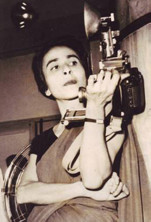
Around ten years later this remarkable photographic chronicler of India’s transition to an independent nation was awarded the Padma Vibhushan for her historic documentation. Her photographs that captured the intimate and public moments of the nation’s leaders and their British counterparts are now part of the country’s rich historic heritage. When she died on January 15, 2012 at the age of 98 in Baroda the national media paid tribute to the woman who was probably the first professional woman photographer of the country.
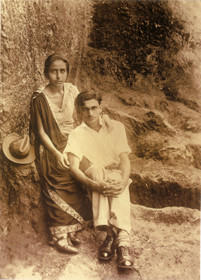
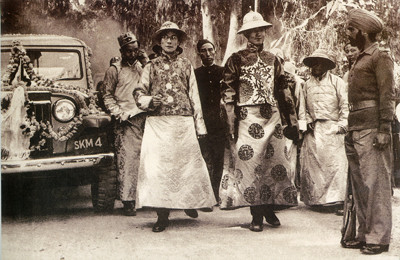
Homai Vyarawalla (top and above left) with Maneckshaw in 1931; (below right) her photo of the Dalai Lama and the Panchen Lama stepping into India
It was through the efforts of Gadihoke and Parzor founder Dr Shernaz Cama that this forgotten lady residing in Baroda came to public attention and acclaim. As Ava Khullar, Parzor’s executive council member and trustee of the Delhi Parsi Anjuman (DPA) observed, "after a tragedy which took away her husband Maneckshaw (in 1969), who was her partner, co-worker and lifetime friend, she packed up her camera and left for a retired life in Pilani and then Baroda with her son Farouq (a lecturer, who succumbed to cancer in 1982). She would, in her no-nonsense humble way have remained unrecognized if Shernaz, while researching Parsi history and heritage in Gujarat, had not met Homai in Baroda at the instance of Dhun Bagli… Shernaz and her team held the first exhibition of Homai’s work in the basement of the Delhi Anjuman’s Bhiwandiwalla Hall in 2001 on the occasion of the 40th anniversary of the Katrak Dar-E-Meher and gave Homai her first public exposure. From then on there was no turning back. Parzor took her under their wings and commissioned Sabeena, an independent documentary filmmaker who had earlier included Homai in her short documentary film Three Women and a Camera, to write her biography. The result was the beautiful pictorial coffee table volume, Camera Chronicles of Homai Vyarawalla.”
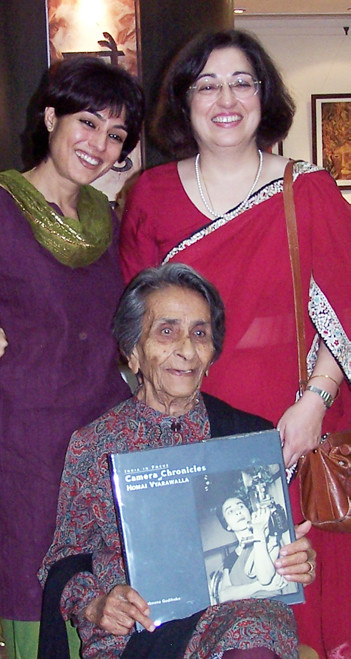
Homai Vyarawalla with Sabeena Gadihoke and Dr Shernaz Cama
After Vyarawalla’s passing away the DPA and Parzor jointly held a condolence meeting on February 18, 2012 at the DPA auditorium. Madan Metha representing the famous Mahata Studios, well-known in pre-independent India, recalled at the condolence meeting how Vyarawalla who lived close to the Studio would spend long hours watching the laboratory assistant and learning from him the finer nuances of photo processing, enlarging and printing that subsequently gave her and Maneckshaw the confidence to develop photos in the bathroom of their small flat.
.jpg)
Pratibha Patil (center) presenting Homai Vyarawalla the Padma Vibhushan in 2012
The Vadodara Parsi Panchayat (VPP) convened a condolence meeting in her honor at their Godrej Hall on January 22 that was attended by the mayor of the city Jyotiben Pandya, former mayor Jatinbhai Modi, police commissioner Satish Sharma and municipal commissioner Ashwini Kumar. Commending Vyarawalla’s simplicity and purity Pandya repeated the photographer’s philosophy, "Good work is manushya’s jeevan. Work done from the heart always gets success.” When VPP president Baman Cama requested the mayor to create an enduring memorial in the city in honor of the dedicated lensman, she named the new garden in Channi Nava Yard area after her on January 30, 2012 which was considered a fitting tribute to the lady who valued tranquility, plants and the sun.
Only a week prior to her demise the VPP had felicitated the lady on winning the Padma Vibhushan and had marveled at her grit to sit on the podium for more than two hours on the cold and windy January evening with only a light sweater and shawl protecting her frail, bony frame. Even the chief guest Justice Jamshed Pardiwala commented that it was "a prestigious moment” in his life to share the dais with the star of Vadodara, as noted a write-up by Meher Ginwalla, editor of VPP’s newsletter Zend. "This little known legend…lived in our city in semi oblivion till she received the Padma Vibhushan which was when most of us opened our eyes to her talent, her achievements and her international fame,” conveyed Ginwalla.
When addressing students at Harvard University in USA and the University of Westminster in London the nonagenarian had acknowledged that she learnt the art of photography from her husband who supported her ambitions, willingly shared his Rolleiflex camera with her when they were on joint assignments and whom she considered as one of the pioneers of photojournalism in India, reminisced Soonu Engineer. As a dutiful wife and mother, she ensured that she had completed her household chores, even standing in a queue for milk at 4.30 a.m., cooking and cleaning before leaving for work at 7 each morning.
Once the couple had relocated to Delhi in 1942 as employees of the British Information Services they were regulars at political events and social functions. Simply addressed as "mummy” by the first generation of independent India’s photographers she deemed it a privilege that C. Rajagopalachari described her as "a new phenomenon” and Dr S. Radhakrishnan termed her "princess” or "my lady friend.” In her eagerness to get a vantage point as a photographer, she would perch herself precariously and at the last press conference of Mohammad Ali Jinnah in 1947 before he left for Pakistan, she brought the proceedings to a halt when she fell with a thud. There were other occasions too when she had fallen as when shooting Ayub Khan and the Shah of Iran; when the Pontoon bridge collapsed during the Mahayagna in 1942; when she was thrown off her bicycle at the gate of Sardar Vallabhbhai Patel’s residence. An admirer of Pandit Jawaharlal Nehru and Indira Gandhi, she candidly admitted that she voted against the Congress party for the first time in her life when irked by the infamous Emergency.
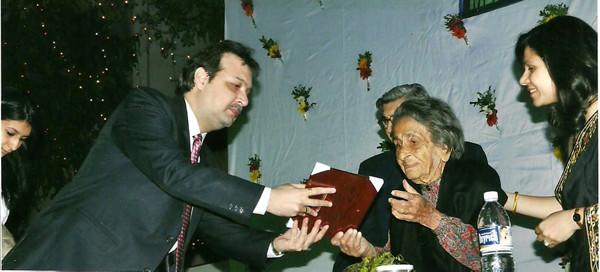
Homai Vyarawalla (center) being felicitated by Justice Jamshed Pardiwala (left) in Vadodara
Known for her ability to capture the spontaneity of many a unique moment she ensured she did not cause embarrassment to her subjects. Therefore despite the pressure on her to release her exclusive shot of Marshal Zukov slipping off an elephant when he was on a state visit to India, she refused to oblige those who wanted to humiliate the Russians.
Whilst enjoying her interactions with British leaders and Indian politicians she was equally happy to shoot the face of the common man, whether a fisherwoman, farmer, toddy tapper or brick layer. Among her most prized shots was the arrival of the Dalai Lama in India for the first time through Sikkim in 1956, reported family friend Arnawaz Havewala of Baroda.
The short documentary screened at the Parzor NCPA function filmed her living alone in her Baroda home, wielding a large screwdriver with which she mended some household artifact, ironing her clothes, driving a Fiat. A few years later Cama showed Parsiana an envelope received from Vyarawalla which the environmentally conscious lady had crafted by taking an old envelope and turning it inside out! "She never likes to waste anything,” Gadihoke had mentioned at the talk referring to the days she spent at Vyarawalla’s home, shooting her film.
In her tribute to the photographer in The Hindu of January 21, Gadihoke described how Vyarawalla’s simple and sparse home had pieces of driftwood that looked like sculpture, her nameplate was made from broken bangles… Fiercely independent, even plumbing work was handled by the lady who assumed for herself the name Homai Kabadiwalla. She could also cut her own hair and tailor her own clothes. Loathe to ask anyone for favors, when someone volunteered to run an errand for her she ensured that she repaid the kindness with a cake baked by her.
Her father Dossabhai Hathiram was an actor in a traveling Urdu-Parsi theater troupe who had to borrow money to return to India when his company declared bankruptcy in Rangoon. He died soon thereafter and his widow had to weave kustis to sustain the family. Gadihoke had also learnt that Homai was the only girl in her class in the Grand High School where she studied and was only permitted to leave her house with a mathubanu covering her head and the sudreh showing. Whilst she would tuck her sudreh into her blouse once she was outside, she had "to remember to let both these items show” when she returned home. After earning a degree in economics from St Xavier’s College she further studied at the J. J. School of Arts in Bombay.
Unafffected by pomp and show she had told Havewala how she and Maneckshaw had married in the presence of five-six friends with two garlands. The sole luxury she permitted herself was wearing a blouse stitched by a tailor for the first time. After the wedding the couple went to Chowpatty and ate bhelpuri. The first birthday that she celebrated was the last one when she turned 98 on December 9, 2011 just five weeks before her demise when friends came over to her place. Admiring the values of Baba Amte, she donated to his ashram, just as she regularly gave financial aid to the sick, old and the poor, believing that she was only a trustee of her wealth. When asked (see "A pictorial odyssey,” April 21, 2006) if she frequented fire temples, the lady pointed to her heart and said her spirituality resided within.
Many who knew her intimately wanted to photocopy her handwritten book of recipes and medicinal home remedies. She had more faith in nature cure and shied away from visiting a doctor. "Homai hadn’t stopped writing letters in her beautiful handwriting but since my own correspondence with her of late had been so disappointingly sparse, perhaps she realized that (the mobile sms) was a quicker way of communicating with me and the rest of the world. In her 90s she learnt how to use a cell phone. In 2008, at the age of 96 she traveled across the Atlantic making her first ever journey abroad,” recalled Gadihoke in Tehelka, January 28, 2012.
"Preserved meticulously in boxes under her bed, Homai always worried about a safe haven for her work and it was with a great sense of relief that she supervised the packing and dispatch of her archive to the Alkazi Foundation in March 2010. She was extremely happy when a retrospective exhibition of her work at the National Gallery of Modern Art traveled from Delhi to Bombay to Bangalore. At each venue Homai insisted on being with us through the day as she supervised and watched us put up pictures.” Among her last messages to Gadihoke she wrote, "There is no news about the Calcutta venue? And why is New York so far away in time?”
As summed up in the tribute by Ginwalla, "Not only was she unique in life, but so too thereafter for very rare is it that someone receives, in the space of a month, sanman, shraddhanjali, smarak (honor, eulogy, memorial).”
◆ ◆ ◆
From the archive