
Media
The letter legend
With his penchant for writing letters to the editor Behram Dastur has created a new Guinness World Record
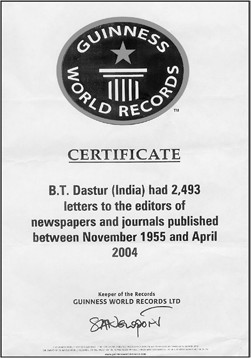
"To gain stature in the world of writing you have to rise above bias and pettiness. Letter writers are not political propagandists. They should be balanced and should have done a lot of reading and researching so that they can offer original suggestions and not plagiarize,” believes Behram T. Dastur who in August 2005 received a certificate for setting a new Guinness World Record under the category of "Most published letters to newspaper editors.” The chief executive officer (CEO) of the Bombay Parsi Punchayet has a framed certificate hung up in his office which reads, "B. T. Dastur (India) had 2,493 letters to the editors of newspapers and journals published between November 1955 and April 2004.” His total Press contributions actually numbered 2,828 but the Guinness World Records discounted his pieces which classified as articles and not letters, explains Dastur.
Observing that "the same old hogs continue to write and hog space… resulting in hardly any space being available to the younger/newer letter writers,” on August 31, 2002 Dastur stopped contributing to the national and international papers/journals. He refers to his logbook where he has maintained a meticulous record of all the letters since his first one to The Times of India was published on November 1, 1955. At the start of each year he summarizes the number of letters that appeared in different publications in the preceding year. "God willed that I maintain a meticulous record,” says Dastur, admitting that when he started noting down his entries he had never heard of the Guinness World Records. It was only on the persistence of his sister Arni Banaji that Dastur felt obliged to approach the Records Research Services of the Guinness World Records in end 2004. When he was asked to send his original letters for verification, an elated Dastur despatched the set by courier, not bothering to maintain any copies of the same. In the interim period until his certificate arrived as a Khordadsal gift on August 25, 2005, his logbook was the only proof of the loads of letters he had written. He may well be the fifth Parsi to feature in the Guinness Records, the earlier four being Kaikhosru Sorabji for his longest non-repetitious piece for piano ever composed, Meher Heroyce Moos, the most widely traveled woman (130 countries), Merzban Lahewala for producing the longest incense stick (14 feet nine inches in length, six inches in diameter and weighing six kilos), and Kairshasp Choksy for fighting the longest trial in history when he defended the Sri Lanka President Ranasinghe Premadasa.

Dastur may not now know the contents of his letters but by referring to his records he is sure that his most prolific period was 1991 when spurred by the economic turmoil in India which was then on the verge of bankruptcy 143 letters (or nearly 12 each month) were published. The next year it was down to 107 letters. Altogether 692 letters of his have been published in The Financial Express, followed by 689 in The Economic Times, 593 in The Indian Express and 500 in The Daily, sums up Dastur listing his contributions to 18 periodicals, the prestigious dailies as also the slimmer bulletins of the Institute of Secretaries and the Institute of Company Secretaries, and The Journal of the Bandra Tata Blocks Welfare Association.
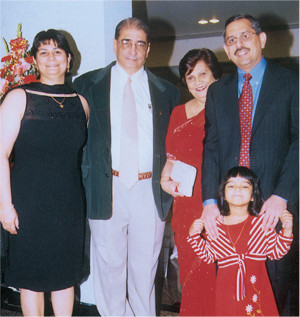
Dastur (above) Photo: Sarosh Daruwalla, Mazda Audio Video Lab and (alongside) with family (from left) Benaifer, Pervin, Rushad and Aliza
"I have commented conscientiously on controversial and non-controversial matters (mostly controversial) on subjects close to my heart: women’s and children’s rights and causes, animal rights, national and international economics, unconstitutional amendments to our Constitution, economic plunder of India, degrading environment, corruption, independence of the judiciary, public health and hygiene, lack of investments in education, and so on,” clarifies Dastur who views himself as a bitter critic of the Nehru-Gandhi family and insists that they must bear the largest share of the blame for mismanagement of the economy considering that amongst the political parties they have enjoyed the longest tenure in India. He is equally disillusioned with the constant constitutional amendments — 113 or 114 times in the last 55 years.
"After economic reforms were introduced and implemented I reduced the acidity of my writing. If the fence has been mended, they need to be complimented,” asserts Dastur, describing himself as "an unaligned, independent writer who is reasonably fearless.” He alludes though to the six-seven anonymous calls he must have received in the last nearly 50 years threatening him with "Jaan léga…Khatam kar déga (We will take your life).” A critic of abattoirs he wonders whether it was some butcher making these calls. He refers to the Emergency days when he felt that he would be hauled up by the political powers, but he escaped censorship. Over the years friends, neighbors, colleagues have been appreciative of his views whilst simultaneously cautioning him "against being a firebrand and to curb his flamboyance… But I can’t change my grain,” he insists.
"I have never apologized in my life,” candidly declares Dastur adding, "I have always engaged my brain before putting my mouth in gear.” His wife Pervin may not appreciate this stand and their married daughter Benaifer and son-in-law Dr Rushad Eduljee, both vice presidents of the Maryland Bank of North America, were not available for comment either! But his letter writing has never impinged on the time he spends with the family for, as Dastur confesses, "I have pinched my employers’ time. All my letters have been written while on duty.”
Before joining the Punchayet as CEO in 1998, Dastur retired as senior general manager of Burroughs Wellcome where he had served for 10 years. Prior to that he was with Cadbury for 14 years from where he resigned as corporate development manager. Seven years before that he was with Hoechst Dyes and Chemicals Limited as their first purchase cum administration manager. The first two and a half years of his career in India that he spent with the Wadia Group, Dastur considers the most rewarding, viewing them "to be my best employers.” As soon as he had established himself in his career his first crusade in life was helping young boys and girls find respectable job placements using his good contacts. Prevention of cruelty to animals is another activity on which he spends considerable time.
After his early education at the Zoroastrian Boarding High School (later rechristened the Deolali High School) Dastur studied at Nasik’s Hansraj P. Thackersey College. As an Inter Arts student he sent off his first letter to The Times of India in 1955 pointing out that certain names of national figures had been omitted from their list of great Indians. In 1960 he was selected as the first J. N. Tata scholar for management studies. Whilst in Bristol he worked as an apprentice with Consolidated Zinc, a subsidiary of what was then the largest mining concessionaire in the world. During his years in the UK he contributed to The Daily Telegraph and The Manchester Guardian.
The Times of India, The Economic Times, The Indian Express, The Financial Express, Mid-Day constitute Dastur’s daily reading material in addition to the umpteen periodicals he receives from other professional bodies. While Pervin reads Asian Age, he does not have the time, he mentions. Over the years his job demanded that he keep abreast of laws concerning customs, sales tax, excise, etc. "The backbone of a newspaper, according to me, is its editorial and the letter writers,” says Dastur pointing out that "space allocated to letters has shrunk and that’s sad.”
The community Press like the Jam-e-Jamshed, The Bombay Samachar and Parsiana continue to offer a forum for the readers to express their views so Dastur happily sends his salvos whether on the subject of co-housing the sacred fires, emigration of Parsis, dwindling numbers, the pilferage at Bhikha Behram Well, the accomplishments of his maternal grandfather Dhunjishah Jall... As Parsiana can vouch, if the letter is not published within a month, comes a first reminder. Sometimes it is followed by a second and third reminder too! After that he does not pursue believing that the topicality of the subject matter could suffer. On an average barely two-three percent of his letters have never seen the light of publication, he states.
But then, he only writes if he is convinced that he has an original remedy to offer to "see that good continues and bad abates” for Dastur is a firm believer of the Biblical maxim "Every sore has a salve.”
◆ ◆ ◆
From the archive