
In Memoriam
Dadi’s dynamism
Died: Dadi Eruchshaw Mistry, 84, erstwhile president of the Delhi Parsi Anjuman (DPA), founder member of the Federation of the Parsi Zoroastrian Anjumans of India (FPZAI), the World Zoroastrian Organisation (WZO) and the World Zarathushti Chamber of Commerce (WZCC), and Zoroastrian representative on the National Commission for Minorities; in Gurgaon on November 13, 2022.
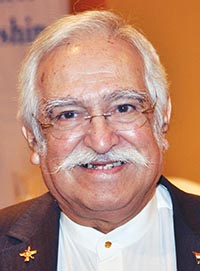 "Dadi had a perpetual presence on most matters that affected the welfare of the Parsi community not only in Delhi but both nationally and internationally… He was a well-meaning, big-hearted Parsi sethia who, along with his dynamic and highly efficient wife Nergish, was at the forefront when it came to supporting Parsis in difficulty,” expressed DPA president Ava Khullar.
"But Dadi’s forte was in successfully persuading our good Parsis with deep pockets to donate to umpteen community causes. The DPA is indebted to him for his successful efforts to expand the Dharamshala by collecting funds to increase its rooms. His prophetic answer to those who said that Delhi’s Dharamshala occupancy did not warrant additional rooms was ‘We must approach our old generous sethias now for help before it is too late as the younger generation are not as ready to put their hands in their pockets.’ Those extra rooms he got built on the top of the Dharamshala are going with full occupancy, thus keeping our finances in a healthy state,” added Khullar.
"Dadi’s extensive contacts served the DPA very well indeed,” wrote Yezad Kapadia who succeeded Dadi as DPA president. "Any difficult or costly project would be referred to people with authority and got executed promptly.” At one time Dadi used his contacts with the Delhi Jal Board that deals with the capital’s water supply and got the clogged pipes replaced at no cost to the DPA. When the new Metro station was to be built in the immediate proximity to the DPA premises, using his contacts Dadi got the station to be located outside the Anjuman premises and not cut into the DPA property, related Kapadia.
Dadi became a trustee of the DPA in 1966 and was president when Delhi’s Kaikhushru Pallonji Katrak Dar-e-Meher celebrated its golden jubilee in 2011. He had then remarked, "The DPA has come of age and has achieved a coveted status among other anjumans in India. My vision for the future is that the DPA should be the most forward looking anjuman of its times, not only in terms of the norms it follows but also by way of the ethics as they act as a binding force to hold the community together. The DPA has tried its best to keep intact Zoroastrian values, religion, heritage and culture, keeping in sync with today’s youth.”
In his condolence message to the family, erstwhile Rajya Sabha member Fali Nariman referred to Dadi as "such a fine human being.” "Always dressed immaculately, mostly in white, he cut a noble figure amongst us all,” wrote DPA honorary secretary Adil Nargolwala who had worked with Dadi on the DPA board from 1997 when he joined as a youth trustee till 2012 when Dadi retired as the president. "Though there were times we crossed swords at meetings, he always had a heart of gold and good interests of the DPA and Parsi community at heart,” appreciated Nargolwala. He remembered how Dadi was "a big help” when his father Shiavax Nargolwala, then president of the DPA, died in a car accident in 1986. Dadi had also assisted Adil during his initial business days by placing orders with him for his IT (information technology) needs. When he stepped down as president, the Anjuman gifted him a clock making Dadi comment: "Don’t count every hour of the day, make every hour in the day count.”
Chairwoman of the Bombay Parsi Punchayet and ex officio president of the FPZAI, Armaity Tirandaz gave him credit for "selflessly devoting his time and energy to the causes of the community... Dadi was deeply involved in the working of all community matters and was meticulous and thorough in all his decision making and served every institution… with sincerity of purpose and utmost dedication.”
"Dadi had a perpetual presence on most matters that affected the welfare of the Parsi community not only in Delhi but both nationally and internationally… He was a well-meaning, big-hearted Parsi sethia who, along with his dynamic and highly efficient wife Nergish, was at the forefront when it came to supporting Parsis in difficulty,” expressed DPA president Ava Khullar. "But Dadi’s forte was in successfully persuading our good Parsis with deep pockets to donate to umpteen community causes. The DPA is indebted to him for his successful efforts to expand the Dharamshala by collecting funds to increase its rooms. His prophetic answer to those who said that Delhi’s Dharamshala occupancy did not warrant additional rooms was ‘We must approach our old generous sethias now for help before it is too late as the younger generation are not as ready to put their hands in their pockets.’ Those extra rooms he got built on the top of the Dharamshala are going with full occupancy, thus keeping our finances in a healthy state,” added Khullar.
"Dadi’s extensive contacts served the DPA very well indeed,” wrote Yezad Kapadia who succeeded Dadi as DPA president. "Any difficult or costly project would be referred to people with authority and got executed promptly.” At one time Dadi used his contacts with the Delhi Jal Board that deals with the capital’s water supply and got the clogged pipes replaced at no cost to the DPA. When the new Metro station was to be built in the immediate proximity to the DPA premises, using his contacts Dadi got the station to be located outside the Anjuman premises and not cut into the DPA property, related Kapadia.
Dadi became a trustee of the DPA in 1966 and was president when Delhi’s Kaikhushru Pallonji Katrak Dar-e-Meher celebrated its golden jubilee in 2011. He had then remarked, "The DPA has come of age and has achieved a coveted status among other anjumans in India. My vision for the future is that the DPA should be the most forward looking anjuman of its times, not only in terms of the norms it follows but also by way of the ethics as they act as a binding force to hold the community together. The DPA has tried its best to keep intact Zoroastrian values, religion, heritage and culture, keeping in sync with today’s youth.”
In his condolence message to the family, erstwhile Rajya Sabha member Fali Nariman referred to Dadi as "such a fine human being.” "Always dressed immaculately, mostly in white, he cut a noble figure amongst us all,” wrote DPA honorary secretary Adil Nargolwala who had worked with Dadi on the DPA board from 1997 when he joined as a youth trustee till 2012 when Dadi retired as the president. "Though there were times we crossed swords at meetings, he always had a heart of gold and good interests of the DPA and Parsi community at heart,” appreciated Nargolwala. He remembered how Dadi was "a big help” when his father Shiavax Nargolwala, then president of the DPA, died in a car accident in 1986. Dadi had also assisted Adil during his initial business days by placing orders with him for his IT (information technology) needs. When he stepped down as president, the Anjuman gifted him a clock making Dadi comment: "Don’t count every hour of the day, make every hour in the day count.”
Chairwoman of the Bombay Parsi Punchayet and ex officio president of the FPZAI, Armaity Tirandaz gave him credit for "selflessly devoting his time and energy to the causes of the community... Dadi was deeply involved in the working of all community matters and was meticulous and thorough in all his decision making and served every institution… with sincerity of purpose and utmost dedication.”
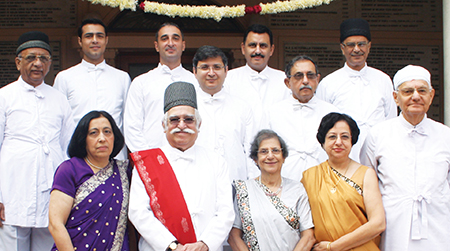
Top: Dadi Mistry; above (standing front row, 2nd from l): with DPA trustees;
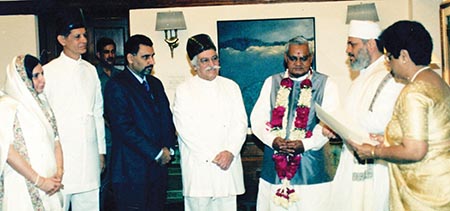
below (4th from l) with Parsi delegation that met Prime Minister Atal Bihari Vajpayee
One of the founder directors of WZCC India Region, he "very much cared for its progress. His message to WZCC members was ‘Somebody helped me to grow in life, specially my community. I do not have pots of money to give away but I give whatever advice I can or the contacts I have to others,’” noted a condolence message from the WZCC international board. "Dadi was a great soul and so loved and admired by us all… His extraordinary work for our community will never be forgotten,” wrote WZO president Zerbanoo Gifford.
"We in Dubai have had memorable interactions with Dadi on various occasions such as the World Zoroastrian Congress, Enterprise Dubai and Dubai Pravasi Yatra. Whenever Dadi’s help was needed we knew it was just a phone call away. Several times we were awed by his unwavering dedication, his legacy of tireless and dignified public service. A thought leader par excellence, his constant service to the Zoroastrian community will forever remain an important part of our community’s history,” wrote Meher Bhesania of Dubai.
Associates from the business fraternity too commended Dadi. Noted businessman and conservation activist. Cyrus Guzder wrote, "He was such a dear friend of my father (Jamshed Guzder) who respected and trusted him enormously. I also held Dadi in great esteem. He was always smiling and a person who never said ‘no’ to any request for help or assistance.” At public forums Dadi would repeatedly acknowledge Jamshed Guzder’s support in his career. Dhunjibhoy Neterwala too was viewed as a godfather. Feroze Neterwala who was not present for the uthamna as he had to attend the golden jubilee of Uni Abex Alloy Products Ltd, wrote in a condolence note that he made "a special mention of Dadi before the large gathering at the event. He was instrumental in setting up the joint venture with Manoir Petro India Ltd. I had a wonderful association with him over two decades.”
After earning a diploma in mechanical engineering from the Victoria Jubilee Technical Institute, Dadi had worked as an apprentice under Naval Tata at the Trombay Power House. A marketing management course from the Administrative Staff College, Hyderabad and sales experience in Rogers Company, Forbes and Marshall, J. N. Marshall, Dai-ichi Karkaria, Uni Abex and Uni Linger emboldened Dadi to start Mistry Engineers in 1972. His company offered consultancy to private and government agencies and multinational firms in the fields of industry and commerce, finance, energy, power and environment. Besides locating prospective joint venture partners in India and overseas, he would help surmount bureaucratic hurdles till government approval was obtained.
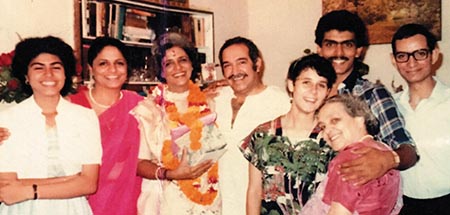
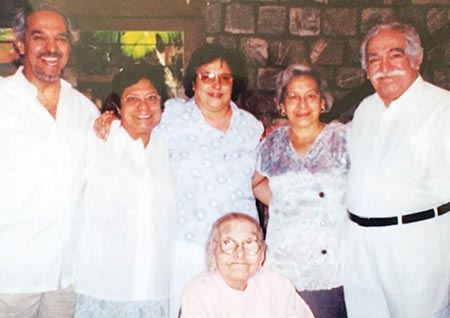
Above, Mistry family, from l: Bella, Nergish, Dhun Bagli, Dadi, Margarita and
Armeen Shroff, Roshan and Ervad Cawas Bagli
Siblings (l-r): Sharukh, Kety, Dinoo, Povru, Dadi with Roshan
His daily routine included an hour in prayer no matter how early he had to get up. He would make sure that his grandchildren donned their sudreh-kusti at all times, insisting, "soccer or no soccer, sudreh is a must.” He considered himself fortunate to have Gurumayi Chidvilasananda as his spiritual guide for nearly 35 years, for "deepening interest in our Gathas and introducing meditation.” To the self-confessed coffee lover who had a passion for travel and love for nature, short holidays to the seaside or hill stations gave him a welcome break and balance in his hectic life.
He married Nergish when he was 42 years old. "Dadi has been more than any biological father to my children with his passionate desire to be the best of fathers and give them the best of everything…It was a pleasure for me to work by his side and help him achieve his goals and vision in life…He was a perfectionist and hence always had a problem with anyone not putting in their best efforts to whatever they were doing and would strive to make them understand that even the smallest task should be done with great care and dignity… Helping fellow men was his forte…No one every returned empty handed or without being helped when they met him,” recalled Nergish.
The eldest of Eruchshaw and Roshan’s five children — the other four being Povru Writer, Dinoo Rivetna, Kety Bhaka and Sharukh — when his father could not afford to pay his fees at Don Bosco School, his paternal grandmother Alamai of whom he was very fond, approached the school administration for a fee waiver and it was granted. The principal only asked that he should "prove his worth in school and in life. This made me strive to live up to the expectation,” noted Dadi in Bhesania’s book The Ashavans.
When he was a young bachelor he was suddenly entrusted with family responsibilities after his father passed away. He chose not to marry his childhood girlfriend explaining to her that family duties would not permit him to consider matrimony. "He was my elder brother, father figure, mentor, all rolled into one… With dad’s meager salary it was Dadi who looked after all of us. He got (our) sisters married, paid for my education. I am an architect today because he sacrificed for the family,” acknowledged Sharukh. On his visits to Bombay, "I became his errand boy, car washer, shoe polisher, ice maker and more. I loved doing every bit of it. During those visits the happiness quotient of the family went a notch higher… Dadi loved his evening takoro (drink) and was a real foodie... To the outside world he came across as a tough mentor. All one had to do to soften him up was to get a dog in our midst…”
His motto was "Never leave for tomorrow what you can do today and express gratitude for what you’ve received by helping others in need.” To the children around him, he would advise, "Even if someone has helped you with a pin, you must always remember and be grateful to that person.”
The well connected leader is survived by his wife Nergish, step children Armeen Shroff and Bella (Behroze) Jaikaria, sister Kety and brother Sharukh.
◆ ◆ ◆
From the archive