
In Memoriam
The literary legend
Died: Dr Ratan Rustomji Marshall, 99, popular Gujarati litterateur and mainstay of the Surat Parsi Pan-chayat (SPP) having served as their special officer, on January 16, 2011 in Ahmedabad.
A strong pillar of the Zoroastrian religion and a storehouse of knowledge, with his guidance, encouragement and inspiration Marshall was able to implement many of the amelioration projects of the Panchayat, noted a condolence resolution in Gujarati signed by SPP president Darayas Master. In recognition of his loyalty and willingness to shoulder responsibilities the Panchayat has decided to honor the contributions of the special officer by hanging his portrait in their administrative office.
.jpg)
Dr Ratan Marshall: living encyclopedia
With his sharp memory the nonagenarian Marshall was considered a veritable living encyclopedia on Parsi history with facts, dates and explanations in abundance. "He rendered yeoman service to the SPP and to other institutions of our community. He led a true Zoroastrian life,” summed up Burjor Antia, trustee of the Parsee Surat Charity Fund that is authorized to appoint or remove SPP trustees. During his seven decades of association with the SPP, starting as a head clerk to oversee the establishment of The Parsi Technical and Industrial Institution and the Nariman Home and Infirmary, Marshall contributed to the progress of many other community institutions like the Nariman Parsi Girls Orphanage, Alpaiwala Industrial Institute for Women and Girls, Pirozebai M. Patel Singanporewala English School, Sir J. J. School, and different housing projects. Talking to the inmates of the Nariman Home and Infirmary and making them feel loved was a Sunday ritual with Marshall, remembered family friend Bapsy Engineer in her condolence letter.
"Dr Marshall was an institution by himself and his encyclopedic knowledge on all matters pertaining to Gujarati journalism will be surely missed by all students of Gujarati literature and journalism,” noted Muncherji Cama, managing director of The Bombay Samachar in his condolence letter.
The prolific author is known for his books Ardeshir Kotwal, Parsioe Surat ma Vahavela Danganga, Pushpo ane Patangia, Nari Na Heiya, Sona Na Heiya, Monghu Gharenu, Katha Ratan, Gujarat Sahitya — Patrakaratvo — Rang Bhoomina Kshetre Parsio nu Pradan and his last work Parsi Sansari Prem Kathao. His contribution to Gujarati language and literature was recognized with the Gujarat Sahitya Academy award and his Katha Ratan was adjudged an outstanding work in the section of biography and earned him the Narmad medal. The Narmad Sahitya Sabha he had served as secretary, vice president and president. When reviewing his book Pushpo ane Patangia, Bejon Desai, erstwhile principal of the Boys’ Town Public School in Nasik had acknowledged, Marshall’s "vast contribution in the field of education, cultural history and research in... Gujarati drama and journalism are highly commendable…”
Even at 99 years of age, "he was always spirited, full of life and humor and wanted to know and do as much as he could. He loved to write and would sit for hours together writing short stories, articles, plays and whatever theme or idea came in his mind,” noted a write-up from his son Rustom. An accident seven years ago had incapacitated him necessitating a shift from Surat to Ahmedabad to spend his last years with his son, daughter-in-law Nishmin and grandchildren Rhia and Yohan. Despite difficulties in hearing and having others decipher his handwriting his creative outpouring flowed incessantly.
A gifted playwright, director and actor, he made significant contributions to Parsi theater. Actively involved with the Yezdi Karanjia drama group he would happily replace a stage artiste who was indisposed at the last minute. Six houseful shows of the play Kutra Ni Puchhdi Vanki written by Marshall were performed for audiences in Karachi last year to raise funds for flood victims.
Marshall had spent 14 years to research his treatise "Gujarati Patrakaratvo no Itihas” (History of Gujarati journalism) that took an encyclopedic look at the development of Gujarati journalism. With the submission of this thesis he became the first individual at the Bombay University to earn a PhD in Gujarati literature. The presentation of his findings in the form of a book "offers us extremely important information on a world that has completely disappeared: a world where the Parsis played a major and often times leading role in the Gujarati Press, running papers such as Chabook, Kaiser-e-Hind and Sanj Vartaman,” noted a tribute by Harvard research student Dinyar Patel.
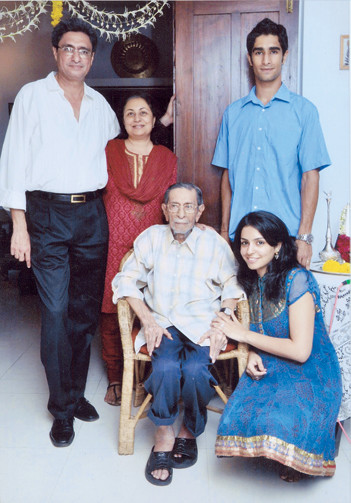
From left (standing): Rustom, Nishmin and Yohan; (sitting) Ratan and Rhia
A Gandhian at heart with simplicity and humility being his hallmark, Marshall would happily reminisce about his interactions with political legends when approached by upcoming researchers and students. He had vivid memories of his dissertation being scrutinized by a committee that included Sir Rustom Masani, a prominent voice in community and national affairs through the 1950s, whom Marshall referred to as a demanding teacher ordering several modifications and revisions of his treatise. In Surat he had met "Veer” Khurshed Nariman, the Congress leader whose fall was as dramatic as his rise. Taking his morning runs on Juhu Beach he would be trailed by enthusiastic supporters chanting "Nariman! Nariman!” Marshall was also familiar with Burjorji Bharucha, a Parsi Congress leader largely forgotten by the community in spite of being a well-known proponent of khadi and the general secretary of the All-India Congress Committee in 1924 along with Jawaharlal Nehru.
Considering himself fortunate to have interacted with Marshall recently, Patel wrote: "I have spent a grand total of 24 hours in Surat but thanks to Marshall I feel that I know the city and its history quite well... He explained in detail Surat’s importance to the Parsi community in the days when Bombay was still a relative backwater.” Patel admired Marshall’s persistence in getting a major street in Surat named after the legendary Ardeshir Kotwal who was instrumental in bringing peace and order to the city in the early 1800s and for which the founder of the Swaminarayan movement had presented Kotwal his own pugree which is still an object of reverence for people of diverse faiths.
Social work, whether for the Parsis or sister communities, he felt obligated to render. At the time of the devastating earthquake in Bharuch he was deputed by SPP to oversee relief operations in the city of his birth for two months. Marshall was also involved with a leprosy home, admiring the loving and selfless efforts contributed by the Spanish sisters. The civic minded Marshall made time to serve on the board of various hospitals (his late wife Freny was a popular gynecologist in Surat), and government advisory committees related to police, radio and rationing. An honorary magistrate he subsequently headed the South Gujarat Magistrates’ Association and was twice conferred the Best Citizen award by the Surat Municipal Corporation.
Although "a staunch Zoroastrian he was a realist” with moderate views observed Nishmin. He firmly believed that the community should not rush headlong into change lest the Parsi culture be lost yet he realized that gradual changes were inevitable for the community to survive in a changing world. In the intervening years he felt that the spirit of Parsi entrepreneurship and industry was receding as the youth opted for comfortable 10 to five jobs. Towards the end though he revised his views when he saw many young Parsis pursuing different vocations and studies, proving that the future of the community was in capable hands.
Convinced that the community in Surat does not need elections, he had conveyed to Parsiana (see "The Surat impasse,” August 2002) "Saaro vargh nahi avsé (it is not the cream of society who will hold power).” How happy are the Parsis in Bombay despite their elections? he had questioned. Upheavals and criticism directed at the SPP and its trustees he took in his stride, declaring, "In any institution, those who work the most have to suffer.” Decline in community numbers, shift in residence and duplication of services (like those offered by the orphanage and infirmary) in nearby towns have resulted in the downfall of these majestic institutions in Surat, Marshall had observed.
The stalwart’s preoccupation with community institutions commenced after his graduation in arts. His PhD thesis was undertaken whilst working for the SPP and in 2002 he was conferred the Doctor of Letters degree by the University of South Gujarat. Most remarkable though was his graduation in law at the age of 70 years. Rustom, a senior counsel in the Gujarat High Court, was quoted in the Ahmedabad edition of The Times of India: "He always wanted to study law but was not able to do so when young. So when I enrolled in the law college… he got himself admitted a year later… The age difference between me and my father was 48 years. He was older than even my senior professors but his spirit amazed many as even students less than half his age had fun chatting with him… He knew exactly what time I came to college and the days I didn’t turn up at all. But thankfully he never scolded me!”
"He bemoaned the fact that Gujarati has become a second language and even a foreign tongue to so many Parsis. As someone who did not speak a lick of Gujarati until two years ago and then spent two summers studying the language and going through various libraries in Gujarat, I can now understand why. If we cannot read Gujarati, we miss out on a huge portion of our history and culture. I have been simply stunned to see in old, dusty cupboards, the prolific literary output of our community in Gujarati…” admitted Patel. Aware that a small park and playground in Surat has been named after Marshall, Patel remarked, "I think the best memorial to Marshall would be individual attempts at our community’s reengagement with Gujarati, spoken and written.” An admirer Gahver Kapadia, in her condolence letter specially penned in Gujarati, described the savant as "viral, vidvaan ané namra (unique, learned and humble).”
The remarkable writer is survived by his son Rustom.
◆ ◆ ◆
From the archive