
Books
Loving the letters
Zarathushtrian Kusti Prayers, Calligraphy in Avestan, Gujarati, English and an English Translation by Perin Pudumjee Coyaji. Published in 2005 by the author, Survey No 65, Off Victoria Road, Ghorpadi, Poona 411001. Pp: VII + 92. Price: Not mentioned.
Zarathushtrian Kusti Prayers, Calligraphy in Avestan, Gujarati, English and an English Translation by Perin Pudumjee Coyaji. Published in 2005 by the author, Survey No 65, Off Victoria Road, Ghorpadi, Poona 411001. Pp: VII + 92. Price: Not mentioned.
Bringing the beauty of letters into the limelight is Perin Pudumjee Coyaji’s calligraphic creation Zarathushtrian Kusti Prayers. Webster’s Dictionary defines calligraphy as "beautiful writing, the art of fine handwriting.” By that yardstick, Pudumjee Coyaji’s book is indeed aesthetic and stands out in its simplicity.
Sponsored by Jamshed N. Guzder and the trustees of the J. C. D. Adenwalla Trust, in memory of Shirin Jamshed Guzder, the cover in deep-toned red has the 101 names of Ahura Mazda in tiny gold lettering set within a sphere. There are but five prayers — Ashem Vohu, Yatha Ahu Vairyo, Kem na Mazda, Ahura Mazda Khodae and Jasa me avanghe Mazda. Each is spaced out separately on a pure white, glossy page, ornamented by a motif which enhances the idiom of Persia.
"Let us use the heritage of our script to unite peoples, not to divide; to spread the universal truth of an ancient religion, not to fence ourselves in; to share in the diversity of human achievement, not to blinker ourselves in the realm of culture. Let our children one day write in Avestan with pride — and live their faith with honor,” writes Pudumjee Coyaji in her foreword.
A copywriter by profession, calligrapher by choice, Avestan calligraphy has been for her a quest and a joy. Pudumjee Coyaji has learnt the technique of Chinese brush calligraphy in Japan at Obirin University in Tokyo, under the auspices of an Indo-Japanese NGO (non-governmental organization) called Ashta no Kai. Her exhibition there entitled Humata: Calligraphy from India had on show Avestan, Gujarati, Devanagari, Hebrew, English and Chinese scripts. "Brush calligraphy is the more true expression. The brush is an alive instrument, though difficult to wield. You go with the flow, release energy through heart and hand. It is more natural, more realistic,” Pudumjee Coyaji told Parsiana. The Hebrew script was self-taught with study sheets from Europe under the guidance of her mentor, Achyut Palav of Bombay, who is one of India’s leading calligraphers, she explains. Two different styles of Hebrew script – Ashkenazi and Sephardic – were studied.
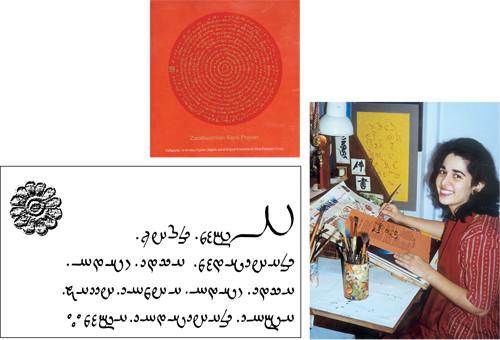
Ahura Mazda’s 101 names on the cover (top); Aves-tan script (far left) and Pudumjee Coyaji with her brush calligraphy
Pudumjee Coyaji’s serious study of calligraphy began in 1996 with Palav, when for nearly three years she traveled once a week from Poona to Bombay, spending the day studying and returning home in the evening. "Though I had already been asking around for a while if there was something like an Avestan script… nobody I asked could answer me! I was often dismissed with the fact that they used to teach it to aspiring priests at the madressas,” she writes. She was however directed by Dr Jeroo Coyaji (later to become her mother-in-law) to the Vaidika Samsodhana Mandal (Sanskrit research institute) in Poona, but they could offer her only an Avestan reader in English and a sheet with the alphabet. But her mission was to copy out the prayers.
In 1998, her neighbor Perin Keki Shroff gifted her an 1891 edition of Practical Grammar of the Avesta Language by Ervad Kavasji Edalji Kanga. This over 100-year-old book in a crumbling state was to her a real treasure as in the first chapter she found the alphabet – and three prayers (Ashem Vohu, Yatha Ahu Vairyo and Yenghe Hatam).
It was a solitary exercise learning the structure of the letterform. "Under my master’s expert guidance, I xeroxed every alphabet, enlarged it, cut it out and placed it on a grid. This was done to get some idea of the letter proportions. Now I could copy out the three prayers with a lot more confidence,” she notes. Attempting to learn the Avestan language, she attended Ervad (Dr) Rooyintan Peer’s lectures at the University of Poona and later at the Vaidika Samsodhana Mandal. But grammar was not her forte and she was enjoying attending more for the sound and meaning of Avestan words. "It was Dr Peer who gifted me a precious copy of the 1931 edition of The Bombay Parsi Association’s Khordeh Avesta in the Avestan script. At last I had all the kusti prayers in hand,” she rejoiced.
The idea of publishing a book with the kusti prayers in the three scripts of Avestan, English and Gujarati (with an English meaning of the words) received encouragement and support from Dr Homi Dhalla and the World Zarathushti Cultural Foundation. Pudumjee Coyaji also expresses her gratitude to Palav and to her guide, the late Behram Pithavala. Cyrus Guzder of Bombay and Poona’s Dr Statira Wadia, Rati Forbes, Perin’s husband Dr Xerxes and parents-in-law Drs Jeroo and Kurus, as well as her parents Dinky and Kaikobad Pudumjee and sister Aimy Pudumjee receive special mention. With four-year-old twin boys to manage, the venture would not have been possible without family support, she asserts.
With the first print order already sold out, Pudumjee Coyaji is looking at a re-run. "The book has struck an emotional chord,” she says. The concept of connecting with history, of seeing the prayers in their original script has greatly interested people, she believes.
◆ ◆ ◆
From the archive