
Medicine/Health
A potato vaccine?
Professor of immunology, Yasmin Thanavala is working on preparing an oral vaccine for hepatitis-B
"Even though a safe and effective vaccine became available over a decade ago, hepatitis-B remains a public health problem even today,” asserts Dr Yasmin Thanavala whose team at the Department of Immunology, Roswell Park Cancer Institute in Buffalo is working on the world’s first potential oral vaccine against the hepatitis-B virus. "The vaccine will be delivered by simply eating potatoes genetically designed to contain the vaccine. This project is a wonderful example of moving research ideas from the laboratory bench to the bedside,” she adds.
Based on the success of their pre-clinical studies involving mice, a placebo-controlled, double blind, Phase I study was conducted. "Here 45 healthcare workers who previously responded to a licensed, injectable vaccine received an oral booster dose. We took ordinary potato plants and genetically altered them to include a single protein from the hepatitis-B virus. The idea was that once consumed, the protein would trigger the body’s immune system to recognize and fight any future encounter with the hepatitis-B virus without causing disease,” she elaborates.
These participants were evaluated for safety, reactions to the vaccine and boosting of the immune response. There were statistically significant increases in antibody titers in 60 percent of the volunteers who ate two or three doses of these transgenic potatoes.
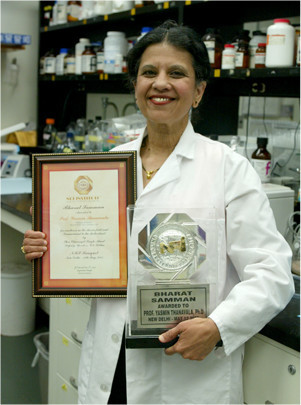
Thanavala: "belief in myself and my abilities”
While some people suffer only an acute illness and recover quickly without any long-term liver damage, hepatitis-B can cause a chronic illness that lasts more than six months, sometimes for life, with symptoms that come and go. This can cause cirrhosis and liver cancer. In order to globally eradicate this disease alternatives to injectable vaccines are needed. An oral vaccine would make it ideal for global immunization programs. The future hope is that countries could grow their own potato vaccine plants and immunize entire populations. But more research in this field is needed to see whether it would work in people who had not already been vaccinated against hepatitis-B and whether the immune reaction seen in the trial was large enough to be effective in real life.
The BBC, National Geographic and a host of other media have been talking about her. Thanavala is on the scientific advisory board of the Association for Research of Childhood Cancer since 2003 and she has been the recipient of awards like Inventor of the Year Award (Life Sciences) in 1996, the FEZANA (Federation of Zoroastrian Associations of North America) Award for Excellence and the New York State Governor’s Award for excellence in Health Advocacy in 1998. In May 2005 she received the prestigious Bharat Samman Award from the NRI Institute of India which honors non-resident Indians for their work enhancing India’s prestige in the country of their adoption and for their commitment to their motherland.
The scientist’s typical day sees her alarm go off at 6:30 a.m. She continues to snooze till 6:45 since she is "not a morning person. But once my feet hit the floor I am on the go. Till I have drunk my first cup of coffee I need to be left alone because that is the time I think. Then I get myself together, get breakfast ready and leave for work by 8-8.15 a.m.”
Work is a series of meetings, seminars, attending to visitors, telephones and e-mail correspondence, checking on the staff to see what they are doing, and mainly planning and executing experiments and their results. Being very particular about her food she has a green salad for lunch 365 days of the year. After her husband Dr Arvind Thakur comes home at around the same time that she does i.e. 8 p.m. they chat, cook food, have dinner and sometimes watch TV or listen to music. On the weekends she frequents the gym.
"Though fitness is important to me I am not a hard-core fitness freak. I swim in summer and go to the gym throughout the year. My stress busters include gardening, listening to music and going to the theater and opera,” she says. "My other passions include cooking and I enjoy Indian, Thai cuisines and barbecues among others.” She enjoys traveling too, which is mostly work related, be it for seminars or conferences. "I am a total type A personality — hyperactive, perfectionist, can’t tolerate lazy people and need people who have a passion for their work. Oh and I shamelessly confess that I am a shopaholic with a penchant for Indian clothes specially the garas and salwar kameezes. I love wearing them for my conferences.”
Born in Bombay on October 8, 1948 Thanavala schooled at Villa Teresa and Convent of Jesus and Mary. She graduated as a microbiologist from Sophia College and did her Masters at the Institute for Research in Reproduction (the funding for this was provided by the Indian Council of Medical Research in New Delhi). "It was then that I went to London to do my PhD at the London University at the Middlesex Hospital Medical School with immunology as my special subject. I did my postdoctorate training in London and in December 1985, I was recruited to the Roswell Park Cancer Institute in Buffalo, New York. Here I started off as a junior scientist. Then I was promoted to assistant professor and my next promotion saw me rise to the post of associate professor. Today I am a professor in the Department of Immunology,” says the achiever.
Being in such a top position we can’t resist asking her if she was ever discriminated or sidelined just because she was a woman. "I am a woman and a foreigner on top of that so I put pressure on myself to excel though no one discriminated against me. I forged ahead with the belief in myself and my abilities to get this far,” she replies.
"We women have every opportunity in life and must take it. We have to believe in ourselves and surround ourselves with people who believe in us. We must basically take charge of our life and do something that is meaningful,” she advises on a parting note.
◆ ◆ ◆
From the archive