
Politics and Policy
“A new beginning...” - III
The absence of priests to preserve sacred fires was the recurring difficulty expressed at the Federation meeting
Badnera-Amravati which has a 120-year-old agiary (with a dadgah fire) catering to the needs of 10 Parsis referred to difficulties in finding a substitute when their priest, who is paid Rs 7,500, falls sick. Chikhli which has a Zoroastrian population of 25 too is in urgent need of a mobed. Even Delhi requires a priest to whom they are willing to pay a monthly salary of Rs 17,000.
At the executive council meeting of the Federation of Parsi Zoroastrian Anjumans of India hosted by the Bombay Parsi Punchayet (BPP) on September 5 and 6, 2009 (see "A new beginning…,” Parsiana, September 21 and October 7, 2009) when some of the individual anjumans referred to their activities and problems, the common refrain was the difficulty in maintaining their fire temples with the decline in community numbers and nonavailability of replacements for their ailing or aging priests.
Areas like Agra and Mathura cannot find priests "even for the last rites,” regretted Porus Debara, relating his recent experience when following a death in Mathura he was summoned from Agra to pray from the Khordeh Avesta since no Delhi priest was available. Finally the person was buried in a Christian cemetery after the Christian "Father gave the last rites,” mentioned Debara. The World Alliance of Parsi Irani Zarthoshtis (WAPIZ) has now introduced a locum service where in case of emergency they fly over a priest to an anjuman in need which can pay whatever it can afford with WAPIZ bearing the rest of the cost, conveyed WAPIZ founder and BPP trustee Khojeste Mistree.
"Sadly we can’t produce priests as…young boys don’t want to become priests,” noted Mistree. Their parents having led a tough life have advised them not to do mobedi. The Dadar Madressa has 16 boys today. The Andheri Mad-ressa has only three boys. They don’t want to pursue a calling that offers no provident fund, no pension, no leave, and requires them to work seven days in a week, he added. "Karachi is willing to pay Rs 45,000 per month to a priest but no one is willing to go to Karachi… Priests don’t want to move to small areas where they do not socially accept them as equals. How often do you invite them for meals? How often do the rich interact with the poor priests?…Social isolation is difficult to handle… In Bombay they have their own network, athornan circle.” Referring to the High Priests who would often use public transport in the past, he compared the respect they earned with that given to the Pope, the Syedna, or Shankaracharya, and remarked, "We treat them in this infra dig way…In the last 50 years…we have treated our priests like registered slaves.” For the yasna ceremony (when the hoama water is blessed with rituals) which requires a priest to pray for two-and-a-half to three hours, a priest is given Rs 200-300. How much would a surgeon performing an operation for this length of time charge? queried Mistree.
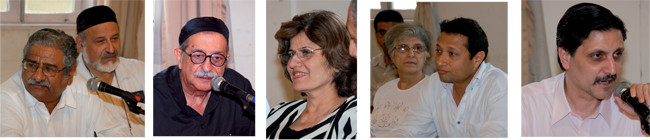
From left: Dinshaw Mehta, Khojeste Mistree, Areez Khambatta, Arnavaz Mistry, Armaity Tirandaz, Jimmy Mistry, Yazdi Desai: "Open to taking the community into the 21st century”
"We will have to think of bringing these fires to Bombay… of creating fire hospices” to house these fires separately and not mixing them together. Even a dadgah fire needs at least two bois otherwise it becomes a household fire and then the fire temple would be no different from a prayer hall, explained Mistree.
Noshir Paghdiwalla of Borivli referred to the vast exodus of Zoroastrians from south to north Bombay and the difficulties senior members face especially during muktads in the absence of a fire temple in their area. He enquired, "Can not an agiary be shifted from south?” Replied Mistree, "Borivli is on our radar…” If there is a fire temple in a mofussil area "with no resources and no worshipers, there is a good chance that Borivli will strike it lucky.” BPP trustee Jimmy Mistry referred to his late board member Rustom Tirandaz’s intentions to bring a fire to Borivli and told the delegates, "Identify a piece of land, tag a value and start collecting money to buy land.” When Satara representative Jamsheed Kanga asked, "Can defunct anjuman assets not be used to start agiaries so that there is no need to run around for donations?” Federation president and BPP chairman Dinshaw Mehta responded, "There is no money as of now on the horizon.”
Zarsis Udhnawala of Thana sought BPP help to house their priest temporarily so that the sacred fire can be shifted to the priest’s abode after which the 230-year-old agiary can be demolished and built anew as per plans sanctioned. But Mistree tried to impress on them to get the structure restored with the guidance of skilled heritage architects instead of breaking down an "old fire temple which has seen years of spirituality…A new structure may not be in consonance with an old fire. How would an old man look in hippy clothes? I find it criminal that where stone work is adequate it is replaced by bathroom tiles and granite.” Even though he was open to expert views, Udhnawala maintained, "Everything has its own life. How long can we preserve?” Jimmy Mistry then explained the difference between restoration and refurbishment and volunteering his technical guidance suggested that "guidelines be drawn under which agiaries can be restored.”
Erstwhile Federation treasurer Farrokh Rustomji believed that the paramobed scheme initiated by the Federation earlier could be reactivated to create a class of part-time priests. But Mistree explained it does not attract young or middle-aged people: "You have to deal with hot fire, seven days a week…We are relying on them to be mini saints…If there are no priests, Zoroastrianism is in serious threat.”
Enquired Adil Nargolwala of Delhi, "I know it is not the right forum…but can we think of a different kind of fire? Maybe one that runs on gas?” Before anyone could speak in support of or against this concept Mehta declared, "We have had enough controversies for the day.”
Seething and simmering
Nargol president Hoshang Wania raised the issue of the priest in Ahmedabad whose heart problem required a bypass surgery. Instead of the Punchayet bearing the medical costs as per their agreement, they served him a notice, complained Wania who sought financial assistance from the Federation to help this priest. Since Ahmedabad was not officially represented at this meeting and former president Areez Khambatta declared "animosity and jealousy is the key word of the Punchayet,” Mehta remarked, "We will look into this…”
When Parsiana sought a clarification from the Ah-medabad Parsi Pan-chayat (APP), president Kersi Shethna and Mobed sub-committee convenor Navroze Kanga refuted all the allegations but stated as the matter is sub judice they did not want to commit in detail.
Referring to Ervad K. Karkaria’s alleged "irresponsible” behavior over the years particularly on last Khordadsal, Kanga mentioned that on the first day of the muktad he conveyed his inability to manage the muktad due to "ill-health.” Refusing the Panchayat’s offer to call for an ambulance, he did so himself, and walked up to it. Subsequently he filed a "false police complaint” against Kanga, as also the president and joint honorary secretary of the Panchayat and two mobeds. As per the Panchayat practice, assistance to meet medical expenses is only extended after the relevant bills are submitted. However in his case they sent him a cheque for Rs 10,000 which was "blatantly refused.”
Udhnawala wondered, "Why not insure priests under a group pension scheme?” Mehta urged him to work on the modalities. Even as Udhnawala sought data from the anjumans, Bomi Kavina representing Ankleshwar, alluded to the Parsi Resource Group’s (PRG) assistance to mobeds. PRG founder Jimmy Mistry had conveyed on the first day that 757 priests were registered with the PRG. But since he was not present on the second day when this discussion ensued, Kavina mentioned that 375 mobeds were covered under the group insurance scheme for which Rs 17 lakhs were paid in the first year. The demand for the second year was Rs 32 lakhs. Further, "every month a dole is given to 85 mobeds, I think.”
Paghdiwalla who works for the Zoroastrian Co-operative Bank conveyed that although the Bank cannot give doles, it can extend loans to priests for vehicles, repair of homes, etc. Those seeking guidance were urged to contact Tehmasp Bharucha (tel: 66661010).
Bardoli president Homi Pithawalla sought to convey the present office bearers’ difficulty in functioning due to past president Jamshed Mohta’s attempts to put spokes in the wheel. Their agiary will complete 125 years next year but Mohta is trying to stall repair work, claimed Pithawalla who also complained about Mohta’s non-cooperation for their dakhma land which is being used by the community since 1885 but which, he feared, could be lost to the community with land records showing an entry as Parsi Kabrastan since 1947. When a specific request was made for Mehta to intervene, BPP trustee Yazdi Desai remarked that it would be "most unfair to discuss the issue when Mohta is not there” and urged the Bardoli representatives to meet the BPP trustees at their board meeting on a Tuesday. Mehta too assured, "I’ll talk to Mohta and we will sort out the problem.”
Resourceful rejuvenation
The Vyara Songadh Parsi Jarthosti Anjuman has plans to construct a small funerary bungli on their Anjuman property that can be used by Parsis staying in Vyara as also those in the villages around Vyara who use the Vyara Doongerwadi. After internally raising Rs 2.5 lakhs they are facing "a huge shortfall of around Rs 5.5 lakhs” and hence appealed to community benefactors to contribute towards the cost of the building and fencing the bungli as also to repair the walls, well and structure of the dakhma. Vyara representative Persi Buhariwala referred to their young trustee personally spending four lakh rupees to renovate their agiary and make it eco-friendly so that there is no build-up of smoke.
Commodore Medioma Bhada of Belgaum acknowledged the magnanimity of a "dynamic Parsi couple” who sends funds to pay the priest’s salary and the group of "unsung heroes of our community” who silently worked on the repair of their agiary roof over two weekends. Clarified Mehta, "Most of them are from Nowroz Baug. They not only give their services for cleaning and repairing agiaries but also dakhmas.”
The Parzor report on the demographic and health studies conducted by it as also an account of its seminar on "Research on Socioeconomic, Attitudinal, Demographic, Scientific and Health Aspects of the Zoroastrian Community in India,” was distributed to all the delegates. In her covering letter Parzor director Dr Shernaz Cama urged, "I do hope that after reading the report, several anjumans would like to take up some of the suggestions for the welfare of the community.”
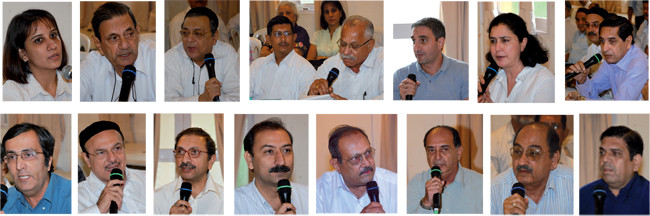
From left (top row): Pareecheher Daviervala; Jamsheed Kanga; Hoshang Wania; Pervez Mehta and Homi Pithawalla; Adil Nargolwala; Firoza Punthakey-Mistree and Noshir Paghdiwalla. (2nd row): Tehmasp Bharucha; Zarsis Udhnawala; Farrokh Rustomji; Porus Debara; Jehangir Batliwalla; Commodore Medioma Bhada; Bomi Kavina and Parvez Italia
Bounty for Bombay
For major housing projects on the anvil, the BPP has decided to accommodate an agiary on each of those sites and so too will there be a senior citizens plus medical facility as also crèches. The present "cubbyhole flats” will be replaced by more spacious accommodation, announced Mistree. Matrimonial meets under the auspices of the BPP will be organized by Arnavaz Mistry at the Khareghat Colony hall, announced Mehta. Presently there are 500 couples under BPP’s fertility project of whom 246 have borne fruit. "We are a dying community. There is no doubt about that. We have to see the graph goes up,” added Mehta. Under the BPP’s third child assistance scheme there are 143 cases. Earlier Rs 1,000 was extended every month and beginning April 1, 2009, the six children considered under the scheme receive Rs 3,000 each month. In the last financial year, the BPP expended Rs 18,16,000 on this scheme. From January, even the second child will qualify for Rs 3,000 monthly assistance, announced Mehta.
On behalf of Secunderabad and Hyderabad, representative Jehangir Batliwalla said their residents are given an incentive of Rs 1,000 for the first child, Rs 2,500 for the second child and Rs 5,000 for the third child. There is a parallel scheme under a private trust which gives Rs 10,000 for the first child, Rs 20,000 for the second child and Rs 40,000 for the third child. The much impressed delegates later learnt that this was a one-time payment as against the BPP monthly help that continues until the child attains majority.
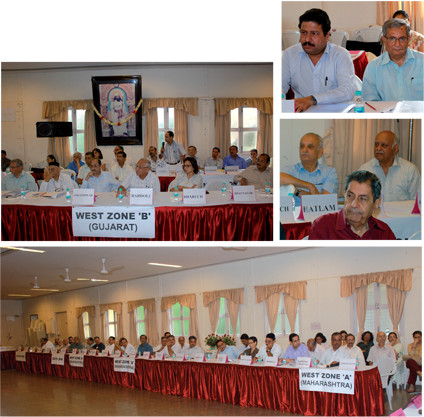
Clockwise from top right BPP’s Mehli Colah and Cawas Panthaki; Bahadur (left) and Jal Postwalla, Bomi Hirjee (forefront); delegates from the various zones
Student counseling
School counseling service initiated 10 years ago is now restricted to Bombay’s C. J. School, a coeducational institute with around 1,500 students from the lower socioeconomic strata. Alcoholism among parents as also drug abuse among children are known to exist because of which both the child and his/her family need counseling, conveyed Pareecheher Daviervala. Of the 16 Parsi children under her care, four suffer from learning disabilities for which remedial education in terms of individual attention is necessary, each session costing Rs 350-400, she pointed out.
"The biggest hurdle in diagnosis is denial,” observed Jimmy Mistry who was supported by co-trustees Arnavaz Mistry and Armaity Tirandaz relating their experiences at the Jai Vakeel School, and Firoza Punthakey-Mistree representing Ankleshwar mentioning that the parents of children at the Panday School in Bombay (where many of the nassessalars send their wards) are not willing to admit there is a problem.
Besides remedial education many students are in need of career/vocational counseling too, observed Khojeste Mistree who in his interactions with boys at the Gamadia Colony hostel found that they wanted to do an MBA without knowing what the acronym stood for.
"This BPP board is extremely open to taking the community into the 21st century,” mentioned Mistree in his concluding remarks, beseeching anjumans for their "cooperation and support all the time” so that "when talking to the government we speak with one voice.” Working on the BPP board for the last "nine months” Mistree found, "I learn new things every time when I go to the BPP…nurtured by the senior BPP staff. Dinshaw, of course, is an old warhorse. It’s incredibly stimulating working under him. He is an encyclopedia of information on the community.” Despite their "different perceptions…we have a positive, focused way of working.”
In her vote of thanks Arnavaz Mistry remarked, "Differing points of view have place, but not at the cost of unity in the community. Mutual respect will have to replace rancor.” She urged members to "make things happen” rather than let opportunities slip by and wonder "What happened?” Armaity Tirandaz was sanguine the community "will overcome problems if we undertake every step in God’s name.”
Those attending the Federation meeting were: Porus Debara from Agra; Gustad Anklesaria from Ajmer; Rustom and Shehernaz Gandhi from Allahabad; Bomi Kavina and Firoza Punthakey-Mistree from Ankleshwar; Adil Vania from Badnera-Amravati; Homi Pithawalla, Pervez Mehta and Kersi Sanjana from Bardoli; Commodore Medioma Bhada from Belgaum; Sarosh and Pilloo Ginwalla from Bharuch; Sohrab Anklesaria and Feroz Patel from Bhopal; Marazban Baria from Billimora; Dinshaw Mehta, Khojeste Mistree, Jimmy Mistry, Yazdi Desai and Armaity Tirandaz from Bombay; Noshir Paghdiwalla and Yazdi Motiwala from Borivli; Bahadur Post-walla from Calcutta; Parvez Italia from Chikhli; Mancher Mubarakai from Dahanu; Burges Wania from Daman-Vapi; Marazban Wadia from Davier; Adil Nargolwala and Farrokh Rustomji from Delhi; Sherena Khan from Deolali-Nasik; Anahita Desai and Yasmine Sanjana from Dumas; Shovir Irani from FOZYA; Phiroze Gandevia from Gandevi; Dr Mehroo Panthaki from Illav; Bomi and Shireen Heerjee from Indore; Pervez Irani and Mehrwan Irani from the Iranian Zoroastrian Anjuman; Kerman Batliwalla from Jabalpur; Ronny Dick from Jhansi; Rustam Patel from Kanpur; Tannaz Parakh, Noshir Captain and Pervez Khergamwala from Khergam; Firoz Patel from Lucknow; Farokh Kavina and Parhad Postwala from Mahuva; Dadiba Dalal, Mani Clubwala and Nariman Mogrelia from Madras; Pervez Mandvi-wala and Godrej Hansotia from Mandvi Mangrole; Commodore Aspi Marker from Mhow; Navroze Daver and Shiraz Doongaji from Nagpur; Hoshang Wania and Kersi Saluwala from Nargol; Noshir Jal from Neemuch; Navroze Kotwal and Kersi Tamboli from Panchgani; Homi Pardiwala from Pardi; Tehmasp Bharucha and Porusasp Mehta from Poona; Khushman Tambulli from Rajkot; Tehmton Anklesaria and Rus-tam Patel from Ratlam; Sarosh Poonawalla, Jehangir Mandviwala and Yezdi Panthaki from Saronda; Jamsheed Kanga from Satara; Keki Colah, Jehangir Batliwalla and Kerfegar Antia from Secunderabad and Hydera-bad; Pervez Bhesania, Zarsis Udhna-wala and Rustom Cursetji from Thana; Marzban Dhanbhoora and Aspi Sanjana from Valsad; Mehli Colah and Soonnoo Vesuna from Vesu; Dr Bahadur Jokhi, Persi Buhariwala and Sarosh Buhari-wala from Vyara-Songadh; Dinyar Nakra and Jal Postwalla from Vizag; Adi Mehta from Zai Bordi. The Press was represented by Parsiana, The Bombay Samachar and Parsee Voice. The office bearers who were not representing their Punchayet were West Zone B vice president Areez Khambatta and executive secretary Arnavaz Mistry. The guest speakers were Dr Mehroo Ben-galee, Eruch Desai, Shernaaz Engineer, Sorab Katpitia, Pareecheher Daviervala and the World Zarathushti Chamber of Commerce delegates Kersi Limathwalla, Cyrus Bagwadia and Yazdi Tantra.
◆ ◆ ◆
From the archive