
Religion
Moving with the times
Outward symbols are less important for the Zoroastrians of Iran than the essence of the religion
Shahin Bekhradnia does not disregard rituals. In fact she says, "I adore the pomp, ceremony and pageant of rituals. However, it makes it so much more interesting and effective if they are meaningful to us.” Bekhradnia, president of World Zoroastrian Organisation, was speaking on how "Zoroastrian attitudes have evolved differently among Iranian Zoroastrians” to about 30 eager listeners on December 21, 2011 at a talk organized at the home of the chairman of the Association of Inter-Married Zoroastrians which has approximately 350 members on the roster. The daughter and granddaughter of practicing priests, history and anthropology are Bekhradnia’s passions. According to a press release "she got her first degree from Oxford University in modern languages.”
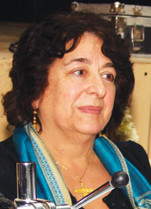
Shahin Bekhradnia: differing customs
Bekhradnia mentioned how the Iranian practitioner of the faith does not wear black head cover as it is associated with the color of Islam and negative forces. In fact wearing white or green head covers is expected of Zarathushtis. Iranians are also mystified at "pious Parsis fishing out their handkerchiefs to cover their heads which are either previously or later seen to be used for their nasal function.” The scholar specified that Iranian Zoroastrians do not cover their heads with their hand. There are several ways, she believes, "of communicating religiosity and the Iranian Zoroastrian enters a place of worship without any head cover rather than a handkerchief or hand. Neither do they kiss railings and place their forehead on the kebla or put ash on their foreheads.” Practices, she believes, Indian Zoroastrians (Parsis) have acquired as a result of centuries of Indianization. The custom of using rice and coconut in auspicious ceremonies is also the result of influences of the land the Parsis made their own, she ascribes. Further, due to the paucity of sandalwood, fires do not blaze in Iranian places of worship; theirs is a low wood consuming fire.
"The sudreh pushi (navjote),” Bekhradnia states "is an important rite of passage but if this is not done by parents, the person does not lose his faith in Iran.” There may be constraints of finance and personal safety which stop some from performing this ritual. "Iranian Zoroastrians do not suddenly lose their validity just because their parents may never have arranged the ceremony… We have grown up communicating with Ahura Mazda and are not shocked, nor judge a person’s worth or authenticity by whether or not they are wearing these outward symbols.” She then narrated a personal incident when she and a group of Iranian Zarathushtis tried to enter a place of worship in India. Her party was denied entry as they were not wearing the sudreh and kusti although they spoke in Dari (the language used by Zoroastrians from Yazd and Kerman), and recited the Avesta prayers. The only criterion for admission was the requisite attire which, as Bekhradnia pointed out, anyone could simply don as proof.
The doors of worship are open to all in Iran. "Some certainly come with evil intent but even where the community has been particularly vulnerable” they are welcomed as are all at gahanbars and farvardigan. "Men and women are equal as in the Gathas — the musings of Zarathushtra.” When there was no male heir Zoroastrian queens ruled. Iranian women were the first females to go to school, university, become professionals and maintain a high standard of literacy in Iran. She emphasized that the home was run by either men or women, whichever arrangement was most efficient for that specific household. "Women used to and continue to fulfill priestly duties. Priests respect the eight female mobedyars” who were recently initiated.
"Our religion optimized and celebrated life — we dance, we drink and eat together. We are allowed to make our own wine. Navroz is the most joyous. Parsis don’t celebrate this to the same extent with a table, etc.” The celebration in Iran seems similar to that in Tajikistan, and as observed by the Kurds and Azaris. Only the Parsis have a variant in celebrating it in summer rather than in spring, when nature is bountiful.
The advice given to celebrants at the wedding is unfortunately in an unintelligible language for Parsis, she lamented. For Iranian Zoroastrian immigrants who may no longer be fluent in Farsi or Dari or for interfaith marriages, this inspiring liturgy is recited with an English or French translation. "There is nothing reprehensible about updating the liturgy so that it can really be meaningful and communicate an important message as it was intended to do. We do not see it as a cardinal principle to remain entrenched in the past and not change.”
Several Iranian towns gave up the dakhmenashini system in the early 20th century as social changes swept through, noted Bekhradnia. She does not consider cremation a defilement of fire as "fire is inherently self purifying by its very nature. Where cremation is not an option, then burial has to be the alternative… It is clear that what may have been appropriate for past times, can no longer be relevant in a changed social context.” In India, due to the monsoons and moisture, there is putrefaction of the body, a problem which simply does not exist in Iran.
She explained that segregation during menstruation was practiced to give women some well-earned rest, "not that they were contaminated and with evil spirits...” This was loudly rebutted by some attendees who said grapes are not to be picked by "such” women. One voice repeatedly asserted that there was scientific proof of contamination during menstruation. "The point is that such matters were not spelt out in the Gathas, but became the obsession of a priestly caste that wished to keep the people in its thrall…” she insisted.
Bekhradnia talked passionately of the tribulations of Iranian Zarathushtis and how the priests were the last to convert to Islam in a community of about 7,500 persons there. The scholar also mentioned how we in India lost knowledge about practices as years went by and how B. N. Dhabhar, Nariman Hoshang and Manekji Limji Hataria were sent back and forth between India and Iran over a period of three centuries to calibrate some of our practices. Bekhradnia referred to "our late High Priest Mobed Ardeshir Azargoshasb whose erudition and authority as head of the Iranian Mobed’s Council is indisputable despite efforts to undermine (his) learning and knowledge. Prof Kaikhosrov D. Irani published a statement in Parsiana of May 1991: "We must preserve our religion and accept persons who want to embrace it.”
In conclusion, Bekhradnia quoted from the Gathas (31.3, 47.6 and 45.1) to buttress her point that conversion is permissible. She mentioned how the slaves who had converted wore the kusti, how Darius and Xerxes propounded conversion: "spread by force even.” In the time of Mohammad Reza Shah Pahlavi 300 people were converted to Zoroastrianism and were later killed by the Revolutionary Guards when the revolution came. Bareshnum is performed on those who have been forced to change their religion. "When asked if juddins may convert to Zoroastrianism the answer from Iran was ‘yes,’ if no harm comes to the juddins. Even in adoption, there is no thought given to the person and s/he is welcomed. We have no discrimination between boys and girls. We do not subscribe to mindless dogma, superior genetic or superior composition and (some) seem to bully us and resort to violence — and why should we tolerate this?”
◆ ◆ ◆
From the archive