
Books
Guardian of doctrinal purity
The Collected Scholarly Writings of Dastur Firoze M. Kotwal (Volume I) edited by Firoza Punthakey Mistree and Cashmira Vatcha Bengalli. Published in 2018 by Parzor Foundation, F-17, Block F, Hauz Khas Enclave, Hauz Khas, New Delhi, 110016. Pp: 726. Price: Rs 3,500.
No Zoroastrian high priest, in the last few centuries, has attained greater scholarly heights than Dastur (Dr) Firoze Kotwal, or been embroiled in more religious controversies than him. To his legion of admirers, both Zoroastrian and non-Zoroastrian, he is the preserver of the pristine purity of the faith. To his detractors, he is a cold obscurantist, disconnected with ground realities. It is undisputed, however, that Kotwal has been a colossus on the Zoroastrian firmament for more than six decades.
The Collected Scholarly Writings of Dastur Firoze M. Kotwal (Volume I) is broadly divided into the life and times of the scholar-priest, and some of his writings and research papers. The first part, written by Firoza Punthakey Mistree, recounts the life story well. The second part, bristling though with stellar scholarly research, is heavy reading, even for a reasonably well informed student of the religion.
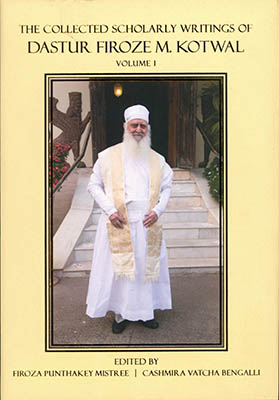 The book, publised by the Parzor Foundation and funded by the Wadia trusts, purports to be an authorized biography; it reads like a clever hagiography. Mistree is not even faintly critical of her subject, who is a demi-god worthy of quasi veneration, though she clinically presents the tale of his early life – a poignant story of poverty and great adversity. Even Kotwal’s worst critic will admire his perseverance, persistence and profound knowledge. Hailing from a family of wholetime priests, all proficient in performing the inner liturgical ceremonies (his great-grandfather walked from Navsari to Bombay carrying the holy alat for the consecration of the Anjumanna Atash Behram), Kotwal was the first to combine it with great scholarship. With candor, Mistree recollects the touching story of his father who became mentally unstable after unwittingly consuming sweets spiked with poison designed to kill rats. This led to acute poverty and financial stress for the young lad, who spent 30 years with the M. F. Cama Athornan Institute as a student, housemaster, and then principal. Enthralled at being permitted to give boi at the Navsari Atash Behram, young Kotwal vowed to save enough money to make a donation for the holy fire’s upkeep. Decades later, in 2015, Kotwal donated Rs 10 lakhs (USD 14,490) for his favorite Atash Behram. This was magnanimous for a honest priest with meager savings.
Prof Mary Boyce was the first to appreciate Kotwal’s rigors for academia. She remained a lifelong mentor for the scholar priest, beginning from his first visit to the UK, where he did pioneering work. Later, at Harvard, he co-authored a treatise with James Boyd, another formidable scholar. The Royal Asiatic Society of Great Britain and Ireland made Kotwal an honorary fellow, a mark of great scholarship. The culmination was in 2012, when a Festschrift was published to honor Kotwal’s scholarship. On correct ritualistic practice, Kotwal will always be regarded as the foremost authority, unparalleled in his grasp of the minutiae.
The Collected Scholarly Writings of Dastur Firoze M. Kotwal (Volume I) is broadly divided into the life and times of the scholar-priest, and some of his writings and research papers. The first part, written by Firoza Punthakey Mistree, recounts the life story well. The second part, bristling though with stellar scholarly research, is heavy reading, even for a reasonably well informed student of the religion.
The book, publised by the Parzor Foundation and funded by the Wadia trusts, purports to be an authorized biography; it reads like a clever hagiography. Mistree is not even faintly critical of her subject, who is a demi-god worthy of quasi veneration, though she clinically presents the tale of his early life – a poignant story of poverty and great adversity. Even Kotwal’s worst critic will admire his perseverance, persistence and profound knowledge. Hailing from a family of wholetime priests, all proficient in performing the inner liturgical ceremonies (his great-grandfather walked from Navsari to Bombay carrying the holy alat for the consecration of the Anjumanna Atash Behram), Kotwal was the first to combine it with great scholarship. With candor, Mistree recollects the touching story of his father who became mentally unstable after unwittingly consuming sweets spiked with poison designed to kill rats. This led to acute poverty and financial stress for the young lad, who spent 30 years with the M. F. Cama Athornan Institute as a student, housemaster, and then principal. Enthralled at being permitted to give boi at the Navsari Atash Behram, young Kotwal vowed to save enough money to make a donation for the holy fire’s upkeep. Decades later, in 2015, Kotwal donated Rs 10 lakhs (USD 14,490) for his favorite Atash Behram. This was magnanimous for a honest priest with meager savings.Prof Mary Boyce was the first to appreciate Kotwal’s rigors for academia. She remained a lifelong mentor for the scholar priest, beginning from his first visit to the UK, where he did pioneering work. Later, at Harvard, he co-authored a treatise with James Boyd, another formidable scholar. The Royal Asiatic Society of Great Britain and Ireland made Kotwal an honorary fellow, a mark of great scholarship. The culmination was in 2012, when a Festschrift was published to honor Kotwal’s scholarship. On correct ritualistic practice, Kotwal will always be regarded as the foremost authority, unparalleled in his grasp of the minutiae.
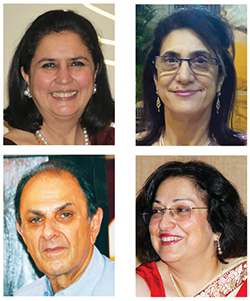
Clockwise from above l: Firoza Punthakey Mistree,
Cashmira Vatcha Bengalli, Dr Shernaz Cama
Photo: Jasmine D. Driver, Nusli Wadia
Out of the five high priests of India, the H. B. Wadia Atash Behram trust is the only one which appoints scholar-priests as its high priest on merit and not heredity. Mistree repeatedly suggests that this has put Kotwal in a disadvantageous position vis-à-vis the hereditary appointees. This reviewer tends to agree. Mistree does not mince words to state that the then trustees of this Trust, particularly a now deceased trustee, treated Kotwal shabbily, compelling him to surrender his post. Very recently, he has been, quite appropriately, re-installed as the high priest of the Wadia Atash Behram.
Kotwal’s orthodoxy is of the dry kind. He dismisses the passionate Ilm-e-Khshnoomists as an esoteric cult, thereby earning the ire of the ultra orthodox. On the other hand, he has always been a whipping boy for the liberals. As a result, he has been attacked by both ends of the spectrum in several religious controversies. To his credit, he has remained unflinching in the defence of what he believes to be the correct doctrinal position. There is little doubt that in his private moments Kotwal must be proud of being labelled as the Defender of the Faith. However odious or regressive Kotwal’s views may appear to the progressives, none can allege inconsistency except for a solitary episode. This involved Kotwal sanctioning the navjote of late industrialist Neville Wadia (baptized son of a non-Parsi mother and a Parsi father), then in his 70s. Naturally, Kotwal was viciously attacked by the ultra orthodox. His defence appears extremely feeble. Kotwal’s arguments on this issue, for the only time, are not based on doctrinal grounds but on factors such as the magnanimity and philanthropy of the Wadias and Neville being a great gentleman. In his otherwise stellar record as a guardian of doctrinal purity, this perhaps is the only incongruity. Sauce for the goose is not always sauce for the gander. While the scholar-priest has lived a very principled life of spartan simplicity, and at times great economic hardship, loyalty towards his life long patrons, the Wadias, is understandable. Even Oliver Cromwell, who detested hereditary royalty, was succeeded by his son.
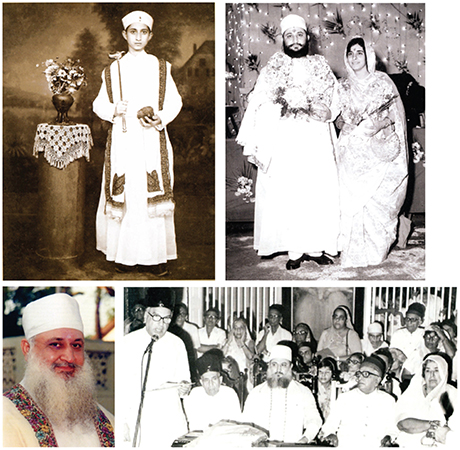
Top row, from l: Dastur (Dr) Firoze Kotwal at his navar ceremony; at his wedding to Navaz Saklatwalla;
2nd row: Kotwal; Sir Jamsetjee Jejeebhoy, 7th Bart, speaking at Kotwal’s installation as high priest in 1977
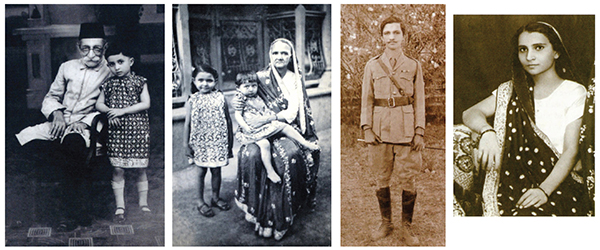
From l: young Kotwal with godfather Navroji Desai in Navsari; seated on grandmother
Manekbai’s lap with sister Dina; father Meherji; mother Najamai
Barring the above episode, for Kotwal, the slightest deviation from doctrinal purity has been impermissible. Of course, extra religious worship is sacrilege. The followers of the Parsi Irani mystic, Meher Baba ("like the Desais of Navsari,” says Kotwal, which is incorrect — the Desais of Navsari themselves condemned the one couple who were believers) are indulging in unZoroastrian practices. The learned dastur does not even approve of the widespread practice in the community of lighting a divo (lamp) on Friday and Behram roz, to Mushkil Aasan; and he prevented his mother from engaging the services of a Parsi faith healer to cure his jaundice. He was also dismissive of widely held priestly superstitions like bad luck follows if the number of bells rung in a fire temple is altered. The Khshnoomists make Kotwal terribly uncomfortable. The discomfort is reciprocated.
Kotwal has been a persona in every major religious controversy. In most of them, he has steadfastly held to his views. A couple of times, he has backtracked. There is no conversion in Zoroastrianism, he emphatically stated in the Joseph Peterson episode (a North American’s navjote in the USA). He opposed the uthamna prayers for J. R. D. Tata at the Doongerwadi complex alleging that Tata was "hardly a Zoroastrian.” He upheld the Bombay Parsi Punchayet (BPP) ban on the so-called renegade priests (for performing after death ceremonies for crematees). He was vociferous in his opposition to the BPP providing a cremate-ni-bungli near the Towers of Silence. He condemned the attempted tragicomic navar of Mikhail Chistyakov, a Russian, at Sanjan by the formidable Dr Meher Master-Moos of the Mazdyasnie Monasterie; and endorsed the orthodox position in the ongoing case of Goolrookh Gupta (interfaith married Parsi woman asserting her rights as a Zoroastrian). Mistree’s spirited defence of Kotwal in the Athravan Education Trust (AET) controversy convinces a dispassionate reader that the scholar was unwittingly caught in the crossfire of opposing forces.
However, he really went overboard in the Roxanne Shah controversy (not allowing the body of a young interfaith married Parsi accident victim to be consigned at the Tower). "To marry outside the fold is next to adultery,” were Kotwal’s memorable words, never to be forgotten by a shocked community including traditionalists. Even Mistree grudgingly concedes that "it was somewhat inappropriate” and "unnecessarily harsh.” It is sad that Kotwal, a man of great and admirable scholarship, who led a pious, spartan, honest life with humility and religious fervor, will be remembered most for this Marie Antoinette like pronouncement. Perhaps it was his biggest lapse of judgment. He was no rabid ranting mobed venting his ire. Kotwal, without the slightest doubt, is beyond any comparison in his knowledge of the religion. Hence, he ought to have been more responsible. Subsequent feeble attempts by his supporters to redefine "adultery” hardly helped.
Not so strangely, in two controversies where he took a progressive view, he had to step back. Kotwal played a cameo role in the Zubin Mehta inspired film, On Wings of Fire, which was assailed by the ultra orthodox, compelling Kotwal to back step in his defence of the filmmaker. More recently, in the Mumbai Metro case (movement to stop a tunnel running underneath the Wadia Atash Behram) Kotwal initially gave a clean chit to the Metro authorities and later did a volte face. He admitted that he was mistaken and possibly misled or maybe he misunderstood. Secular issues have not been his forte.
In practical matters, the scholar-priest appears to be naïve. His position and standing have been "used” by vested interests in some of the controversies, putting him in an embarrassing position. Be that as it may, while Kotwal’s judgment may have been faulty, his bona fides were never in doubt.
On a personal note, I first met Kotwal in May 1966, during my navar and maratab training in the Navsari Vadi Daremeher, the most ancient and sacred of daremehers in India. Barely 10, I was greatly impressed by his handsome and imposing personality, enhanced by a flowing jet black beard and sparkling eyes. There was a hushed silence amongst the navar candidates when he strode like royalty in the corridors of the Daremeher. Once, when some mischief of the boys angered him, he flung his joda (footwear) at us, as no one could touch a navar candidate. In Desai Vad, his adoptive parents were our next door neighbors, gentle souls who were so kind to us children. The entire town was awed by this dashing and highly learned priest. At 19, I participated in an essay competition by the Bangalore Parsi Anjuman on the future of Parsis. The views expressed in the essay were liberal, if not radical. I won the first prize. The sole judge of this competition was Kotwal.
Mistree’s style is lucid, some of her statements backed by source material and painstakingly researched. The quality of translation of Gujarati phrases is excellent, save and except that she is wrong in stating that the Parsi delicacy, umbaryun is like the Gujarati signature dish, undhiyun. They are worlds apart. Mistree’s account of the bitter rivalries between different priestly groups in the 18th and 19th centuries (including physical violence) is riveting. Of course, her bias towards the orthodox view is palpable. As is her obvious disdain for the liberal elements in the community. Printed on art paper with some rare color photographs, the book is a collector’s item. A primer for those interested in religious issues which have agitated the community in the last 100 years or so. She may be adjudged as a blatant hero worshipper, but then there is a lot in her hero which is worthy of worship.
BERJIS DESAI
Desai is a lawyer in private practice and a part-time writer.
◆ ◆ ◆
From the archive