
Environment
The weeping wadis
The poor yield of chikoo orchards in Dahanu is compelling the Zoroastrian farmers to seek alternative sources of income
You have lured away my laborers to pluck the fruits in your wadis (orchards),” was the commonly heard accusation among Zoroastrian farmers in Dahanu until a few years ago. Blessed with fertile land, salubrious climate, and hardy chikoo trees that gave a good yield with minimal tending, the Zoroastrian farmers in Dahanu had little cares but to supervise the movements of their hired labor. The scenario has changed radically in the last decade since the Reliance Energy Dahanu Thermal Power Station became operational. Now the fear is not of the hired hands being employed elsewhere but whether there will be enough work on their own orchards to justify their wages.
"This is a sad situation for the nearly 160 Zoroastrian families in Dahanu, 80 percent of whom depend solely on horticulture for their income,” conveys Ronnie Irani who has two wadis on the outskirts of Dahanu, but thankfully also owns Hotel Pearline on the beach front which he says is "supporting the farms.” Originally the region enjoyed three successful harvesting seasons for chikoos (November-December-January/April-May/August-September) but now they get barely one-and-a-half good seasons, is the lament of most Zoroastrian farmers in the area.
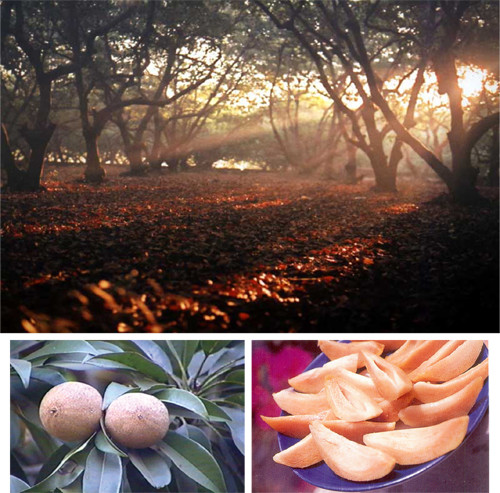
Top: An overview of the chikoo wadis and the tempting fruits before and after plucking
Whether global warming and the fall in water tables is contributing to the drastic reduction in output is not certain. Nor is it known whether proliferation of seed borers or the heavy floods of 2002 which saw 32 inches of rain in 10 hours is ruining the harvest. But seeing the smoke rise from the 275-foot chimney (one of India’s tallest, according to an article in The Indian Express of December 27, 2003) of the coal-based Thermal Power Station in Dahanu [initially set up by the Bombay Suburban Electric Supply (BSES) Company and since last year taken over by Reliance Energy], deposits of fly-ash on the leaves of fruit trees and acid rain in their area declared as an "ecologically fragile green zone” since 1991, the farmers are inclined to believe that the thermal plant is causing their ruin. More so considering that there is a bumper crop in neighboring Amalsad and Gandevi.
Depending on the location and size of the orchards, the age of the trees and fruits they are cultivating, the Zoroastrian farmers have different experiences to relate. Parsiana met some before the onset of the monsoons. With the winter crop failing, Percy Irani says there were no chikoos for six months. His 60-year-old trees are giving him no returns. "The crop has gone down by 60 percent,” believes Feroze Yezdani pointing out how they were without chikoos for two-and-a-half months. While the agents or middle-men pay the farmers Rs 4-5 a kilo, they sell them in the market for Rs 24, he observes wondering whether it would be wiser to sell off his land. While he is still deliberating, Zubin Irani sold off his 22 acres of ancestral property when faced with labor problems. Referring to the massive deforestation in the area, even around Mt Bahrot, he had noticed that the district was losing its charm for the farmer. He preferred to pursue his business in exporting cricket bats while his wife Smriti is the popular TV star in the serial Kyunki Saas Bhi Kabhi Bahu Thi.
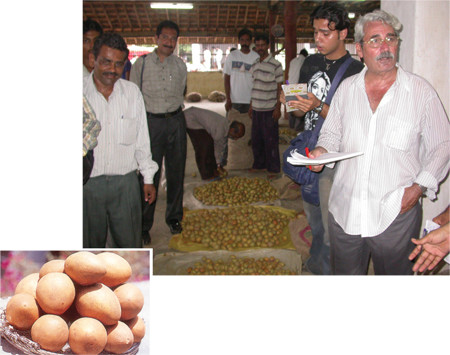
Top: Chikoo auction in progress Left: The fruit is ready for marketing
Down to a quarter of their annual production Gover Mubarakai visits her wadis every morning. A trained audiologist and speech therapist, she runs a School for Deaf Children in Dahanu while husband Bomi simultaneously pursues a construction business. Despite his yield having gone down by nearly 30 percent, Kaizad Irani "enjoys working with nature.” Like him, Bomi Irani admits that the yield per tree has gone down by 30-40 percent and feels obliged to "pay more attention to cultivation.” The popular medical practitioner Dr Beheramshah Mazda complains the product has gone down to 25 percent. He finds the pollution particularly noticeable with the winter inversion and points out how windshields of cars are black with soot at night, how almond trees showed black water dripping from the leaves, and how clouds of smog are seen when it rains. Respiratory ailments and skin allergies which he is now asked to treat were never known in the earlier years, he recalls. In the hope of finding Dahanu’s "chokhi havaa (pure air)” better than Bombay, Adi Sanjana and his wife relocated here but are wondering whether they are slowly going the Chembur way! Although their crop yield is down by 50 percent they manage to make ends meet, he says.
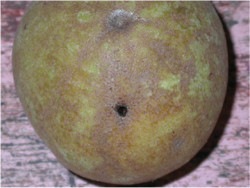
A seed borer leaves its mark
"With the exception of chikoos, everything on this land comes at a higher price,” points out Moti Irani who regrets that the farmers continue to earn barely Rs 4-5 per kilo when 20 years ago she remembers her father sending her a letter to "enjoy her vacation” abroad for the chikoo prices then had reached an unprecedented Rs 12 a kilo. Despite labor costs escalating, the costs of manure and inputs increasing, the income has remained static over the years with the result that "we have to keep digging into our coffers.” Her husband runs the Agnee Bakery in Dahanu.
The coconut yield is down too but complaints about those trees are of a different nature. Invariably on the periphery of the wadis the coconut trees are seen more as a liability they attract thefts. There is also the possibility of a coconut falling on a richly laden chikoo tree and causing wanton damage. The quality of the coconut is substandard too with the outer shell appearing to bear a brownish rash. Whilst initially there was good demand for the coconuts at the Dahanu railway station, now with 200 ml aerated drinks available for Rs 5, there are few takers for coconuts which are sold for Rs 12 each.
If a 500 megawatt thermal plant can allegedly upset the ecological balance, the locals dread to think what would happen if a 2,500 megawatt station becomes operational, as is rumored. On behalf of Reliance Energy, Sangram Mohanti, additional vice president — corporate communications, cautions, "A rumor is more fatal than an atom bomb...We are not flouting any pollution laws of the land. Even based on international standards we have been rated among the 10 best in the world by Power magazine,” he trails off before reminding how useful the thermal plant is in supplying electricity to the northern suburbs of Bombay. Lest Parsiana be "biased by the Zoroastrians of Dahanu” he volunteers to take us to the thermal plant to see how clean it is. "Have you seen any ash on the plants in Dahanu?” he demands before continuing, "I am willing to lay down my 22-year-old career if it is proved” that noxious pollutants are upsetting the ecology. According to a court ruling, BSES was supposed to switch to gas in preference to coal and set up a flu-gas desulphurization unit (which reduces sulphur dioxide content in smoke) within the first five years of operations. Global tenders have been invited for this task, assures Mohanti.
In 1989 when the BSES was granted clearance by the state government to set up its thermal plant in Dahanu, among the select few individuals who took the BSES to court were Nergis B. Irani, Kety A. Rustom and their advocate Kerban Anklesaria. They had then formed the Dahanu Taluka Environment Welfare Association constituted by a majority of Zoroastrians. Subsequently was formed the Dahanu Bachav Andolan (half of its members are Zoroastrians) and the Dahanu Parisar Bachao Samiti. The Krishi Samaj and the Dahanu Kashtakari Sangathan are the other organizations which have joined forces to protect their fertile land. They are alarmed by a 1996 report of the National Environment Engineering Research Institute according to which 76,000 kg of sulphur dioxide, 72,000 kg of nitrogen oxide and 4,700 kg of particulate matter are released in the air every day by the thermal plant.
On behalf of the Maharashtra Pollution Control Board (MPCB) member-secretary Dr D. B. Boralkar was quoted in The Hindu of June 6, 2004: "We are putting the onus on the industry to monitor air quality and we get monthly data from Reliance. Based on these readings, the pollution levels, especially sulphur dioxide, are well below limits.” He also insisted that the plant is one of the best coal-based power plants in the country as the coal has an ash content of only 28 percent as compared with the usual 40-45 percent.
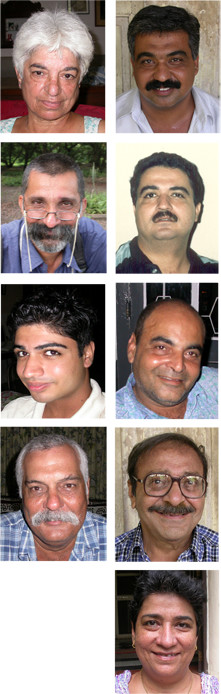
Clockwise from top left: N. Irani, H. Irani, B. Mazda, R. Irani, Sanjana, M. Irani, Yezdani, F. Mazda and Sorab Mubaraki
In March 2004 the MPCB, renewing the contract, granted a further five years’ consent to Reliance Energy to operate its thermal plant in Dahanu. But the Dahanu Taluka Environment Protection Authority (set up by the Supreme Court to monitor development in the region) reduced the period to one year, subject to the installation of the flu-gas desulphurization unit. The Dahanu residents also allege that intermittent shutting of the plant’s electrostatic precipitator causes fog. Reliance Energy maintains that the precipitator is operational throughout the day and the fog is due to inversion which occurs in winter.
To cope with the drop in output the Dahanu farmers have deployed different strategies in the hope of reaping better rewards. Presently there are about 850 Zoroastrians in a general population of 40,000 who have been used to enjoying a high standard of living. The need to save for an unforeseen future was realized by few. They have adopted measures to raise revenue depending on their level of urgency. Many horticulturists have started seeking salaried jobs or initiating businesses. Others have emptied their bank accounts. Land which until a few years ago used to fetch four to five lakhs an acre has today no buyers even for two lakhs, and that too for a ready wadi, reveals Ronnie Irani. "My family has no side business,” declares Percy Irani. "I’ve had to cut down expenses drastically. I may get bushed or I may get through,” he wonders aloud. Those who are getting no yield from their chikoo trees have cut them down in the hope of earning at least some income from the chopped wood. The three Mubaraki brothers — Sorab, Shapur and Firdosh — of Freedom Farms, have put their chikoo wadis to alternate use by planting rows of aloe vera on a commercial basis. The more adventurous are willing to experiment with organic farming and introduce preventive measures like pruning and watering in the hope of improving their crop. "If you take interest in your wadis, prune the trees regularly, spray them, take proper care,” the situation will improve, Kaizad Irani is optimistic. To keep the seed borers at bay, farmers are trying different kinds of pesticides on the premise that the only time the insect can penetrate the tree is in the flowering stage.
After years, the August-September 2004 crop of chikoos has made the farmers optimistic again. It is not because of the rainfall, insists Adil Irani, who explains how they depend primarily on their wells to nurture their wadis. More likely it is because of the continuous functioning of the precipitator, he believes. If the winter yield is equally good they can put the harrowing past behind them.
To get the maximum returns from their limited crop, beginning 2004 a 12-member committee of Zoroastrians — thanks to the initiative taken by Hormuzd Irani — oversees the auctioning of chikoos instead of depending on the middle-men to quote abysmally low rates. The committee handles about 50 tons of chikoos a day (about 70 percent of the total chikoo output in Dahanu). "The chikoo auctioning has not only saved the farms of Dahanu from shutting down, but has also created a unity among Dahanu Zoroastrians which never existed in the past,” writes Farzan Mazda. (Chikoos being highly perishable, they are plucked four days before they ripen. Prior to marketing, they are invariably washed and dried.)
For most, there remains a reluctance to cut the trees which are viewed almost like their children, the attachment having grown over the years. There are few like Zubin Irani who are optimistic saying, "Finally persistence always pays. At some stage they’ll bear the fruits of their labor.” As Bomi Irani points out, "The chikoo tree is a tough tree. It will have to come back and get used to this climate.” Bomi Mubarakai too is confident that ultimately things will improve "for nature has a way of adapting.”
◆ ◆ ◆
From the archive