
Politics and Policy
"Don't create a monster"
The High Priests and the other orthodox sections urge the Bombay Parsi Punchayet and the Indian Federation not to join the proposed World Body
With the June 2005 date for the Eighth World Zoroastrian Congress in London drawing nearer, the din over the formation of a World Body (WB) grows louder. The orthodox elements led by the seven High Priests strongly oppose the proposed global organization claiming it "will not only threaten the religious identity of our community but will also endanger the survival of our race, religion and its institutions (see box "A dangerous and foolish move”).”
At a talk at the Framjee Cawasjee Hall on October 21, 2004 Zoroastrian Studies (ZS) founder and orthodox champion Khojeste Mistree warned that the "tentacles” of the world body would be "more intrusive to the Parsi way of life... don’t create a monster.”
The orthodox lobby’s main objection is the admission of Zoroastrians as versus Parsi Zoroastrians to membership in the WB. "Under no circumstances should this over 1,250-year-old Anjuman of Parsis of India be equated and put on par with the pseudo-Zoroastrians who now claim to profess the Zoroastrian faith and whose increasing numbers abroad will have the potential of marginalizing our community under the unfortunate auspices of a new World Body,” stated the priests’ letter addressed to the trustees of the Bombay Parsi Punchayet (BPP).
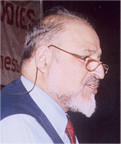
Mistree: going "political”
Mistree was even more scathing in his attack on the ‘neo-Zoroastrians’ terming them "altoo faltoos (worthless)” and claiming "Aie lok ni garam havah ahinya avsé (their hot air will infiltrate here).” He envisioned the day when Tajikistan Zoroastrians would "come (to Bombay) and ask for accommodation” in our housing colonies.
In November last year The Parsee Voice had convened a public meeting (see "Traditionalists’ meet: The conservative voice,” Parsiana, February 2004) at the Framjee Cawasjee Hall where resolutions had been passed voicing disapproval of joining "any World Body of Zoroastrians.”
The resolution stated, "That with a view to maintaining this separate identity and for preserving our religion as practiced and handed down to us by our ancestors, the community thoroughly disapproves of FPZAI (Federation of Parsi Zoroastrian Anjumans of India) and/or BPP joining or associating with any World Body of Zoroastrians existing as on date or proposed to be set up.”
Lamenting the tendency of the Parsi Press to "misrepresent” or "ignore” his statements, Mistree said he decided to speak directly to the community and hence convened the meeting under the ZS banner "so that you know what our leaders are doing.”
The Oxford educated community activist said he was going "political” to oppose the Federation and the BPP from joining the proposed WB.
He noted there was a move to delink the term Parsi and Zoroastrian. In foreign associations the word Parsi had been dropped but in India the Parsi nomenclature had been preserved. "It is the Bombay Parsi Punchayet not the Bombay Zoroastrian Punchayet,” he noted. Similarly it was the Federation of Parsi Zoroastrian Anjumans of India.
"Parsi is not just the race.” Parsipanu was "the foundation on which the religion sits, especially in India,” Mistree said. "They say Parsi thy name is charity. Not Zoroastrians thy name is charity.” (The usage of the term Parsi is absent in earlier legal documents in India. As Justice Dinshaw Daver noted in his landmark judgement in the 1906 Petit vs Jeejeebhoy case: "The language used in all these documents — relating to the immovable properties dedicated to charities is, to my mind, most clear and unambiguous. The people for whose benefit these institutions were established, the persons for whose use these religious establishments were founded, were the members of the Zoroastrian community of Bombay.” The expressions most frequently used are "Zoroastrian population of Bombay,” "the Zoroastrian anjuman,” "the people of the Zoroastrian community,” "the people of the anjuman of the Mazdiasni faith,” "the whole anjuman,” "the holy Zoroastrian community of Bombay,” "the dasturs, mobeds, herbuds (ervads), and behdins of the Mazdiasnian religion of the Holy Zoroastrian community,” "the entire Zoroastrian anjuman of Bombay,” "persons of the Firka of the pure and best Mazdiasnian religion,” "the Zoroastrian community of Hindustan,” and "the Khas-va-Aam of the Zoroastrian anjuman.” — Editor)
In North America, Zoroastrian associations admit "those who profess to be Zoroastrians,” stated Mistree. The World Zoroastrian Organisation (WZO) in the United Kingdom accepts "anybody who professes to be a Zoroastrian.” Three trustees of the BPP — Dinshaw Tamboly, Dadi Engineer and Burjor Antia — are also WZO India trustees/office bearers as well as members of the Indian Federation.
Claiming there was a conflict of interest because of their dual roles, Mistree termed Tamboly "one of the most powerful Zoroastrians in the community... he is not an ordinary person but somebody extraordinary.” He prophesied that Tamboly would "one day have a downfall” if he did "not follow the path of Ashoi.” Mistree and Tamboly had clashed publicly over the alternate methods to be followed for disposal of the dead at Bombay’s Doongerwadi four years ago.
Of the 20 or so Zoroastrian associations in North America all were liberal save one, said Mistree, the Traditional Mazdayasni Zoroastrian Anjuman nurtured by Tahamtan Aresh, a millionaire Irani Zoroastrian now settled in California. (The word Parsi incidentally does not appear in the title of the association as also in Mistree’s own organization Zoroastrian Studies. — Editor)
Mistree noted there was no mention of the word Parsi in the proposed WB. The body will consist of an International Zoroastrian Organization (IZO) under whose wings will exist a World Zoroastrian Organization of Individuals (WZOI) and a World Zoroastrian Organization of Federations (WZOF).
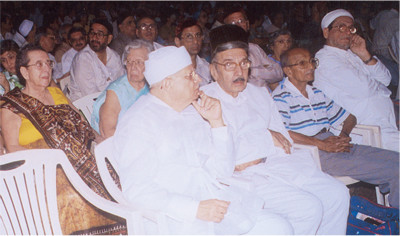
Section of the audience: Dr Nelie Noble, Arnavaz Khan, JamaspAsa, Cowasjee N. Dinshaw
"Why should we allow our leaders to drop the Parsi nomenclature?” Mistree demanded. "Fifteen to 20 years from now you and I will be marginalized and all these converts will have a say... no proportional representation has been given.” Claiming there exist 1,15,000 Parsi Zoroastrians worldwide, (the actual worldwide figure would be under 1,00,000 — Editor) and with 70,000 in India, Mistree said he was appalled that the BPP did not have overriding powers despite representing 60 percent of the global community.
(Mistree made no mention of the 90,000 Zoroastrians in Iran who would also be part of the WB and who do not consider themselves Parsis. Even the Daver-Beaman judgment would exclude them for their definition of Parsis included those who migrated from Iran to India, not those who stayed behind and nurtured the faith. See box on this page, "Who is a Parsi?”— Editor)
The Indian vote would be less than that of the Federation of Zoroastrian Associations of North America (FEZANA) and the Zoroastrian Trust Funds of Europe (ZTFE) combined or that of FEZANA and Iran put together, said Mistree. "The IZO is a paper tiger on the top... We want the BPP to be the strongest body in the world.”
Mistree envisioned a time when neo-Zoroastrians from Eurasia would come to India and claim the rights extended to Iranian Zoroastrians under the Daver-Beaman judgment of 1906 that defines Parsis as those Zoroastrians of Iranian descent who visit or reside in India. Tajiks for example could claim they are originally of Iranian descent. The WB will recognize them as Zoroastrians. "Which judge is not going to be persuaded by that argument...Why create legal lacunas?...
"People say I’m an alarmist.” Referring to priests refusing entry to fire-temples to neo-Zoroastrians and others, Mistree thundered: "Do we expect our mobed sahebs to become religious policemen? I don’t think so!”
He attacked the administration of the BPP and the Federation claiming that he could not obtain a list of addresses of the Federation members nor a revised constitution of the body. "The office bearers of the BPP treat us like dirt... for 25 years I’ve always turned the other way.” But now he was going to take up cudgels. "What does the secretary of the Federation Keki Gandhi say...‘I am ashamed to be a Parsi.’” (Gandhi made the remark at the Bardoli Federation meeting. The context in which it was stated is reprinted here from the minutes of the meeting: "I do not accept, my heart and my mind do not accept that the Zoroastrian religion forbids or prohibits an innocent child from being initiated into the religion and from professing and practicing the religion. Adoption has a humanitarian aspect. An orphan child or an abandoned child thirsts for parental love and care. Parents destined to be childless feel the urge to bestow parental love and care on such children. The relationship of guardian and ward does not fulfill such needs. The orphaned and abandoned children do not need the community’s wealth and the trust funds which in any case are guarded by the trust deeds. What they need is the feeling to belong — to a family, to a community, to a religion. If the Parsi Zoroastrian community is so hardhearted as to deny the orphaned child a place in their homes and hearts I am very sorry; I am ashamed that I belong to such a community. By the same token, if it were to be true, which most certainly it is not, that the Zoroastrian religion forbids the initiation into the faith of such children then I would have been ashamed to profess and practice such a religion.”)
Gandhi says we should ignore the voice of the scholars and the High Priests, said Mistree. Gandhi has been FPZAI secretary for 20 years. "Can’t we find another secretary?” Mistree queried.
Amidst cries of "impeach the scoundrel,” Mistree replied, "We may have to do this.”
Noting that Gandhi was one of the key negotiators on behalf of the Federation in regard to the formation of the WB, Mistree likened the situation to "setting a fox to mind the chickens.” (As a matter of fact Gandhi opposed the formation of a WB under the aegis of the WZO for many years. — Editor)
He termed Gandhi "an extraordinary and competent person.” The way to counter Gandhi and others like him was "to become tigers... It’s the only language they understand.”
He referred to the BPP and Federation’s "badmaashi (roguishness)” in regard to keeping the formation of the WZOF and the WZOI secret from the community and referred to the "hollow platitudes” and "secret communiques... I’ve (therefore) decided to become politically active.” [In the Parsiana, March 2001 issue the article "Unanimous or unilateral” by Arnavaz S. Mama makes reference to such a structure: "The WZO draft constitution now proposes a bicameral system under which functions a Council of Federations comprising proportional representatives from the various regions of the Zoroastrian world. This Council of Federations, with its own office bearers, would address its assigned list of topics independently of the Council of Individuals that comprises the WZO’s existing membership, both of individuals and associations. The WZO’s system of proxy voting is confined to the council of individuals.
"Thus the two Councils work according to different sets of rules but combine to form an International Board of Directors (IB) where any of the 16 + 16 members are free to raise issues outside their immediate jurisdiction. A London-based secretariat is meant to provide executive support.”]
Noting that the BPP has assets of more than 10,000 crore rupees or even double that amount, he pointed out the Federation "does not even have a desk or table to its name.” (The asset figure for the BPP would be less. The BPP has 6,000 flats. If valued at 50 lakhs each the figure would come to 3,000 crores. The 53 acres of Doongerwadi at 60 crores an acre — the price per acre cited by
The Times of India for the Cama bungalow, ‘Cozy Corner’ on Malabar Hill in Bombay was around 100 crores for approximately 1.5 acres — would fetch 3,180 crores, making a total of 6,180 crores. The other BPP assets may be around another 500 crores. — Editor) The associations in North America operated from the homes of whoever was the president at the time, he noted.
"To hell with them! We don’t want them!” Mistree exclaimed adding they were "wonderfully wealthy” but "in 40 years there is no enthroned fire in Canada, in the US... aasman jameenno farak chè (there is a difference of the sky and earth between them and us).”
Alleging that the presidents of FEZANA come to India every year to attend family or business matters and not for community purposes yet they meet with the BPP trustees, Mistree queried, "Why institutionalize something which can be done informally?”
If the Zoroastrians in the West do not accept the Parsi nomenclature in the world body "tau maro goli (to hell with them),” he thundered.
"Maintain the status quo...Don’t do it secretly...We don’t want to be united with any... altoo faltoo (worthless) Zoroastrians. I want our (BPP) chairman (Minoo Shroff) to be strong, to lead. My fight is not with Mr Shroff.”
Referring to the commercial development of fire-temple properties in Bombay which he opposed, Mistree prophesied "cosmic justice takes its own time... and the nine pins will fall.”
Desist from forming a cosmopolitan world body, he urged. "Burjor Antia says if Russia and the US can join the United Nations then why not Zoroastrians sit together? Neither the US or Russia is going to lose their sovereignty,” Mistree argued.
He noted that when the "Pope says no to birth control the Christians follow” his dictum! (Italy is said to be leading Europe in restricting family size. — Editor)
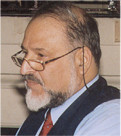
"Maintain the status quo...Don’t do it secretly...We don’t want to be united with any... altoo faltoo (worthless) Zoroastrians”
He bemoaned the fact that The Zarathushtrian Assembly founded by California based scholar Ali Jafarey had set up the Spenta University in Poona "in our back door... aie lok ni garam havah ahiya avsé (their hot air will come here),” he warned.
Mistree referred to the tree cutting controversy at Doongerwadi and the audience demanded that Sarosh Daruwalla, who was assigned by the BPP to videograph the area while the BPP trustees were visiting the site explain what he saw. Mistree and his wife, Firoza, happened to be at Doongerwadi at the same time and joined the trustees and Daruwalla on the two-and-a-half-hour tour. Khojeste Mistree is a member of the Doongerwadi Advisory Committee since the last three years. A perplexed Daruwalla reluctantly addressed the gathering stating that trees may have fallen "due to negligence.”
He later clarified in a report in the Jam-e-Jamshed Weekly of October 31, "The most important statement in the Doongerwadi tree-felling episode by Mistree was that the trustees were with him for two-and-half-hours and not once was there any confrontation with them. Yes, there were sharp exchanges from both sides and tempers ran high sometimes, but Mistree will concede that it was not with the trustees who were very civil and receptive, but between him and the BPP Doongerwadi staff, and I say this because it happened before me.
"Honestly speaking, my response at the Framjee Cawasjee meeting was only due to the humiliation to which I was unnecessarily put. It was like an unending walk from the last row of the auditorium to the stage. A man who tries to provide best quality equipment for the audience on his professional assignment, tried to furnish the best-unbiased observations to the audience, but to large extent failed due to nervousness. Couldn’t do much justice to the 75-year-old chairman Minoo Shroff who walked for two-and-a-half-hours in the sun, a man who has been with BPP for over 20 years doing honorary work selflessly. He does not need to be castigated but needs to be supported. On the one hand Mistree says he wishes to reconcile and on the other hand faults him in an open forum.
"To put the record straight what was the need for Mistree to bring up this topic at the meeting where he himself clearly told the audience that the trustees were with him for two-and-half-hours. Yes, I said there was negligence at Doongerwadi, but by the staff at Doongerwadi. The picture of the tree that had fallen during heavy rains itself explains that there was no chopping off of the trees, but they had fallen due to natural reasons.
"In the vast Doongerwadi complex of nearly 53 acres where there would be at least a few thousand trees, I did not see more than 10 trees that had fallen down. Is it not blowing up the issue out of proportion?”
Mistree pointed out that his talk had cost thousands of rupees to which he had also personally contributed thousands. When asked by a member of the audience how they could help, Mistree urged them to be vigilant and write to the Press and the Punchayet voicing their opposition to the ills facing the community.
Who is a Parsi?
Parsi Zoroastrians as defined by the Daver-Beaman judgment:
Firstly the descendants of the original emigrants into India from Persia who profess the Zoroastrian religion.
Secondly the descendants of the Zoroastrians in Persia who were not amongst the original emigrants, but who are of the same stock and have since that date, from time to time, come to India and have settled here, either permanently or temporarily, and who profess the Zoroastrian religion.
Thirdly the children of a Parsi father by an alien mother. If such children are admitted into the religion of their father and profess the Zoroastrian religion.
"A dangerous and foolish move”
The Trustees, Bombay Parsi Punchayet, D. N. Road, Mumbai 400001
Dear Sirs/Madam
In recent times, the community has been turning more and more to us, the High Priests, for guidance in matters that might be seen by some as beyond the para-meters of religion per se; yet these matters are so intrinsically woven and inseparable — from issues that have a direct bearing on the religion viz the survival of our race and the role that the Parsi Zoroastrian community must play in the preservation of the true, classical form of the Zoroastrian religion, that it becomes imperative for us to guide the community in all such composite matters.
The present crisis faced by the community is in connection with the move by the Federation of Parsi Zoroastrian Anjumans of India (FPZAI) and/or (the) Bombay Parsi Punchayet (BPP) to join the proposed World Body of Zoroastrians (WB).
When this matter of FPZAI and/or BPP joining the WB was brought to our notice earlier, we had, after considerable thought, opined that this WB was completely unacceptable for many reasons; the most important being that the new WB would accept as members, directly or indirectly, self-proclaimed converts from around the world.
Some of us immediately wrote to you expressing our concerns and requested you to refrain from joining such a WB. All seven of us whole-heartedly supported the public meeting organized by The Parsee Voice, in Mumbai in 2003, where the community passed a resolution (without a single dissenting vote) strongly disapproving of any move by FPZAI and/or BPP joining or associating with any such WB. We are informed that a copy of the said resolution was forwarded to you.
At that time, we felt that this very strong verdict against the WB from the community as well as from us, the High Priests of India, would suffice to close this unfortunate chapter, forever. We are deeply pained that this has not happened, and matters in fact are moving ahead to form the WB.
As you are aware, our migration from Iran to India was an intentional and planned one for the sole purpose of preserving our religion and race through our spiritual and religious institutions. Under no circumstances, should this over-1,250-year-old anjuman of Parsis of India be equated and put on par with the pseudo-Zoroastrians, who now claim to profess the Zoroastrian faith, and whose increasing numbers abroad, will have the potential of marginalizing our community under the unfortunate auspices of a new WB. By joining a WB that condones and actively acknowledges conversion, by institutionalizing it through the constitution of the proposed WB, you are making the entire community a party to condoning that which is against the practice of the religion in India for over 1,250 years. As High Priests of the community, we cannot allow this to happen. A WB with this kind of mixed membership, now or in future, will not only threaten the religious identity of our community but will also endanger the survival of our race, religion and its institutions, defeating the very purpose for which our ancestors first came to India.
We have survived and progressed in India for over a millennium under the divine protection of our Holy Iranshah Atash Behram and the other Padshah Sahebs enthroned in India. We did not need a WB to protect our "interests” then, and we do not see the need to have one now. We see no benefit accruing to the Parsis of India by our joining this WB. In fact, if the BPP/FPZAI were to join, it would be a dangerous and foolish move.
As High Priests of the community in India, it is our duty to provide guidance to the community in times of crisis. In performance of this duty, we caution that this WB is a threat to our survival as a community and to our religious denomination. We reiterate that the formation of the WB does not have our sanction and that it would be in the interest of the community to drop any move by FPZAI and/or BPP joining such a WB now or in future. Let not future generations of Parsis be deprived of the rich heritage passed on to us by our worthy ancestors.
Yours in His service,
DasturS Dr Kaikhusroo M. JamaspAsa, Mumbai; Dr Firoze Meherji Kotwal, Mumbai; Khurshed Kaikobad Dastoor,Udvada; Cyrus Noshirwan Dastur, Surat; Meherji K. Meher-jirana, Navsari; Dr Peshotan HormAzdyar Mirza, Udvada; Nadirshah P. Unvalla, Bangalore
◆ ◆ ◆
From the archive