
Business
Housing at new heights
Centrally located, the 23-storeyed Hilla Towers being developed by Zarir Bhathena of Hilla Builders combines comfort with affordability and modernity...
The project reflects the changing face of Bombay. The 23-storeyed Hilla Towers, on ownership for Parsi/Irani Zoroastrians only, will soar into the sky in the Parel precinct — the mill heartland of the textile town that once was Bombay. Currently under construction in the compound of the over 100-year-old M. J. Wadia Fire-Temple at Lalbaug, the project is expected to be completed in two-and-a-half years’ time.
The urban landscape in central Bombay is witnessing a construction boom, asserts Zarir Bhathena, director of Hilla Builders Private Limited who is the developer for the project. The turning wheel of history over three-and-a-half centuries has seen Parel metamorphose from a sleepy hamlet of mudflats, which passed into the hands of the British Crown in the 1660s, to an affluent area where British governors and guests wined, dined and waltzed in the stately ballroom of Government House (now the Haffkine Institute) and rich sethias built their villas to escape the confines of the Fort. The industrial revolution and the cotton boom of the 1860s saw the development and then decay of the area with the mushrooming of migrant workers’ chawls, mill chimneys spewing smoke, narrow streets and gullies unable to cope with the stress of a burgeoning population.
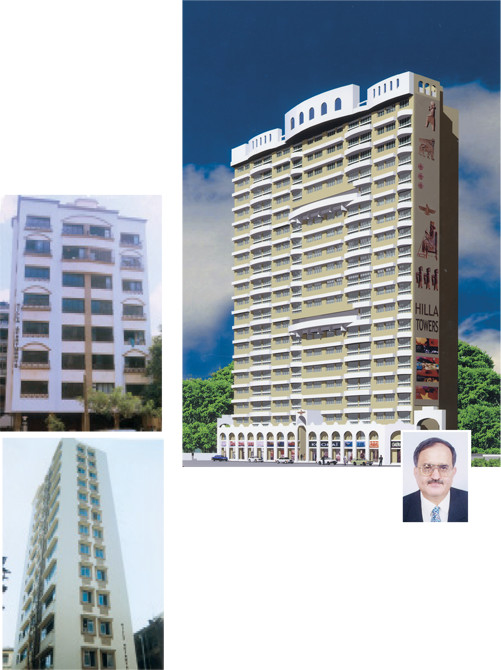
Above: The new tower and Bhathena (inset); below: earlier constructions at Malad and Grant Road
The labor unrest of the 1970s brought silent looms and shut-down mills — and the subsequent corollary in the recent past of opening up mill lands for residential and commercial development. The construction of numerous flyovers has facilitated the smoother flow of traffic. "The Stamp Duty Ready Reckoner 2003 notes that prices in Parel/Lalbaug are rising and are currently quoted at around Rs 4,340 per square foot (sq ft),” says Bhathena who is a chartered accountant by profession and a builder by choice. "No, I do not find the construction line stressful,” he smiles in response to Parsiana’s query. "I find it challenging!”
The project has finally got off the ground after a protracted legal tussle which went all the way to the Supreme Court which dismissed the Special Leave Petition filed against the trustees of the Muncherji Jamshetji Wadia Fire Temple Trust and Hilla Builders by a few individuals who sought to block the development of the property. "I can only term this ‘vexatious litigation,’” says Kersi Limathwalla, of Kersi Jamshedji and Company, chartered accountants who is chairman of the Trust. "Ours is a religious trust. My first concern is to have adequate funds to sustain the agiary and keep the surroundings in a manner befitting a place of worship. We have put in so much effort to make the whole complex look nice. As part of the contract, the builder has already repaired the agiary roof last year on a war footing. Several more improvements are planned. The Trust did not have the funds, but we had the space. The chawl in the complex (where a few Zoroastrian families reside) is old and dilapidated and will go in setback in any case due to BMC (Bombay Municipal Corporation) road widening.” Elaborates Bhathena, "These tenants will be given similar accommodation (on ownership basis) on the lower floors of the new building. Up to now, they used to have a common latrine. They will now have the added advantage of an attached bathroom.” The existing shops run mostly by non-Parsis will also be relocated on the ground and first floor of the new building. The panthaky Maneksha Vajifdar, his son Dinyar and family residing on the premises will also be rehoused. "The project is a good step forward,” opines Nariman Mehta, president of the Navroze Baug Play Centre. "Rather than a narrow or fanatical approach, an overwhelming majority in Nowroz Baug (situated nearby) appreciate the new construction which will benefit a large number of people.”
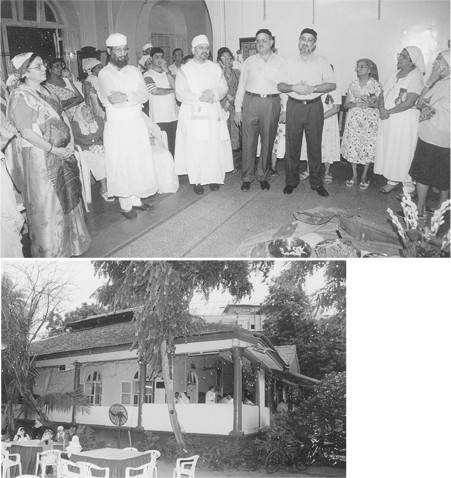
At the jashan: Udvada’s Khurshed Dastoor flanked by Ervad Dinyar Vajifdar, Bhathena, Limathwalla and devotees; the agiary (bottom)
Photos: Superstar Video Labs
Situated close to Currey Road and Lower Parel railway stations, Hilla Towers has one and two BHK (bedroom, hall, kitchen) flats of 740 sq ft and 1,150 sq ft respectively. Designed by architect Rusi Khambatta and Associates Vijay J. Kabre, the structure is of corrosive resistant steel. "Steel with a green coating (which does corrode if left open) is usually utilized in construction but we are paying almost 40 percent more for non-corrosive steel from the TISCO (Tata Iron and Steel Company Limited) factory,” explains the builder, adding that the design is earthquake resistant up to the required specification as well. A double basement car park will have two car elevators. There are to be five passenger lifts, and the ‘A’ and ‘B’ Wings will also be linked by an interconnecting passage on several floors. The building will accommodate over 100 families.
The flats in ‘B’ Wing above the seventh floor are reserved for NRIs (non-resident Indians) and incorporate special features like security with video system and panic button. "Though people usually wait to see the building come up before they buy, almost 60 percent of the flats, including 30 in the NRI wing, have been booked,” declares Bhathena, with Zoroastrians from the Gulf, Canada, USA and UK evincing interest in the project. Flats on the top floors command a good sea view, he adds.
With a 10 percent down payment to be made with the application form, Hilla Builders’ advertisement in the Jam-e-Jamshed Weekly of October 20, 2002 and Parsiana of October 2002 quotes the rate at Rs 3,800 per sq ft of saleable area up to the seventh floor and an increase of Rs 50 per sq ft on every floor rise thereafter. The advertisement adds that a new tower on the same road (S. S. Rao Road) has a base price of Rs 5,400 per sq ft of saleable area and a floor rise of Rs 35 per sq ft from the first floor. (The Express Estates of The Indian Express of March 9, 2003 in its "a la carte” column pegs Parel prices at Rs 4,000-6,000 per sq ft for residential and Rs 5,000-7,000 for commercial premises).
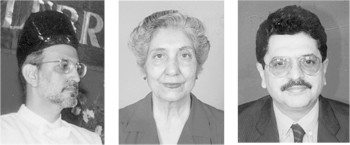
Trustees Limathwalla, Shirin N. Wadia, Shyam A. Wadia
The geometry of the building seeks to explore to the maximum the limitations of the plot. The adarian is but 10 ft away. "No, it is not possible to look into the fire-temple from the building. The entrance is from S. S. Rao Road and the part of the building that overlooks the fire-temple is so designed that residences start from the third floor level. Below that, a jaali (trellis) design blocks out the view,” Bhathena explains. In return for the development rights, the builders have contributed substantially to the agiary Trust and will undertake repairs/renovations including a new hall with air-conditioning and improvements to the surroundings.
Soon after the agreement was signed in 2000, a few Parsis, some of them residents of the nearby Nowroz Baug, objected to the construction. Approaching the charity commissioner, they took the stand that the residential complex violates the objectives of the agiary Trust and the sanctity of the fire-temple. The original petitioners were four in number and the last hearing before the charity commissioner was held on July 27, 2001, Bhathena narrates. Two days before the date (August 6, 2001) fixed for the final order, a junior advocate unexpectedly appeared on the scene without notice to the trustees or signature on the vakalat-nama, he continues. The 31-page charity commissioner’s order came in favor of the builders. The objectors went in appeal to the Bombay High Court with a writ petition filed by Bomi J. Mistry, Bahadur B. Sanjana, Noshir Vajifdar and Vispi B. Baria. In December 2001, Justices P. S. Patankar and A. M. Khanvilkar directed the parties to sit and settle the matter.
Despite the best of Bombay’s legal luminaries lending their expertise to sorting out the differences, the matter went back to the High Court. In a 65-page order, the judges ruled in favor of the trustees and builder: "...The grievances made on behalf of the petitioners as well as the intervenor do not impress us for they are devoid of merits... The offer now made before this Court is obviously impertinent and has been made only with a view to protract the proceedings so as to frustrate the builder and to make him withdraw from the present transaction. We, therefore, see no reason to exercise our writ jurisdiction.”
The petitioners then went to the Supreme Court. At a hearing on May 9, 2002, the Court dismissed the special leave petition. In the interim, the builder had reportedly received several threatening phone calls as well as a letter in Marathi which was handed over to the Crime Branch of the Bombay police. Explains Bhathena: "As I climbed the steps of the Supreme Court, I told Dadar Ahura Mazda that if I am doing anything wrong, please let me be defeated. If I win, I will see to it that nothing comes in the way of this project. I will overcome any obstacle to see this through.”
"Every time the objectors lost at one level, they would put other names as petitioners and advocates. We have always been open to any sensible and practical solution. But we cannot accept when they say ‘do not develop’ or ‘develop only in the way we say.’ We cannot go by whims and fancy or the ego or idiosyncracies of individuals,” asserts Limathwalla. Coming onto the board of trustees around 10 years ago, Limathwalla has Shyam A. Wadia and Shirin N. Wadia as co-trustees. "I am very happy that my co-trustees give me a lot of cooperation. We work in a congenial, cordial atmosphere,” he observes.
"The agiary has had a chequered history,” Limathwalla had told a large crowd of devotees at the Dae mah jashan and dinner organized by the trustees and the directors of Hilla Builders on June 2, 2002. Built in 1834 by Dadabhai and Muncherjee Pestonji Wadia, the fire was shifted to the Wadia Atas Bahram from 1852-62 on account of various difficulties, notes the agiary’s history. The founders’ paternal uncle Muncherji Jamshedji Wadia and his sons Nusserwanji and Burjorji constructed the present structure and the fire was shifted back in 1863. The Trust corpus at that time was Rs 20,000. Inadequate funds for repairs and maintenance have always been a problem. "We have faced every difficulty, but everything has been surmounted by the blessings of Ahura Mazda,” Limathwalla told the devotees assembled for the jashan. Leading the priests at the thanksgiving was Udvada’s Dastur Khurshed Kaikobad Dastoor. "When we are fighting among ourselves, my message is that the most important thing is happiness. Let us seek a world where each man is another’s brother and each woman the other’s sister. The burden is lighter if it is shared. My best wishes to the trustees and developer for this project,” said Dastoor in his post jashan remarks. Added Bhathena: "In my 12 years as developer I have faced many problems. I had showed the plans to Dastur Kaikobad and he said I should increase the distance between the agiary and the building to at least 10 ft. We have done so.”
Stepping on to the construction ladder with a four-storeyed building at Bandra in 1989, Hilla Builders has so far completed six projects all over Bombay, from Fountain to Malad. "It was my dream to build a tower,” Bhathena gives a small smile. An alumnus of Don Bosco High School, Mithibai and Podar Colleges, Bhathena did his articles for his chartered accountancy with Dara Sorabji and Company. For the past 21 years he has been running his firm Z. M. Bhathena and Company, chartered accountants, as well as Dara Sorabji. Bhathena stood for election as a trustee of the Bombay Parsi Punchayet in the year 2000, losing narrowly to sitting octogenarian trustee Silloo Kavarana (see "Never touch any institution,” Parsiana, April 2000). Joint honorary secretary of the B. D. Petit Parsee General Hospital, Bhathena is also on the board of The Zoroastrian Co-operative Bank and assists organizations like ZOSTA (Zoroastrian Student Teacher Association) further their activities. "My social service work impinges a lot on my family time,” he says, commending his wife Jasmine for holding the family fort. Teenage son Berges is doing his final BCom at H. R. College. "Youngsters of today are very intelligent but they need to study as well as work hard. They need to be given the right push to be the leaders of tomorrow. But we Parsis are so occupied with the ‘ifs’ and ‘buts’ of things that we have little time left for positive action!” Zarir opines. Assisting him in the construction line is his brother Jimmy who is the coordinator on site. The firm is named after their mother Hilla who raised them after the early demise of their father Manchershaw when Zarir was but three years old.
Leader of the first Zoroastrian youth group to the US and Canada way back in 1982, Limathwalla’s multifarious activities include being a founder member of the CER (now Committee for Economic Revival), publisher of the Blood Donors Directory, chairman of the Godrej Baug Mobed Building and vice president of the Society for Education of the Crippled. Among the organizers of the Avan roz, Avan mah prayers at the Radio Club attended every year by a huge crowd, as well as the Fravardigan at Doongerwadi on Fravardin roz, Fravardin mah, Limathwalla says the recently started humbandagi at different atash behrams also attracts a good attendance.
Terming his new construction a community project, Zarir states that he has long been associated with the Lalbaug agiary. "My parents’ prayer ceremonies are held here. Improvements to the fire-temple are of benefit to all behdins equally. The litigation was for harassment only. With the objectors losing in the Supreme Court, God has shown us his signal.”
◆ ◆ ◆
From the archive