
Books
Umrigar’s upbringing
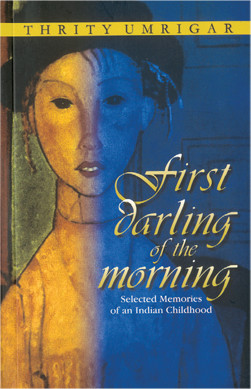
First Darling of the Morning by Thrity Umrigar. Published in 2004 by HarperCollins Publishers, 1A, Hamilton House, Connaught Place, New Delhi 110001. Pp: 294. Price: Rs 295.
First Darling of the Morning is an autobiographical account of Thrity Umrigar’s childhood in Bombay prior to her leaving the city for further studies in the United States of America. When she is seven, her uncle cuddles her one evening and tells her, "You are my first darling of the morning.” She innocently asks him what this means and he shrugs, laughs and confesses that he made it up on the spur of the moment. Umrigar’s autobiography is, at one time, a poignant and unflinchingly perceptive portrait of her childhood and her formative years. "We can choose our friends but not our family members” — how true is this cliché with reference to the various characters that people the book.
The memoir begins on a cheerful note of a middle class Parsi family outing in the 1960s to the cinema to watch The Sound of Music. It is a marvellous opening scene where Umrigar portrays her characters deftly and surely. She also uses this as an opportunity to introduce the main members of her family which, like most Indian families, does not merely consist of her parents and herself but of her uncle, Babu, his wife, Freny, their daughter Roshan, and an eccentric but loving and lovable unmarried aunt, Mehroo. For Umrigar, the Von Trapp family (in the film) represents the ideal family as it characterizes everything that her family is not. The Von Trapps are cheerful and always happy, the children have excellent health and are rosy-cheeked, whereas the Umrigar household is gloomy and Umrigar herself suffers from indifferent health. The trip to see this film is one of the more successful family outings with perfect harmony and understanding amongst all the family members. However, such moments are few and far between and the next outing to the Hanging Gardens is fraught with tension. Tempers run high over trivial matters like a delayed departure and a melted chocolate and the trip is prematurely aborted.
Characters in this family are vividly and poignantly etched with love, compassion and irritation. The most memorable is Mehroo Aunty. The bond between aunt and niece is far stronger than that between mother and daughter. Mehroo is the personification of self-denial. She has sacrificed all for the family. This is evident from the very first chapter when she is ready to forsake going for The Sound of Music as she feels duty bound to stay back and take care of her aged father. It is she who constantly plays games with Umrigar, takes her for walks and looks after her during the long period when the young girl is prone to bedwetting. It is in Mehroo’s bed that Umrigar sleeps, the aunt waking up at regular intervals to either take the child to the toilet or change her wet clothes. The story of Mehroo’s brief romance with Rumi, a young Zoroastrian from Pakistan, the conflict between her love for him and her duty to stay and take care of her widowed father and her two young brothers are poignantly captured. Her father narrates the entire episode as well as Rumi’s untimely death to Thrity and the imagination of the young girl when she pictures Mehroo’s reaction to the news of Rumi’s death is depicted in an extremely effective manner.

Umrigar: need to bond
The mother, on the other hand, is a suitable foil to Mehroo. She has a vicious streak in her which is grotesquely delineated but the reason for which is never really explained or justified. The fear she instills in Umrigar who has to lock herself in the toilet to avoid facing her mother and the manner in which she pointlessly tortures the young Bomi, whom she teaches and occasionally takes care of when his mother is away, and forces him to confess that he eats sali boti (diced meat with gravy with thin potato straws) prepared from rat’s meat, makes the reader wonder if the mother is not mentally deranged. The delineation of the mother’s character could have done with a bit more fleshing out. The reasons for the marital discord are never really justified or explained nor are the mood swings of a woman who is alternately obsessed with either feeding her daughter or terrorizing her.
This strange behavior of the mother causes Umrigar to retreat into an imaginary world where she craves for the affection, peace and tranquillity offered by the lady with straight, long, black hair and a round dimpled face in an Ovaltine advertisement. The author is obsessed with her hands, her slender well-groomed fingers which seem to her the hands of motherhood "capable of smoothing out all my rough, jagged, splintered edges; hands that can take the rawness of my life and turn it into something round and wholesome.” There is a touching scene where Umrigar and her father take their dog to the veterinarian who turns out to be the Ovaltine lady. While the father describes the symptoms of the dog, the daughter notices from his looks and the tone of his voice that he thirsts after the very same things she longs for — kindness, love, peace, beauty and grace.
Umrigar’s schooldays are vividly described and the pleasures and traumas of studying in a Catholic institution are something that will strike a chord in the hearts of most Parsis. She describes the experiences of a girl who is over-sensitive. She is an avid reader, steeped in the works of Enid Blyton and the usual stock of British writers most children at that time were brought up on. These have so fashioned her imagination that she finds it impossible to write about her own country and its denizens. If she is a favorite of Ms D’Silva who teaches her English, she is tortured by Ms Damania, the PT teacher who with her claw-like hands terrorizes the young girls by clutching them by the throat and violently shaking them.
The later school years and the years in college are characterized by revolt, opposition to authority, smoking and drinking, and taking feeble and unconvincing parts in strikes and demonstrations. This sudden transformation from a quiet and obedient schoolgirl to a rebellious teenager is rather abruptly done, and apart from her friendship with Jesse, this, I feel, is the weakest section of the autobiography.
However, the book picks up steam once again when Umrigar finds the domestic scene too impossible to bear. She cannot pluck up courage to confide in her teacher who is sympathetic to her situation at home and feels that the only escape from this mundane routine and grim reality is to pack her bags and head for the United States of America to study journalism. The family is caught up in the usual frenzy of visa, financial aid, packing and goodbyes. Umrigar cogently describes the desperate need of a sensitive individual to get away. However, the need for privacy and freedom, on the one hand are balanced by a profound sense of guilt as well as the conviction that she is abandoning a family that has loved and nurtured her, however flawed such a love may have been.
First Darling of the Morning is a more readable book as compared to Umrigar’s first novel, Bombay Time. Though the novel was peopled by a host of interesting and well-drawn characters, it lacked a well-defined plot and seemed to read like a series of short stories about people living in the same colony. The link between the various sections of Bombay Time is more of place and characters rather than of plot. As an autobiography does not suffer from the same constraints, Umrigar creates in First Darling of the Morning a convincing picture of the family and of family relationships — the need to bond as well as the need to get away to find oneself.
Firdaus J. Gandavia
◆ ◆ ◆
From the archive