
Cover Story
Project-ing Poona
With around 700 Zoroastrians housed in new buildings, the Poona Parsee Panchayet trustees proposes further construction
The vehicles on the four-lane road below look like toys on a tarmac. The view from the windswept terrace is expansive. Poona’s famous Parvati Hill can be spotted in the distance. The mushrooming highrise buildings of Lullanagar and Kondhwa are interspersed with clusters of trees and shrubs which manage to hold their own on a largely dry, tawny hillside. At the back of the buildings, the Patel and the Anjuman dakhmas can be seen at the top of the hill.
As a modern day Parsi baug of 232 flats in four interconnected buildings, the Poona Parsee Panchayat (PPP) housing complex at Lullanagar does not follow the pattern of precincts of earlier colonies constructed by benevolent donors. The buildings are spacious in surroundings, though the flats are small — one bedroom/hall/kitchen and studio (hall/kitchen).
A munificent Rs 10 crore donation from the Bai Maneckbai P. B. Jeejeebhoy Deed of Settlement Funds has facilitated the construction of the buildings. A further Rs 60 lakhs was given recently by the same donor for the students’ hostel being constructed by the PPP in the Camp (Poona Cantonment Board) area. "In our whole life we will never be able to thank them enough,” states advocate Dara Irani, presently vice chairman of the PPP, guiding Parsiana on a tour of the various trust sites.
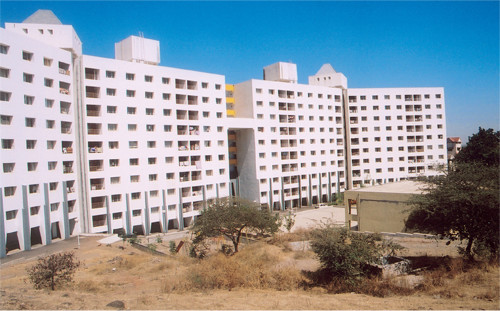
The Bai Maneckbai, Serenebai and Dhunbai P. B. Jeejeebhoy buildings (above) Photo: Cherag Mevawala
The Bai Maneckbai (A and B wings), Serenebai and Dhunbai P. B. Jeejeebhoy buildings at the Lullanagar complex are airy and brightly painted, with a community hall (Bai Maneckbai P. B. Jeejeebhoy Hall) set within a peaceful garden, parking area, etc. The 200 flats of 700 sq ft (built-up area) and 32 flats of 350 sq ft (built-up) are given on leave and license basis. "Interior changes will not be allowed,” states Irani, adding that all modern amenities have been incorporated. "There are electrical points ready for your fridge, mixer, aquaguard, etc. We have kept a soft wall in the kitchen for an exhaust fan, if required. There is a serving window from cooking into living area for the smaller flats, which have been designed specially for bachelors/spinsters and people living alone,” he elaborates.
As the buildings are tall, expenses on lifts, pumps, electricity and generators (Poona being notorious for lengthy and frequent power cuts) are heavy. The premises are well protected, with security in place and visitors’ names entered in the security registers. Occupants pay a rent (leave and license fee) of Rs 500 per month for the larger flats, Rs 250 for the smaller ones plus around an equal amount for the common expenses and maintenance facilities provided, including sweepers, gardeners, etc.
On a rent of Rs 500, the PMC (Poona Municipal Corporation) has fixed an annual rateable value which works out to a tax of around Rs 6,700 per year per (larger) flat,” says Irani with indignation. "This is not acceptable to us and we have challenged it in court. We are fighting it tooth and nail. I am pretty confident the court will strike it down.”
The PPP had been trying for several years to utilize the land. Earlier negotiations with Tata Housing Development Corporation had not fructified. Tracing the genesis of the donors’ contribution, present PPP chairman Firdous Kayani of Poona’s popular Kayani Bakery recounts that it was at a Federation of Parsi Zoroastrian Anjumans of India meeting while members were discussing the difficulties of raising finances that the World Zoroastrian Organisation (WZO) came forward with an offer of assistance. "At the very outset, the trustees express their deep gratitude to the trustees of the Bai Maneckbai P. B. Jeejeebhoy Deed of Settlement Funds for their generous donations for the housing and hostel projects, which would not have been possible otherwise. As in the past, the Incorporated Trustees of Hongkong, Canton and Macau and the WZO have extended continued support by way of generous contributions to the objects and activities of the PPP and to the welfare of the Zoroastrians of Poona. A special mention must be made of Dinshaw Tamboly, managing trustee of WZO (India) for his continued support and contributions,” states the PPP annual report. "Not only do the funds come, but they come readily, in one shot. We are very, very indebted to them,” gratefully acknowledges Kayani.
The paperwork and the spadework began around nine to 10 years ago, states Eruch Irani, who was PPP secretary in 1998, and Dara Irani the chairman when the project actually got off the ground at the end of that year. Trustees are elected three-yearly, with office bearers selected each year. The present board, whose term extends from January 1, 2004 to December 31, 2006, consists of Kayani, Dara Irani, banker Tehmasp Bharucha (treasurer), entrepreneur Jamshed Bokdawalla (secretary), accountant Adil Sarondewalla (joint secretary) and businessmen Hoshang Dorabjee (joint treasurer) and Porusasp Mehta.
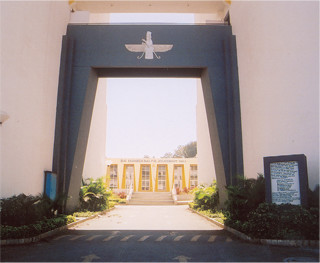
Community hall viewed through portal Photo: Cherag Mevawala
With the PPP still holding vast empty lands below the Anjuman dakhma i.e. Survey No. 603 south side (next to the Mount Carmel School) as well as on the same survey number on the north side of the Kondhwa-Bibwewadi road, Dara Irani points out to Parsiana the places where the fencing bordering the road has been repeatedly pulled out by vandals. "Protecting the vacant land has been one of our biggest headaches. People have been eyeing this land. How many more years are we going to be able to protect it,” he rhetorically queries.
Their new project, still to be started, envisages on the south side of the large plot apartments from 1,100-1,400 sq ft (built-up area), with servant’s room and toilet, drying balcony, etc to be given on long lease. Prospective occupants will pay cost of construction plus amenities, phase wise, as approved by the general body at the PPP’s last AGM (annual general meeting) on November 27, 2004 at the Pudumjee Hall on Synagogue Street. "These will be very nice flats, below the market rate, anybody would love to have them,” opines Dara. The PPP also has in mind an agiary and an old people’s home and "efforts are on to locate generous donors for these projects,” states the PPP report.
With the mushrooming of flats in nearby localities like Fatema Nagar, Wanowrie, etc, the PPP estimates a substantial Parsi population in the area. "Part of our land (around eight and a half acres on the north side of the road) is commercially exploitable. It is buildable after ULC (urban land ceiling) clearance,” Dara explains. If the PPP were to build (or find a developer to build) small commercial premises or shops, the Parsis living in the neighborhood would find some rojgar (livlihood), he believes. "Some have taken VRS (voluntary retirement), some have surrendered their flats and moved to Poona, they could find some income and the PPP would receive rent. The land would be utilized, saved from encroachment/acquisition and the objects of the trust fulfilled as well,” he asserts.
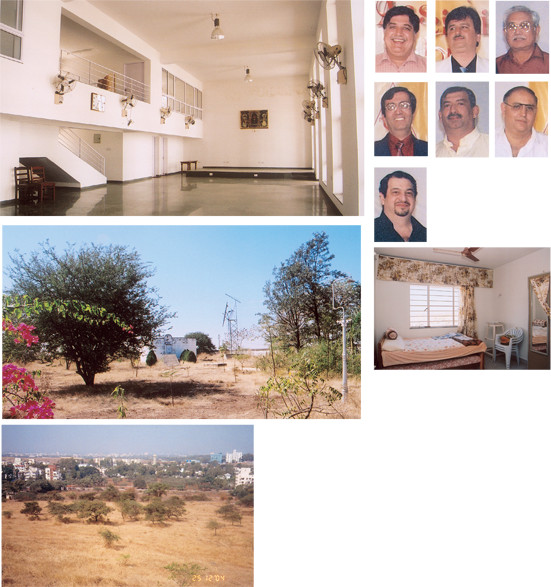
PPP trustees (Top right from left, first row) Kayani, D. Irani, Bokdawalla; (second row) Bharucha, Dorabjee, Sarondewalla; Mehta (alongside); Interior of community hall (top left) and bedroom (below); land around dakhma (alongside) Photos: Cherag Mevawala; Site of proposed apartments
Also in the consideration stage is a small hospital in conjunction with the Grant Medical Foundation and Ruby Hall Clinic, but nitty gritties are yet to be worked out. "All this is trust land. Several compliances/permissions have to be obtained — charity commissioner, PMC, ULC, etc. There is still a lot of respect (for Parsis). The authorities do listen. It just takes a longer time, that’s all. We have not paid one rupee to anybody in the Cantonment Board or the PMC,” declares the vice chairman emphatically. "The personal approach, constant follow-ups and persuasion by the present and past trustees like Eruch Irani, Boman Irani and others have achieved the desired results.”
The PPP’s old trust property of Talukdar Building on M. G. (Mahatma Gandhi) Road was so burdened with the imprint of time that it was in danger of imminent collapse. It was demolished in December 2004 and the new hostel for Zoroastrian boys and girls from outside Poona will be ready by July 2005, to coincide with the new academic year 2005-06. The trustees have relocated the "genuinely poor” tenants in other trust properties, says Dara, adding that the new ground plus two-storey hostel structure will incorporate study, dining and kitchen facilities for the students.
At Lullanager, it was the lay of the land which defined to a large extent what construction would/would not be possible. "Though the size of the plot was large (Survey No. 607, where the four buildings stand), 65 percent was unbuildable because of the steep slope and the entire FSI (floor space index) had to be consumed in the 35 percent of flat land available,” explains architect Iqbal Chaney of Iqbal Chaney and Associates who designed the project. There was no choice but to go upwards and the buildings are of 10, nine, nine and eight stories, depending on the topography, he says. Cost was also a major consideration. "The donors’ requirements had to be kept in mind as the buildings are for the needy and deserving. We had to produce a cost-effective, good setting for urban living — flats which are durable and easy to maintain,” he remarks. For the interiors, fancy ceramic tiles, expensive aluminium windows, etc were avoided, sturdier steel frames, etc were used. Mandatory requirements like earthquake resistant design parameters, fire lift, refuge terrace, etc, necessary for tall buildings, have been complied with.
Since the Patel dakhma sits atop the hill at a distance, it was imperative to ensure that from no point from the top of the buildings could one look into the dakhma. "We have made sure of that. We had enough clearance for one more floor, but have not gone in for it so as to play safe and not take any chances,” the architect explains. Poona’s Bharucha and Company were the civil contractors, Phiroze Karaka and Company of Bombay did the plumbing work while Poona’s Pratibha Electricals were the electrical contractors.
The criteria for allotments had been widely publicized in the Parsi Press — those having no residential accommodation either ownership or rented, those living in dilapidated houses, backward localities or riot affected areas, couples awaiting marriage, etc. Allotments began when the first flats were almost ready for occupation in 2001. All seven trustees of the PPP sat in on the interviews of shortlisted candidates. Then chairman Eruch Irani had reported at a Federation meeting at that time some humorous sidelights: "Most asked for holiday homes. Some said they wanted it for the racing season! In one case, the parents of the prospective bride wanted to make it a precondition — there would be a wedding only if the flat is available!” Several couples who were allotted flats as a start in life were expected to work towards their own independent accommodation, he had added. Those applicants already living in community housing were required to return their flats to their respective trusts as a precondition. Objections were also invited after the allottees’ names were published, at the various stages.
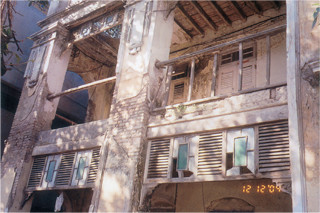
Old Talukdar Building, now site for students’ hostel
"Of course there will always be some cribbing, bickering and backbiting. But the majority of tenants are very grateful. They were homeless, now they have a home. Several babies have been born,” says Dara. Several marriages have also taken place, adds Kayani.
As Parsiana watches, young mother Yasmin Bharucha zips in and out of the gate on her scooter, to drop one small child off to school and pick up another! "I like it here,” says the housewife who has moved in over three years ago. "It’s peaceful, except perhaps for the noise of the passing trucks at night.” The winter fog, she says, touches her eighth floor window! The flat is a tad small for a couple with three lively youngsters but "I wanted my children to live in a Parsi environment and pick up some Parsi values, as we are a dying race! There have been minor difficulties like people misusing the lift, but the trustees were prompt in action and explained things to the residents. We mind our own business; there’s no problem.” Says neighbor Farhad Homavazir: "People have been very cooperative, touch wood.”
The usual chips/cracks/abrasions of community living do occasionally surface: "Yes, there are some problems over things like parking, etc. We take care of all that. Residents should understand their responsibility and think of others,” says Tehmasp Bharucha, adding that the project has remained well within budget. "Financial discipline has been observed,” he remarks.
With around 700 inhabitants, the complex probably provides a bonding, as well as safe and secure premises to a community struggling to survive.
◆ ◆ ◆
From the archive