
Comment
The oracles of opera
Some of the operas of Mozart, Handel, Strauss, Rameau and Wagner have been inspired by the myths and legends of ancient Persia, mentions the author
Several composers of western classical music have derived their inspiration from the East, especially from myths and legends of ancient Persia. References to ‘Wise Men’ from the East and Magus —the priests of ancient Persia, can be found in the early Gregorian chants and the plainsong ritual music. Early French composer Perotin (circa 1160) and an Italian composer Peri (1561) were inspired by the East.
The first example of operatic connections with ancient Persia is an opera Zoroastre by French composer Jena Philippe Rameau (1683-1764). This three-hour-long, five-act opera is staged sometimes even now in European opera houses (three CD recordings on Erato label 0927-43182).
Another great opera composer is George Frideric Handel (1685-1759). This German composer wrote two full length operas connected with ancient Persia. In Orlando (1733), one of the main characters is called Zoroastro. In all the operas the character role of Zoroastro is sung by bass. I saw this opera on October 23, 2003 in London at the Royal Opera House, in which the part of Orlando (written for mezzo-soprano) was given to a young Parsi countertenor Bejun Mehta. The next day the London newspapers gave good reviews about Mehta’s singing and acting. He is a cousin of maestro Zubin Mehta. Handel’s second opera with Persian connections is titled Serses or Xerxes. The London premiere of this opera took place as early as 1738 at King’s Theater, Hay-market. An English composer Thomas Arne (1710-1778) also wrote an opera with a similar title Artaxerxes, including a character role — Darius and depicting Persepolis in the fifth century BC.
Wolfgang Amadeus Mozart, in his famous opera The Magic Flute (1791), has created a prominent role — Sarastro (bass). Generally the operatic role of Zoroaster is given to a tall person dressed in a white robe and with a long white beard. The Magic Flute is a very popular opera and many good recordings are available on CDs and DVDs. Italian composer Gioachino Antonio Rossini has also written an opera Cyrus in Babylon, premiered in 1812.
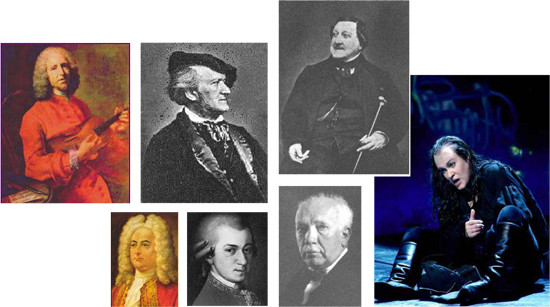
L to R (Top row): Rameau, Wagner and Rossini (Alongside): Handel, Mozart, R. Strauss and B. Mehta in Orlando
The most well-known connection between western music and Zoroastrian faith is the music Also sprach Zarathustra by Richard Strauss, not to be mistaken with the waltz king Johann Strauss II. Richard Strauss was inspired by Friedrich Nietzche’s epic prose poem Also sprach Zarathustra. Strauss’ music contains the contrasting of two neighboring tonalities with major and minor modes suggesting dualism — light and darkness, good and evil, etc. (My favorite recording is on Deccas 1968 LAPO under Zubin Mehta.)
Strauss is also well-known for his many operas. His opera Die Frau Ohne Schatten — The woman without a shadow (1919) — has a very deep connection with Persian mythology. In this opera, the woman’s father is called Kaikobad. His name is frequently uttered in the opera without his actual presence on stage. Kaikobad is an immortal ruler of the spirit world (a three CD set on DG label 445-325 conducted by Karl Bhom).
Richard Wagner was inspired to create his last opera Parsifal (1882), by the epic medieval poem Parzival by Wolfram von Eschenbach (1170-1220). Although this opera embodies the legend of the Christian Holy Grail, mixed with Buddhist and Christian doctrine, I think, a Parsi can appreciate this musical masterpiece from a different perspective.
First of all the title of the opera Parsifal could make a Parsi curious to find out more about the work. According to Wagner the opera is based on the Christian Holy Grail, compassion, salvation, etc. He never indicated any connection between his opera and Parsis. Only once has he made a brief reference to Parsis — in his letter to Judith Gautier in 1877 "... the name is Arabian. Parsifal means Parsi, think of the Parsis, the fire worshipers, ‘pure’...”
I have seen four different productions of this opera, at the Met New York, Vienna, London and at Wagner’s own opera house in Bayreuth. In some of the productions the grail temple and the hall in which the grail is kept bore a striking resemblance to our sacred fire altars.
In the opera, the high priest Titurel who once used to take care of the grail rituals has become too old and bedridden to attend to the temple. In the middle of the opera he dies. Titurel’s son Amfortas takes over the responsibilities. But unfortunately he succumbs to the evil magic powers of Klingsor and Kundry. The latter is a fearsome beauty under the evil influence of Klingsor. Amfortas thus becomes wounded physically as well as spiritually and becomes unable to carry out his duties in the temple.
Out of the blue appears young Parsifal. He manages to destroy Klingsor and through compassion he redeems Kundry from her past sins. Parsifal as a pious person becomes qualified to take over the grail rituals.
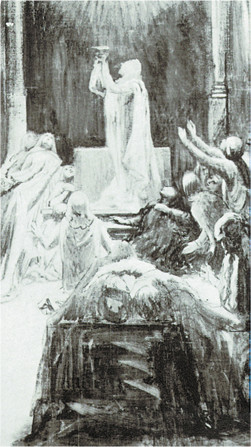
Parsifal holding the grail in the closing scene of the opera. Design by Paul Joukovsky circa 1882
Before Parsifal is allowed to enter the inner hall of the temple he is given a purification bath (nahan!). Kundry applies anointed liquid on Parsifal’s body (nirang!). Parsifal had lost his father before he was born. Kundry with her mystical wealth of knowledge tells him that his father’s name was Gamuret. In our Avestan scriptures the name of the first mortal man was Gehmuret. Geh meaning man and muret meaning mortal. Kundry also tells him that "... the name Parsifal was uttered in far Arbys land (Persia!).”
When I reach this part of the opera, I become convinced that this is the opera which has the strongest connection with legends of ancient Persia.
In the finale, Parsifal dressed in a long, white robe enters the inner hall of the temple and begins to perform the service to the Holy Grail. At this moment, the fire on the grail starts glowing a brilliant red. With special lighting effects the entire stage turns into crimson. Slowly the curtain starts coming down and with this, Wagner’s most sublime music drama comes to an end.
(My favorite recordings: 1962 live recording of Bayreuth Festival conducted by Knappertbusch and the 1981 Berlin Philharmonic under Karajan. Both these sets contain the full text in German as well as in English.)
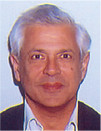
An engineering graduate from Baroda University, Freddie Desai retired as principal engineer from Lucas CAV London. Self taught in the development of western classical music and a frequent visitor to European and American opera houses, Desai is a member of The Wagner Society, London. He is a resident of Coonoor, India.
◆ ◆ ◆
From the archive