
Zoroastrians Abroad
"From brain drain to brain gain"
Zoroastrian NRIs are forging links between American universities and Indian institutions
The 1950s, 60s and 70s saw a lot of Parsi talent migrating to the West. They went as students to the liberal and technological institutions of the US and most remained there to create a career, a family, a life.
Late 2005 saw a return. Not as prodigal sons to feast on the fatted calf but with gifts of influence, expertise and technology to synergize the communities of their original home and adopted lands.
Thus Dr Mehroo and Prof Minu Patel of Chicago created not only an Endowment Fund for Advancement of Nursing in India but facilitated a project whereby the University of Illinois at Chicago (UIC) College of Nursing has entered into a program to develop a College of Nursing at Bel-Air Hospital, Panchgani and to offer a BSc Nursing degree, with HIV-AIDS as a special subject, through the Maharashtra University of Health Sciences, Nashik. Bel-Air, an institution founded by the late Dr Rustom Billimoria to cater to the needs of ostracized tuberculosis patients in 1912 has, after a period of decline, been revived under the Indian Red Cross Society as a lead institution in India for the treatment of HIV-AIDS with the indomitable Father Tomy of Kerala’s Missionary Congregation of the Blessed Sacrament as administrator.
While the Patels came from the heart of the US, Dr Noshir Mehta and Dr Jamshed Bharucha arrived with a team from Tufts University, Boston, the US’ university capital on its eastern seaboard. Their’s was a part of the international mission of Tufts University: to sign two affiliatory agreements for collaboration with the medical school in Mangalore and the S. D. M. Dental College in Dharwar.
College of Nursing
Scheduled to admit its first batch of students in June 2006, the four-year program will be open to students who have completed their two years of junior college with science subjects. After graduation the nurses will have to undertake bond service with Bel-Air (or a hospital deputed by it, Bombay’s Breach Candy Hospital showing keen interest) for two years, notes Fr Tomy in an e-mail to Parsiana. Also on the anvil he says are short-term training programs for working nurses and, once the scheme takes off, continuing education in nursing to the master’s and PhD levels.
Bel-Air, with its experience in the treatment of HIV-AIDS, will provide a focus on the care of such patients together with curriculum and faculty support from UIC which has also offered advanced training to the Indian nursing faculty, writes Fr Tomy. "We are expecting an estimated investment of at least five crore rupees for the first phase of the project. Running expenses can easily be generated by student fees. But the capital expenditure is a problem. Mehroo and Minu are doing their bit…Dr Jethani in Chicago is trying to mobilize resources for Bel-Air. We are hoping and praying that God will grace us by giving more people to support us,” he adds. (Fr Tomy can be contacted on belair@vsnl.com)
Family physician Dr Mehroo Patel, who had done a year’s stint at Bel-Air under well-known surgeon Dr Bomi Billimoria, son of the founder, in the 1950s, had long nursed a fondness for the place. Reading "Legacy of Love” (Parsiana, October 2003), which depicted the revival of the institution in the vanguard of HIV-AIDS management in India, brought to the fore all the latent memories of Drs Billimoria – father and son. A nostalgic article in Parsiana followed ("Bel-Air: Legacy of love,” August 2004), together with a personal visit to Bel-Air. "On our visit in December 2003 we asked Fr Tomy in what other ways besides ‘money’ could we be helpful. He asked for a nursing school as one of the few items,” notes Mehroo in an e-mail to Parsiana. Professor emeritus in biostatistics in the UIC College of Nursing, Minu started a dialog with the College in February 2004. In March 2004 Fr Tomy was invited to present his needs. In December 2004 a feasibility study was begun by the College and completed in January 2005. Led by Drs Karen Solheim and Beth Marks, the report found "Bel-Air Hospital’s strength as an effective HIV-AIDS care provider may give the Bel-Air Hospital a unique and needed place in nursing education in Maharashtra,” quoted Mehroo in a press release.
The Patels established the tax exempt Minu K. and Mehroo M. Patel Endowment Fund for Advancement of Nursing in India with the intention of partially funding the education of Indian nurses at the MS and PhD levels who will then return to their parent institution in India to further education there. They note that they have also ensured that the World Zoroastrian Organisation-US chapter is geared to accept tax deductible contributions to Bel-Air Hospital.
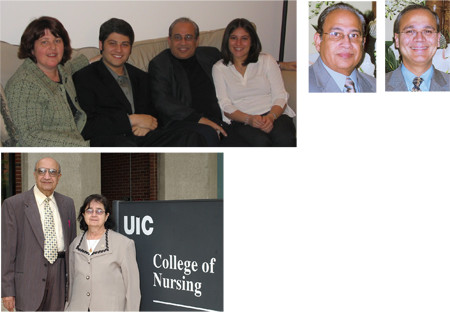
L to R: The Mehta family — Dara, Aaron and Larina with dad Noshir and (ext R) Jamshed Bharucha Alongside: Minu and Mehroo Patel
On a recent visit to India the Patels revealed their goals and ideas. "We tried to form a network of physicians and allied professionals at the last North American Congress in Chicago and had sponsored the two people who came to investigate the Bel-Air proposal. The idea of starting the endowment is two-fold. We want to do something to keep the project going. It cannot die with us. Secondly, if we spend all our money in sending donations to India, we lose five percent in (bank) transactions. This way, the money stays there. When people come there, they get the money.”
The Bel-Air project is the first of its kind with India as far as the nursing faculty of the UIC goes, they note, adding hopefully, "If we take action, other universities will also participate. If we set the ball rolling, somebody else can pick it up and keep it going.” The Tehmi Grant Institute of the Ruby Hall Hospital in Poona is said to have come aboard seeking MS and PhD level programs for their nursing staff. Mehroo speaks of the advances in the profession with Achamma Singh, a former staff member of the Army Medical School now with Ruby Hall, running two-week courses in nursing administration. The S. N. D. T. University, which already has a PhD program in nursing, is willing to host educators from Chicago and to bring the Bombay University on board, notes Mehroo. Minu, who had come as a visiting professor two years ago, dividing his time between Bombay and Poona, is trying to set up a department of statistics at the SNDT.
With MSc (Maths) from Agra University and MSc (Statistics) from the University of Aberdeen, Minu recalls his training under Sir Ronald Fischer, a theoretical mathematician/statistician. In the US he began his career with the Research Resources Center under Dr J. P. Marbarger. Somewhere along the line he says he acquired an honorary doctorate in psychiatric sociology. "Though I sound like Peter Sellers, they liked me!” he says with a self-disparaging laugh. Having developed three courses on statistics he is on the examination committee of the College of Nursing and helps students with research: "What, where, why — the basic things,” he adds nonchalantly.
Mehroo, who had indentured under Dr Bomi Billimoria, a leading chest surgeon of his time, switched into general practice and then into family practice in the US when her son Cyrus, now a BS in computer science working in Arizona, was five months old. Daughter Deena, a PhD in physics from the University of Michigan, followed six years later. Mehroo’s intention had been to revert to surgery when the children were older, but it didn’t happen. Now she says, "If I can get Bombay and Poona Universities to join hands with Bel-Air and Ruby Hall, I can say things are moving in a positive way — from brain drain to brain gain.”
Medical and dental collaboration
It was renowned ophthalmologist Dr Keki Mehta who alerted Parsiana to the high powered delegation from Tufts University coming to sew up collaborative agreements with Indian institutions. Among them were Tufts’ provost and senior vice president Dr Jamshed Bharucha, and professor and chairman of its department of general dentistry and director of international relations of its School of Dental Medicine Dr Noshir Mehta. In pursuit of the philosophy that "We fail to understand other cultures at our peril,” as enunciated by Bharucha, Tufts University is forging alliances with schools and universities in a variety of countries. This, however, was their initial foray in India.
Underlining the international reputation of the Tufts Dental School, Mehta says its alumni include top dentists all over the world, a significant number being Indians. Since the university is branching to get affiliation with Indian universities and dental schools, Mehta says he has been using his own and brother Keki’s contacts and had a meeting with the deans of the universities of Bombay and Dharwar and visited the All India Institute of Medical Sciences (Dental Wing) and the Maulana Azad Dental School and have zoned in on the S. D. M. University and Dental College in Dharwar where they will be working in collaborative research, education and patient care. [Keki modestly disclaimed any contribution toward the success of the mission saying, "I only ensured that he (Noshir) came and met them.”]
Overseeing a training program that includes the treatment of 2,000 to 2,500 patients a year by fellows and residents of the Dental School, Mehta is also involved in clinical research programs apart from teaching postgraduate as well as undergraduate students – approximately 600 of them going through the four-year program. Being director of the School’s Craniofacial Pain Center he administers the clinics and sees patients with chronic pain and sleep apnea. The School has recently introduced distance education for its two-year DMD (Doctor of Dental Medicine) degree under Mehta’s tutelage for those who are unable to spare two years away from their practice and their families. During an initial 10 days in Boston they receive laptops fully loaded with all the software their course requires and remain in touch with their instructors and fellow pupils via the internet. Three more short trips to the Boston campus over the two-year period is all the time that they need to be away from home. "Tufts’ dental school has always been a leader in the international continuing education arena,” says Mehta. "Over the years as we have lectured in different countries, dentists have often reflected on how much they would have loved to get a master’s degree from Tufts but couldn’t take the time away from their busy practice and family life. This program has been our answer to bring Tufts to the dentist.” And it has been coordinated by Mehta’s Jewish-American wife, Dara.
They are now trying to see if Tufts can collaborate with dental schools to give DMD degrees off-site and are working on the possibility of putting together an international Tufts dental program in India at Dharwar. "We would choose American trained faculty….The education of dentists in India is higher than most other countries. The language — English — is common and they are didactically well versed. They need only clinical upgrading… Therefore it would still be Tufts faculty,” says Mehta adding that the scheme interests people who are now getting scared of sending their kids abroad because of their perception of terrorist threats.
In the course of a short interview Mehta provided an insight into the changing world of dentistry. "It is no longer a profession that gives pain. One shouldn’t fear the dentist,” he notes. He speaks of the "increasing areas of aesthetic dentistry – the creation of a beautiful smile” – and the use of implants. And then there is the treatment of chronic pain and sleep disturbances caused by the jaw position or missing teeth: "when there are no teeth, the jaw collapses.” Chronic headaches, migraine and neck pain, tinnitus (ringing in the ear) and dizziness can all be related to the position of the jaw, he notes, adding that his Craniofacial Pain Center is the largest in the US.
As their father Rustom was vice president of the Bank of India and in the course of his career was posted in various parts of India every four years, the boys grew up in Delhi while he was stationed there, studying at the Delhi Public School. Noshir spent his premedical years at the Dayal Singh Medical College and acquired his BDS degree in 1967 from the Punjab Dental College in Amritsar and pursued his MS at Lucknow’s King George’s College before proceeding to Tufts in 1969 where he stayed on as researcher and faculty member; Keki grew up studying at Vellore, Ludhiana and Chandigarh Universities.
Lecturing in France, Germany, England, India, Italy has meant regular travel, meeting people of diverse cultures and frequent visits to India and Parsi food, all of which Noshir Mehta says he enjoys. Fond of jazz music – "There’s a fabulous jazz band at Tufts” – Mehta and his son Aaron, currently an undergraduate at the Tufts School of Arts and Sciences, play the harmonica and the guitar. Daughter Larina graduated from Tufts, has acquired her master’s in public health from the George Washington University in Washington DC and is currently enrolled in Harvard for a master’s in public policy. Both children follow the Jewish faith.
After getting his undergraduate degree from Vassar College, master’s from Yale and PhD from Harvard in bio-psychology and cognitive neuroscience which deals with the understanding between the brain and the mind, Bharucha went on to Dartmouth University in New Hampshire. Though his term at Tufts measures but three and a half years, he is the university’s provost and senior vice president. He spoke to us of the seven schools that encompass Tufts University – the school of arts and sciences, of engineering, dental medicine, medicine, nutrition science and policy, law and diplomacy. Referring to the agreement with the medical school in Mangalore, Bharucha said, "The idea is to get students to experience a completely different variety of diseases, provide an exposure to global health (problems).” Tufts students are expected to come for brief internships when they will also work at the Father Mueller Hospital in Manga-lore. Pharmaceutical development and research is another field of activity they were exploring in India.
Bharucha also spoke of the ongoing inter-disciplinary research at Tufts on water for human security from the point of view of international relations, medicine, engineering, etc. Referring to his own field of neuroscience he spoke of the research on brain and music. "As we experience music of a particular culture, the brain adjusts its wiring to incorporate that music.” The MRI technique "allows us to see which parts of the brain are active at any given time when we put (volunteers) through the MRI while they listen to music,” he notes.
Father Jal Bharucha, an engineer, met mother Elizabeth Robinson, a musician, at Michigan University, says Bharucha. The couple, now retired in Florida, had married and settled in Bombay where they raised their three children. Sisters Camille Bharucha studied social work at Columbia University and the London School of Economics, Anahita Gandhi studied at the Bombay International School, played the violin with Adrian De Mello and the Bombay Chamber Orchestra with Jeanie Dinshaw and Pervez Doctor and has settled in Poona with her two children. Bharucha is married to India born interior designer Shirley Mathews.
Though a member of ZAGBA (Zoroastrian Association of the Greater Boston Area) and ZAGNY (Zoroastrian Association of Greater New York) Mehta says he is not very close to the Zoroastrian community apart from the six or seven Parsi dentists at Tufts. Bharucha says he met Zoroastrian students in Boston at an event organized by Cyrus Mehta. The Patels on the other hand have had a long innings of communal fraternization, with celebration of Avan roz parav with Mehroo’s dar-ni-poris often being written about in the ZAC (Zoroastrian Association of Metropolitan Chicago) newsletter. Nevertheless, for them all, the concern for the motherland seemed to stem more from a common intellectual commitment to their field of work and perception of global requirements than emotional attachment or community bonds.
◆ ◆ ◆
From the archive