
Medicine/Health
“A gift of God”
A four-year degree course in nursing has begun at Panchgani’s Bel-Air Hospital and construction of a building to house the college is underway
A quiet ground breaking ceremony on a promontory of spectacular beauty marked the unfolding of yet another phase in the history of the Bel-Air Hospital and Sanatorium in Panchgani. As popular social worker Homai Modi, in her most demanding avatar as joint honorary secretary of the Maharashtra State Branch of the Indian Red Cross Society, performed the puja in conformity with Indian traditions for the construction of a state of the art building to house a College of Nursing just before sunset on the evening of December 14, 2006, the small but knowledgeable gathering of hospital staff, local school principals and members of the Missionary Congregation of the Blessed Sacrament which has been the backbone for the resurrection of the institute, broke into a happy cheer. "Hopefully, the college building should be ready by year end,” declares Modi.
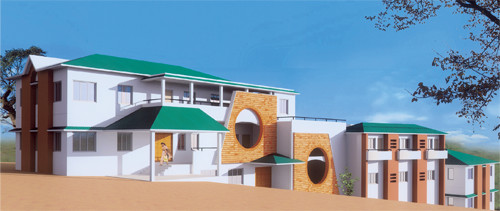
The inception of the College marks a new era in the development of Bel-Air. Once a sanatorium for the tuberculosis afflicted, now regarded as one of the topmost hospitals in India for the treatment and rehabilitation of the HIV positive community, it is emerging as a training ground for medical specialization in HIV-AIDS. A tripartite program involving Bel-Air, the Ruby Hall Hospital in Poona and the College of Nursing of the University of Chicago, the facility will provide a four-year degree program in general and HIV specific nursing and envisages growth to the masters degree from the Maharashtra University of Health Sciences, Nashik, in years to come. While Ruby Hall will provide Bel-Air nurses with practical experience in general medicine, Ruby Hall nurses will avail of Bel-Air facilities in on-the-job caring of HIV patients. The University of Chicago College of Nursing is offering curricular support.
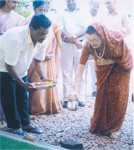
Modi performing puja. Top: Artistic concept of the new college
Undeterred by the lack of its own building which is expected to take a year in construction, the College is currently housed in the St Xavier’s High School on the hospital campus where 40 student nurses — 33 from Kerala and seven from Maharashtra — enrolled since July 2006 for the first year course, had just finished their quarterly exam. Sister Martha T. Reddy of the Jesus Mary Joseph Congregation of Bangalore, with due experience of training nurses in Hyderabad, has assumed responsibility as principal of the College. The team of six other faculty members includes Dr Vijaykumar Naik, consultant and plastic surgeon and GI endoscopist who is doing research on the role of surgery in HIV treatment. He had earlier taught at the Medical College in Sholapur. His wife, a trained nurse, will be joining the hospital staff. Other external lecturers are specialist doctors from Poona.
The institution is expected to become self-supporting with student fees of Rs 83,000 per annum inclusive of boarding and lodging plus Rs 50,000 deposit. Currently accommodated in the surplus hostel area of the school, the student nurses will have their own hostel adjacent to the college building overlooking the valley. We hear that all this area, encroached earlier, has been vacated thanks to the effort of the Red Cross which owns the institution and the Bel-Air’s efficient and enthusiastic administrator Fr Tomy Karyilakulam whose arrival on the scene in 1994 saw the hospital’s return from the nadir of neglect into which it had been allowed to slip. Tomy, whose work has been recognized in government and professional circles associated with HIV-AIDS management, currently chairs the Technical Resource Group of the National AIDS Control Organization (NACO)’s third National AIDS Control Project, notes Modi. Also a member of the Country Coordinating Mechanism of the UN Global Fund, Tomy was recently conferred the Vaidyak Bhushan Award by the J. N. Abhyankar Memorial Trust of Wai and has seen a change of designation from administrator to director of Bel Air, she adds.
The college itself is the product of coincidence. A report in Parsiana on the visit of President of India Dr Abdul Kalam on the hospital’s 90th anniversary celebration had highlighted the history of the institution and the immense labor of its founder Dr Rustom Bilimoria and later his talented surgeon son Bomi, among the earliest renowned thoracic surgeons of India. The article, read by Bomi’s former internee Dr Mehroo Patel in her Chicago home, revived old memories. She and her statistician husband Dr Minu Patel revisited the site of her earlier labors, met and questioned Tomy on what the hospital now most needed. When he suggested a College of Nursing the Patels — Minu has been professionally associated with the University of Chicago College of Nursing — swung into action. The interaction, over a three-year period, has fructified into a compendium institution which is expected to not only serve the needs of Bel-Air but of the region and country. According to Tomy, "nurses with a master of science degree earn in the region of Rs 50,000 to 60,000 p.m. In India there is a shortage of 10,000 nurses a year.”
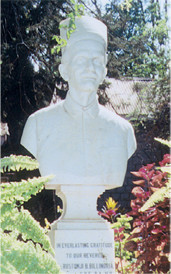
Bust of Dr Rustom Bilimoria on the campus
Tomy calls himself a "facilitator,” adding, "I have a flair for human resource management. My job is to keep (my team) happy.” Doctors and nurses earn such good salaries in the cities and abroad. So he says he plans a lot of celebrations to keep his staff pleased and motivated (including an occasional poolside dinner at a local five star hotel), tries to keep them for about two years, then helps them to go abroad. His strategy is to keep families together by offering employment to both spouses, free schooling for their children and housing on campus where possible.
On World AIDS Day (December 1) Tomy tells us the grounds are lit up for a mela (fun fair) when nearly 1,200 people — 500 HIV positive among them — play games, ride horses, sing and dance together. On the occasion last December they were able to screen a sensitive film made by multimedia journalist Adi Pocha depicting the history and contribution of Bel-Air. The Avert Society — a creation of the Government of India and US Aid — had provided Rs 60,000 for the celebration which Bel-Air also used for a massive eight-day educational outreach program in Satara district, including ITI students, carrying the message of AIDS prevention and care for the HIV afflicted to rural homes. In this context it is interesting to note that with the hospital welcoming the family members of HIV patients to stay with them and help them recover from their ailments, many who have recovered have chosen to stay and work on the premises. Among them is a group which has set up in the business of garbage removal in the town. The problem of the hospital’s garbage disposal, at one time a seemingly intractable problem with the Panchgani municipality, was solved by Tomy permitting stowage of their tractors on the vast premises in exchange for free clearing of garbage and cutting of grass.
"We have no problem looking after patients any more, thanks to funds from NACO and Avert,” says Modi. The Avert annual grant of over 54 lakh rupees has been extended for another five years by the Central Government after Bel-Air was adjudged a "center of excellence” by an external evaluator, she notes happily, adding, "From 29 colleges of nursing in Maharashtra, only Bel-Air could get the full quota of 40 nurses.”
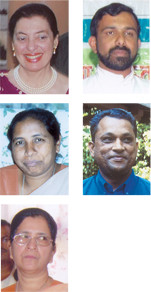
Clockwise from top L: Homai Modi, Fr Tomy, Jacob Joseph, Rosily Arikatt, Martha Reddy
Sister (Dr) Rosily Arikatt, a gynecologist with fellowship in HIV medicine from Vellore, who has had experience of work in Ghana as well as various states of India, has opted to work here since the past four years, treating 50-60 OPD patients from North Karnataka and Maharashtra every day apart from the inpatients of the hospital. Consultant paediatrician Dr Ravinder Mudholkar, dentist Dr Jitendra Dholakia, dietetician and kitchen supervisor Seema Bain who along with co-supervisor Baby Scaria oversees five cooks plus four helpers in the partially automated kitchen where food for about 400 persons is prepared daily, Soumya Mathews and Tintu Joseph, the young and cheerful teachers at the College are among the Bel-Air staff Parsiana had occasion to meet, each radiating enthusiasm for the job. Six counselors aid the staff in looking after the psychological wellbeing of patients who are often acutely depressed when admitted.
The hospital is an interesting combination of old and new practices, both driven by the need for an efficient use of scarce resources. As sterile water is expensive, an ancient system of distillation based on gas continues to provide its needs. But it has invested 25 lakh rupees in a Flow Cytometry machine, the most advance method of blood testing for the CD4 count, the only rural hospital to have it. Tomy tells us that when the count of CD4 cells falls to below 200, the patient is considered a full-blown AIDS case according to the WHO and the Indian Government guidelines and hence the test is compulsory before a patient can begin AIDS treatment.
Bel-Air’s three-bed ICU is the only one in the Mahableshwar-Panchgani area. Its radiology facilities are also availed by others, with about 30 X-rays, three to four ECGs and seven sonographies being performed daily, though the sonography machine needs upgrading.
A product of 12 to 14 years of intensive training in a seminary ("Even the IAS don’t give such training”) Tomy describes himself as "a jack of all trades.” He says his arrival in Bel-Air as a tourist was the product of a "divine intervention — this place is a special gift of God.” A current preoccupation is to create a fund from which all categories of employees can borrow when the need arises, at interest rates and repayment schedules that they can afford.
He acknowledges the managerial and moral support he receives from Modi, "her grit and determination to fight for Bel-Air (with higher-ups). Without it, this wouldn’t have happened…We have a responsibility to history. We cannot allow the great contributions of the world to fade away…”
Bearing a cross?
The Zoroastrian community knows Homai Modi better as the trustee-secretary of the K. R. Cama Oriental Institute and has had ample evidence of her organizational savvy when she was joint honorary secretary of the Third and Fourth World Zoroastrian Congresses (WZC) in Bombay in 1985 and 1990. The Islamic Republic of Iran recognized her aid in the organizing of the Sixth WZC in Tehran in 1996 as also the subsequent Indo-Iranian cultural events in Bombay with an award on the occasion of the golden jubilee of Indo-Iranian cultural relations on January 15, 2007. And the Governor of Maharashtra had a special word of appreciation for her active role in founding the Sir Pherozeshah Mehta Bhavan at Bombay University’s Kalina Campus. However, it is duty as honorary secretary of the Indian Red Cross Society, Bombay Branch, joint honorary secretary of the Maharashtra State Branch and member of its National Management Body that absorbs most of her time and energy.
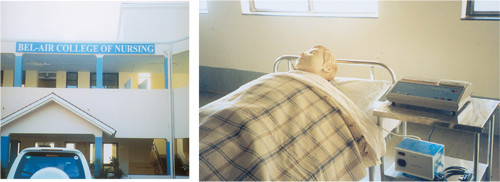
Above: dummy for practical training of students at the College of Nursing (Below)
Modi’s preoccupation vis-à-vis Bel-Air is the maintenance of the many structures on the Dalkeith property so munificently donated by Sir Dorab Tata in 1912 to Dr Rustom Bilimoria for the creation of a sanatorium cum hospital for the TB afflicted. With about 60 such structures housing wards, offices, laboratories, housing quarters etc, the 90-year heritage is in various stages of disrepair. Even renovations, where completed thanks to donations, are a source of anxiety as ground shifts have cracked freshly laid flooring and moisture has blotched repainted walls. And for these, the Red Cross is always scrounging for funds. Even the renovations of the nurses’ hostel have not yet been fully paid for, she notes.
Owner of substantial real estate like the large tract of land in Wai and the old Adam Wylie Hospital property in Nagpada, the Red Cross is currently seeking to utilize them optimally.Thus Modi and her colleagues are engaged in a dialog with the Maharashtra Government Silk Board, whose lease has lapsed, to buy part of the property and return the rest for the use of the Red Cross.
Now leased to the Wockhardt Foundation for a superspecialty hospital, the Adams Wylie Hospital property holds promise in terms of space and funds for Red Cross activities and the two organizations are working towards its development, encountering the usual problems that the development of old properties entail.
An aspect of work that has been increasingly engrossing Modi has been disaster management. Long hours spent in organizing relief after the Latur earthquake, then under the tutelage of the doughty politician Homi Taleyarkhan, resulted in experience that yielded dividends for the Bhuj earthquake in Gujarat, the Tsunami devastation in Kerala and the floods in Bombay and Maharashtra. In the first instance the Red Cross provided a public health center in Yenegur — what came to be known as "the Blue Hospital” — designed and developed pro bono by architect and Red Cross managing committee member I. M. Kadri. After the Bhuj disaster the Red Cross set up makeshift wards, separated by plastic sheets or in tents, in the compound of St Joseph’s Hospital at Gandhidham, and carried on with its work for the next three years, providing relief and rehabilitation to those who had been rescued by timely medical attention. Even a donated X-ray machine was transported there and provision for water storage ensured in a huge collapsible plastic tank procured by that wizard in raising funds, the late Silloo Kavarana, recalls Modi. During the Bombay floods they fed 3,000 people stranded at the CST railway station, helped the government pack and airdrop 15,000 loaves of bread in flood affected districts — for the Red Cross is an auxiliary to the government, not an NGO, she tells us. "Four of us were going from bazaar to bazaar picking up bread, butter, bananas and biscuits,” she adds.
Her insistence on Red Cross personnel overseeing the distribution of their supplies had initially threatened to undermine relations with the Kerala government and the collector of Kollam where she had functioned with a Christian organization but tact and transparent integrity overcame official resistance. Modi is very serious about her commitment to the donors. Every item that goes anywhere is catalogued at the dispatching end, rechecked at the receiving end and distributed only to those who have been visited and whose condition has been checked by Red Cross volunteers. Modi believes in leaving no door open for misappropriation and says "Our regular donors, big and small, come to us even though they get only 80 percent tax exemption from us versus 100 percent they would get by donating to government funds because they know that the proceeds will go where they are meant to go.”
The Red Cross has over 33 branches in Maharashtra, pursuing different programs. For villages with a population below 3,000, where the government machinery is slow to reach, some of them have undertaken drinking water projects with Funds Committee chairperson Dr Chandi Batlivala assiduously raising resources. Once people are assured of a supply of fresh water, the community begins to grow and various developments follow, says Modi. The Poona branch provided an ambulance for the Dinanath Mangeshkar Hospital in a joint effort to provide succor for victims of accidents on the highway. When Modi attended the handing over ceremony she says she urged the assembled doctors at the hospital to aid the Red Cross in times of disaster. Shortly thereafter the tsunami played havoc in south India and many medicos from the hospital volunteered their services to aid the traumatized communities.
Modi says they have also been holding workshops on the national and state level to create awareness of how to work during disasters, especially in areas like Kolhapur where three rivers meet and floods are a recurring problem. As part of a UNDP project with the government, volunteers from the Poona branch demonstrated to local volunteers how sticks, old tyres and empty bottles can be put together to create rafts in an emergency.
"We try to teach people what to do, what not to do. You have to check the needs of the affected people. When you give you must be able to ensure that you have enough of the same thing for every one – you cannot afford to create squabbles by giving different types of things. Old clothes are a definite no-no. These people are already in trauma. You cannot add to it by taking away their identity, by changing their food or clothing. You don’t humiliate them by sending old clothes. In Bhuj we had to send a doctor to weed out outdated medicines. Also, there were hoards of clothes no one wanted. They were eventually shredded and added to firewood. There have been times when so many trucks from Bombay have gone with rubbish that none are available for sending important stuff.”
When one volunteers one’s service in a devastated area one needs to cover one’s personal needs. In Bhuj "nothing was standing. It was the first time I had seen such devastation. There was not a cup of tea or a glass of water to be had. Once I forgot food and water for the volunteers. Everyone was so hungry and thirsty…”
That well-meaning aid can sometimes be a curse was a lesson Modi learnt after the Latur quake when she distributed farming implements from a corporate donor to more than 4,700 farmers in the locality. On a subsequent visit to assess the community’s return to normalcy the headman called her aside and upbraided her: "What have you done to us!” The community had comprised farmers and carpenters. "The carpenters had lived by repairing the farmers’ tools. With so much new equipment, the carpenters were out of work. We had worked hard. We had had nothing to eat. We were on the run. But we hadn’t done our homework!” she realized to her dismay. Since then she has accepted that it is better to study the needs of the affected people, even if it means a little delay, rather than rushing in items that are redundant or detrimental to their well being.
With more than a decade of experience in aiding disaster victims, Modi has been drafted onto the Maharashtra StateDisaster Management Authority as the representative of the Red Cross — the only woman on the body. Though only one meeting has been held so far, she found herself in the company of the chief minister, the deputy chief minister, the municipal commissioner, the heads of telecommunications, police, fire brigade and every department of government concerned with the management of a potential disaster, numbering nearly 100 people. A bit awed by the top brass all around her, she says she wondered what she could possibly contribute. But those who know Modi are aware that her poise, self-confidence and capacity for hard work are unfailing attributes.
◆ ◆ ◆
From the archive