
Institutions
A legacy of love
President Kalam's visit underscores Bel-Air's position as India's leading medical facility for treating HIV-AIDS patients
Panchgani, the little hill station in the rain shadow of the Indian Peninsula’s Western Ghats best known for its few boarding schools, was atwitter with excitement. A flood of official cars and swarms of security officials overpowered its narrow roads, barred entry to its favored promenade — the tableland. On the plus side water, a rare commodity in the town (and drought hit Maharashtra this summer) was flowing again! "History was made as a small hospital in a small town received the President of India” on May 28, 2003, noted Kersi Gherda, chairman of the Red Cross Society, Maharashtra state.
A survivor of 90 years of vicissitudes, the Dr R. B. Billimoria Bel-Air Sanatorium and Hospital is now internationally recognized for successfully transmuting its dedication to the cause and care of tuberculosis (TB) patients to the service of HIV-AIDS (Human Immuno Virus/Acquired Immuno Deficiency Syndrome) sufferers. After all, the scourge of TB had been as frightening a death sentence, with its sufferers treated as social outcastes in 1912 when Dr Rustom Billimoria set up his facility, as AIDS is today.
It was to honor the Bel-Air Hospital and its doctors’ seminal courage in welcoming and treating patients — including little children born with the HIV scourge — when bigger, better and more prosperous establishments refused such service, that the President Dr A. P. J. Abdul Kalam agreed to inaugurate its 90th anniversary celebrations. Not only does Bel-Air address HIV-AIDS patients’ immediate medical problems be it broken bones, teeth or eye problems, the recurring fevers, the propensity to contract TB, a disease which has seen a massive comeback all over the world with the onset of AIDS, but their severely bruised psyche is treated with tender loving care. When their health improves, such patients help the staff in simple labor and managerial functions and in the Red Cross Society’s social program in the villages to educate the people and bring home the message that HIV-AIDS is not a contagious affliction, that its spread is limited to the sharing of body fluids like blood, saliva, semen and that there are ways to prevent this from happening.
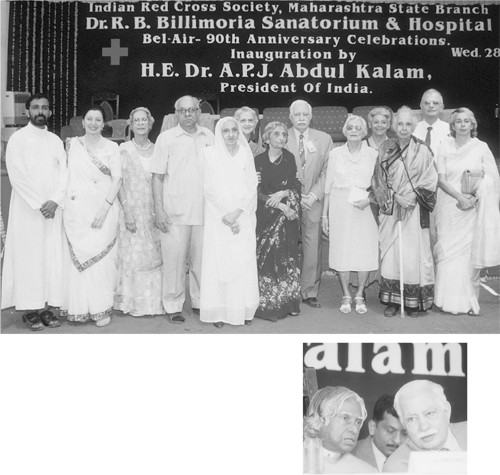
Members of the Bel-Air subcommittee, volunteers and members of the Shapurji Billimoria family. Alongside: Kalam and Gherda
Addressing the audience in the gaily colored shamiana after meeting the medical and administrative staff of Bel-Air, speaking to some of the patients and accepting floral tributes from the child patients and Billimoria’s granddaughter Sarah Cheesman, the President recalled the "vision and unflinching commitment of Rustom Bil-limoria... a great son of India” and said he was "touched to receive flowers from his granddaughter.”
Recording his impressions of the place, Kalam said he "saw the HIV-AIDS patients, saw the environment that gives them emotional support.” He described these doctors and staff as "people of strong mind... divine persons (who) cure pain in body and mind.” Referring to the strides made by medical science and technology, he noted how "TB is now curable. One day HIV will also be curable.” Speaking of Indian researchers working with international collaborations on creating an anti-HIV vaccine, Kalam hoped that five years hence new HIV cases would be prevented. Emphasizing the vital need for awareness among the youth, the President urged schools to include moral science in their syllabi, teach children "how to lead a good life.” Praising National AIDS Control Organization (NACO)’s program of low priced care combined with information to fight the dreaded disease, he spoke of the AIDS affected children’s need for general education free of discrimination and for "all teachers and parents to realize that HIV-AIDS is not contagious. It’s a mission for all of us in good health — to propagate the message to treat patients with God’s love and kindness.” By 2020 he hoped India’s progress will ensure "health for all” and the elimination of HIV, TB, water borne diseases, heart disease and cancer. "It is a big responsibility for scientists, technologists, industrialists (to provide) not only physiological treatment but also psychological treatment” and hoped that the MBBS syllabus will provide enough importance for psychology courses.
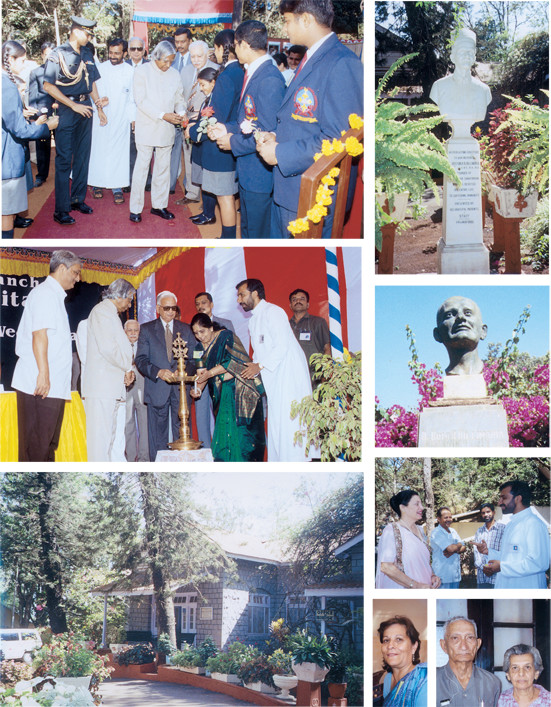
Clockwise from top left: Kalam being welcomed by children from the local schools; bust of Rustom; bust of Bomi; Modi and Fr Tomy jubilant at the morning’s success; Villoo and Eruch Ghadially; Cheesman; the office block; (L to R) Maharashtra health minister Digvijay Khanvilkar, Kalam, Fazal, Ramalingam and Fr Tomy lighting the inaugural lamp
Maharashtra governor Mohammed Fazal who escorted the President spoke of the need for family accommodation for migrant labor as "unnatural sex is the major cause of AIDS in this country, especially among truck drivers.”
In his welcome address Gherda recalled how the 44 acre Dalkeith property had been gifted by Sir Dorab Tata to Billimoria and how the Dorab Tata Trust continued to support the Hospital which has been reborn from the "decrepit state” it had reached five years ago.
Dr Vimla Ramalingam, secretary general of the Indian Red Cross Society — India’s largest NGO with the President of India as its ex officio president — spoke of its work in all disasters, natural and manmade. Like wars and communal riots "HIV is another manmade disaster... We do not have hospitals that look after the needs of HIV-AIDS patients. Here, such a patient is treated as a human entity.”
Bel-Air administrator Fr Tomy Karyilakulam referred to the institution’s services which include a general hospital section, the TB specialty, community care center for HIV/AIDS and an ayurvedic naturopathic center. Recounting how "the ignorance, fear, discrimination and mental agony created by HIV-AIDS is a major problem in its treatment,” Fr Tomy narrated the case of their "first HIV patient who had multiple fractures from an accident and who was refused by many orthopedic doctors in Satara and Poona. Our Dr Sunil Pise took a courageous decision to conduct a surgery to fix his bones. First we had to hunt for an anesthetist because all were refusing. Then my operation theater sisters came to me weeping because they were afraid. We postponed the operation. It took me two days to convince them before they took up the challenge.
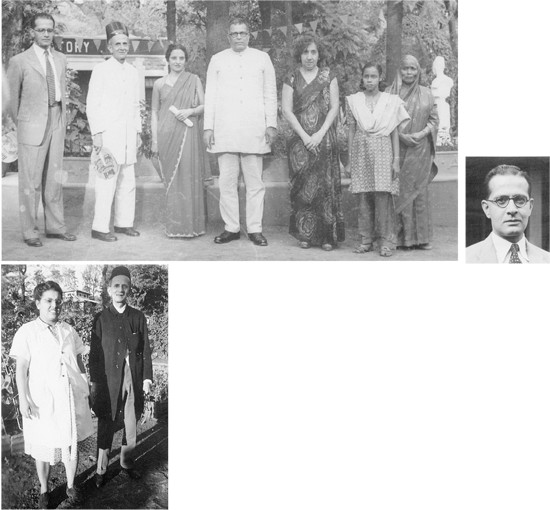
File photos: Bomi and Rustom Billimoria (bottom and above, from left) with Mehru Masina and Gulestan Billimoria (3rd from R)
"We are also ignorant. Our doctors just didn’t know how to manage the complications arising out of HIV. We searched for answers and didn’t find them, not in (Bombay), not in (Madras). That is why Bel-Air doctors were (subsequently) sent for training by WHO (World Health Organisation) to Bangkok and Spain. We also have begun international exchange programs for capacity building of our staff.
"Several HIV positive people are being brought to this Hospital, very sick and on stretchers. Not only are they becoming better (and) go back to work but they are also overcoming fear and discrimination. Due to the impact of the work by Bel-Air there is a sea change of attitude now in the villages of Satara district. Dear ones and families are taking care of the HIV positive patients with love and affection where they were abandoned earlier. This change in social attitudes is also reflected in the bold decision of the New Era High School and its principal Dr Mehressa in availing Bel-Air facilities despite the stigma attached to our Hospital. Other schools in Panchgani have slowly begun to follow suit.”
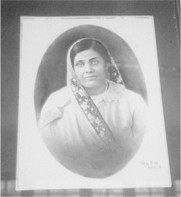
Dr Shireen Billimoria
A national consultation on HIV/AIDS, conducted by the Government of India (GOI) between May 12-14, 2003 at Bangalore, had reviewed pertinent programs at the Sir Jamsetji Jejeebhoy (JJ) Hospital, Bombay, at Sahara, Delhi, at YRG CARE in Madras and Bel-Air, notes a press release. The convention, attended by senior officials of the health ministries of the GOI and the states, recognized the Bel-Air model as the most comprehensive as it integrates home care, community involvement, medical and psychological training and programs for education to generate a change of attitude in society at large.
Today Bel-Air has been nominated as a national training facility in HIV-AIDS management for doctors and health care professionals by NACO and USAID (United States Agency for International Development). As a member of the Avert Society, cofounded by NACO, the Government of Maharashtra and USAID, Bel-Air’s Community Care Center works with patients and families to reduce the transmission and mitigate the impact of all sexually transmitted diseases (STD), notes the 76-page illustrated art paper book Dr R. B. Billimoria Bel-Air Sanatorium and Hospital, Panchgani (1912-2003) published by the Indian Red Cross Society, Bombay, documenting the history and resurgence of Bel-Air.
"We never visualized that this book would be released by the President of India,” noted joint honorary secretary of Bel-Air and the Indian Red Cross Society, Maharashtra State Branch, Homai Modi as she thanked the President, the governor and Maharashtra’s ministers of health and finance who had come to Panchgani in tribute to Billimoria’s social vision and its contemporary manifestation. Modi’s commitment to the cause of Bel-Air, relentlessly pursued for several years, and her talent for organizational nitty-gritties had been rewarded by this first-ever visit by the President of India. It was a short respite from her ceaseless search for funds to maintain the momentum the institution had acquired.
The institution
One of Bombay’s leading physicians and a TB specialist, Billimoria wanted to reduce the incidence of TB and provide the environmental assistance that would aid the recovery of his patients. "Hygienic and clean surroundings was his first priority,” records the book. With a loan of Rs 6,000 from Sir Ratan Tata he hired a bungalow in Poona in 1912 and Bel-Air was born.
"The first patient at Bel-Air was Dr Billimoria’s ENT professor’s cousin who was suffering from TB of the lungs, larynx and bowels. After a prolonged stay and treatment, the patient recovered completely and subsequently led an active life as a practicing dentist for 30 years,” states the book. Though not all cases were as successful, by 1914 the bungalow could not accommodate the many who sought treatment. The search for new premises was proving fruitless, as Maneckshah Pochkhanawalla, a fellow traveller on a Poona-Bombay train, accidentally learnt from a disappointed Billimoria and his friend. He advised the young doctor to "wait till you hear from me.” Soon thereafter the doctor received a letter stating that a bungalow large enough to accommodate 12 patients, with a separate doctor’s cottage, dispensary, laboratory, stables and servants quarters was available in Panchgani: Sir Dorab Tata had agreed to donate his 44-acre estate, Dalkeith, to Billimoria!
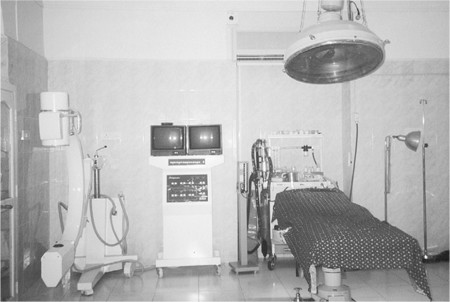
A section of the operation theater
The doctor, appreciating the priceless gift of the scenic estate, with a dry bracing climate ideally suited to the recovery of TB patients, "left no stone unturned to transform Bel-Air into a sanatorium that could compare with its European counterparts,” notes the book.
He had his teething problems. Owners of hostelries in Panchgani, some of whom accepted TB patients as boarders, claimed that the sanatorium would affect their livelihood and sought a government order prohibiting its establishment. The government despatched Major Liston, the head of the Haffkine Institute, to visit the sanatorium and report on its feasibility. His positive findings prompted Sir Leonard Rogers to recommend that the Government "help, not hinder the noble work,” and Lady Willingdon, wife of the governor of Bombay, became the first in a long line of visiting dignitaries as she opened Bel-Air’s Recreation Hall. Governors, chief ministers and international health professionals have visited its portals over the years.
Every week the doughty doctor took the 3 p.m. train from Bombay to reach Wathar station at midnight. From there he took a tonga (a light horse drawn vehicle) — and even continued the nine-mile steep incline of the Parsani Ghat on foot when the rickety contraption broke down — to reach Panchgani at dawn. By the early 1920s the institution was the finest in Bombay state and had a national reputation.
Even though the challenges in the development of such a social institution were but dimly perceived, donations flowed in, enabling the creation of about 50 bungalows and buildings to house wards, administrative offices, laboratory, x-ray room, operation theaters, mess, kitchen, recreation hall, linen room, sterilization facilities and staff quarters, states the book. Clean and efficient, they nestled in the colorful garden amid the scenic mountains. The golden jubilee in May 1962, presided over by Union Health Minister Dr Sushila Nayyar, marked the acme of Bel-Air’s achievements under Billimoria.
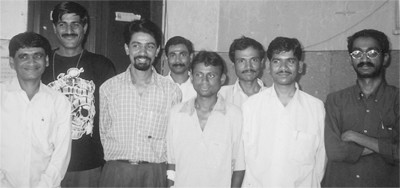
HIV-AIDS patients serving the hospital and spreading AIDs awareness in Satara district
Once the institution achieved stability, Billimoria’s thoughts had turned to ensuring its continuity and, in 1926, he had transferred its management to a board of trustees. The arrangement had worked well, records the book. However, in 1965, Billimoria transferred the management of the Hospital to the Indian Red Cross Society and over the past 38 years it has continued as a Red Cross project.
From its inception Billimoria had ensured that Bel-Air had a social slant. There were only three blocks for paying patients, the emphasis being on concessionary and free treatment. Run on totally secular lines, there were no distinctions of caste, creed or religion. Donations, a small fee, beds reserved by government organizations and banking institutions covered a part of the expenses. The annual operating deficit was covered by a grant-in-aid from the state government. "This arrangement worked smoothly till the 1990s, but from thereon, (with) budgetary constraints and receding public health care funding by the State Government, this important source of funding dried up, with the State reneging on its health care obligations. This was a lethal blow,” documents the history.
From 1965 to 1980 the hospital capacity grew to 250 beds. The laboratory had the facility for biochemical, pathological and microbiological work. The patients had recreational facilities and received rehabilitation training. Nonetheless, by the mid 1980s the tide had turned. New anti-TB drugs eliminated the need for hospitalization and the occupancy dropped sharply. Donor fatigue and erratic government support impacted medical and staff appointments and efficiency. Combined with spiralling drug prices, unchecked land encroachment and labor militancy, these factors drove the management to the wall, despite the support of the Holy Cross nuns, professionally trained nurses, whose commitment sustained the institution through those "difficult and dark years,” records the book.
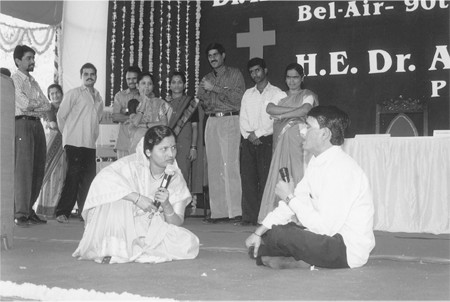
Patients partcipating in a play to propagate community awareness
Into this seemingly hopeless quagmire walked a young tourist, a priest from Kerala. Astutely assessing the potential of the institution and the estate, Fr Tomy approached the Red Cross authorities in Bombay with the proposal that his Missionary Congregation of the Blessed Sacrament (MCBS) would be willing to manage the Hospital as a Red Cross project. In 1994 the Red Cross signed an agreement entrusting the administration of Bel-Air to the MCBS and appointing Fr Tomy as the administrator.
With 30 patients in three wards, three nun sisters shouldered the entire burden of nursing. Funds were so low — the corpus was almost gone — the hospital couldn’t even buy equipment for sputum removal. Fr Tomy and the managing committee of Bel-Air concentrated on raising seed money to turn the institution around. The Dorab Tata Trust, headed by Russi Lala, sanctioned a recurring donation which played a "catalytic role” in rebuilding the eroded corpus, notes the book.
Attempts to discipline the support staff which had begun to threaten the medical and nursing staff "reached a flashpoint in 1998, when an unruly mob instigated by a section of the workers went on a rampage, attacking the staff, destroying hospital property and forcing the police to place the administrator in the lockup for his safety.” The Bel-Air management declared a lockout (which endured for two months), shifted the patients to Satara and Poona and undertook the task of completely overhauling the setup.
Recognizing Bel-Air’s position as the only hospital of its kind in Satara District, the new management committee appointed by the Red Cross worked towards adding departments like orthopedics, pediatrics, general medicine and an intensive care unit.
A donation of Rs 1.25 crore from Mehraban and Faridoon Zartoshty emboldened the managing committee’s fund-raising drive. A firm handling of the labor problem helped to instil discipline and the overall impetus revived Billimoria’s legacy of service among the medical professionals.
With an eye to creating a source of income an Ayurvedic and Naturopathy Centre was established in an area well removed from the rest of the hospital complex, with an independent entrance and parking facilities, offering oil massage, yoga, herbal medicines, steam baths, etc. Ayurvedic therapies have been successful in the treatment of hemiplegia, sciatica, cervical spondylosis, psoriasis, rheumatoid arthritis, obesity, psychosomatic and nervous disorders, says the book, while naturopathy with an array of services like jet massage, mud bath, asthma bath, etc, claims to treat a variety of disorders ranging from hepatitis to hypertension, hypothyroidism, anxiety neurosis, depression, gout, eosinophilia, etc.
Apart from the in-depth elaborate therapeutic programs that span about a month, the center offers stays ranging from four days to 21 days in private rooms with single or double occupancy. These range from Rs 3,000/Rs 4,000 to Rs 12,500/Rs 17,000 for single occupancy in standard/deluxe room respectively for the two periods of stay with several variations in between. The packages include a daily oil massage, alternate steam bath, alternate underwater massage, routine hydrotherapy treatments, daily yoga/physical exercises, natural and therapeutic diet. Deluxe room accommodation includes TV, phone and attached bathroom, notes a Bel-Air press release.
Funded by NACO, Bel-Air runs a 50-bedded Community Care Centre where HIV-AIDS infected persons afflicted with active TB or other infections are treated and their families — thanks to the committed interaction of staff and social workers — are encouraged to visit, stay and help nurse the patient. Many such patients have been located in distant villages by Bel-Air’s social workers, the Bel-Air’s history informs us.
Starting with eight HIV-AIDS patients in 1995, Bel-Air treated 376 in 2002. It offered medical treatment free of charge to 408 patients and at concessional rates to 117 in 2002-2003.
On his final visit to Bel-Air in 2001 as governor of Maharashtra and ex-officio president of the Red Cross Society of Maharashtra State, Dr P. C. Alexander stated, "I have visited Bel-Air regularly during the last eight years since I have been the governor of the State. I am impressed by the change I see today — the cleanliness of the place, the improvements that have been brought about and the additions made in the available medical facilities. The smiling plants and flowers welcome me and there is an atmosphere that permeates peace, tranquility and hope.”
Even so, many of the old blocks are in disrepair. Much of the wiring, according to Fr Tomy is 75 to 90 years old. "We need a lot more funds... to strengthen the infrastructure, to bring it to the international standards of Dr Billimoria,” he adds. Working towards the institution’s sustainability, Fr Tomy says they are already working with the local schools. "If all the schools utilize the Hospital, it would be enough... Naturopathy can be a sustainable project but we need at least 50 percent occupancy.” As of now the 10 double rooms and the 10 dormitory beds in the Naturopathy Centre are occupied only in the season.
Tomy is also keen on installing solar heaters as the schools in Panchgani have done, start a vermiculture project to enrich the beauty of the grounds. The beautiful fountain in the garden needs repair: "These are joys you can provide.” Himself a disciplined man (through the years of travail at Bel-Air Fr Tomy says he completed his LLB from Poona University and has been working on a postgraduate diploma in hospital administration via distance education) Fr Tomy says labor problems "come from attitudes... The best logic of management is equitable payment and no self-interest. I have no favorites.”
The Billimoria family
Raised as a devout Zoroastrian, by his father Bomanji, Rustom Billimoria, the youngest of four siblings, was to know the pain of death several times in his life. His mother died when he was but two years old. His first wife Shireen (née Aga), a qualified doctor prevented from practising by virulent asthma, and their only son Bomi, a brilliant thoracic surgeon, painter, pianist and award winning photographer as Cheesman remembers him, predeceased Rustom Billimoria.
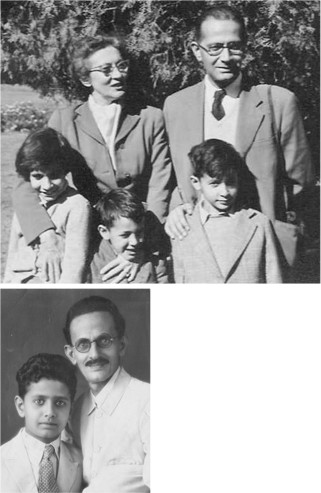
Mavis and Bomi with Sarah, Rustom and Jal. Alongside: Rustom and Bomi as a child
Always clad in a Parsi dagla (white cotton coat), white cotton trousers and a pugree, Billimoria was "a man of few words, soft-spoken, civil, but without meaning to be discourteous, brusque,” describes the book. A traditionalist with great faith in prayers, Billimoria at the age of 76, is said to have stood and prayed throughout the death ceremonies of his brother, friend, and mentor Shapurji, who founded the venerable accounting firm of Billimoria and Company. To Shapurji, Rustom was "Raja” — a king among men, and that is the name the whole Billimoria clan knew him by. Shapurji’s daughters Dina and Roda remember how he teased them, pulling their pony tails, removing the ribbon from their hair. When their father had a heart attack "Raja kaka” treated his brother at his own home. "He was very unpredictable — couldn’t stomach fools, was annoyed by absurd questions. But it never stopped him from looking after his patients,” says Dina. Roda speaks of his dry humor: "He had no bedside manners but he had a heart of gold.”
"To most people he came across as a fiery but kindly eccentric,” records the book. One such eccentricity was to always hold — and to exhort patients and family to do so too — a large white handkerchief over his mouth and nose to prevent the entry of dust into the lungs.
Rustom’s second wife was the renowned social worker Gulestan Baha-durji, several years his junior. Extroverted and public-spirited, Gulestan was the antithesis of her husband who shunned the limelight. Yet they helped and supported each other, notes the book and "it was Gulestan who presided at Bel-Air annual functions and gave the welcome address to the governor.”
Bomi who had accompanied his mother to Switzerland, had schooled there and proceeded to UK for his medical education. After securing his FRCS qualification he continued to live and work in London. He returned to India in 1947 accompanied by his English wife Mavis, a professional midwife and nurse, and their one-year-old daughter Sarah. The accomplished surgeon dedicated a few days a month to operate at Bel-Air, starting with one and gradually increasing to seven surgeries a day according to former patient and old hand at Bel-Air, Eruch Ghadially. They had two sons in India — Jal and Rustom.
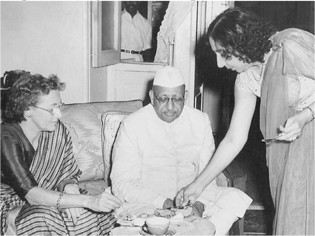
L to R: Mavis and Gulestan and a government minister
Cheesman, who schooled at the Fort Convent in Bombay and her Cathedralite brothers spent holidays at Bel-Air with father. She remembers her grandfather as "overpowering (and) very strict. Dad (who) was softer, quieter and very western in his way of life (was somewhat) in awe of him. Our navjotes were very quiet, at Silloo and Shapurji’s house. Grandpa had arranged for the priests,” recalls Chees-man. She says Bomi always wore his sudreh-kusti though "I don’t know whether he knew the prayers. Dad died before grandpa and he was cremated, against grandpa’s wishes.”
The sensitive Bomi was never quite reconciled to his father’s second marriage and Rustom and his son remained very divergent personalities is the picture that emerges from Parsiana’s chat with the surviving Billimorias. After Bomi’s death, Mavis, who according to Sarah had "loved it here,” took the children back to England where she died.
It was when Sarah joined Air-India as an air hostess and came periodically to India that she came to know her grandfather better. She says her brother Jal, an electrical engineer, is very much like her grandpa while Rustom, who has also passed away, resembled their father. Cheesman’s three children share the professional interests of their great grandparents. Her daughter Selina is an accountant, son Nevil a psychiatrist while Ricky is pursuing medicine at Oxford. They chose their fields without any prompting, says Cheesman who also studied accountancy at the age of 44.
"I have a great desire to come to India and do something,” says Cheesman who wants to dedicate six months a year to welfare work here. A Billimoria scion would probably have much to contribute...
◆ ◆ ◆
From the archive