
Zoroastrians Abroad
His roles and his roots
International baritone singer Anooshah Golesorkhi refers to his Zoroastrian lineage and his performances in leading operas
"The only thing we children were not allowed to touch in the house was the piano.” Considering that his life now revolves around music, baritone singer Anooshah Golesorkhi considers it ironical that during his formative years in Iran, he was prohibited from fingering the percussion instrument when strains of melody constantly reverberated through the house, his father Iraj being a music composer and his mother Javan Minoo, a singer.
When political upheavals in Iran persuaded Iraj to send away young Golesorkhi for a liberal upbringing in the West, the father bid adieu to the little son, placed a gold farohar around his neck and told him "Don’t ever forget where you come from.” With the farohar for his constant companion, Golesorkhi, now based in Munich, Germany, has traveled all over the world, lending his voice for compositions like Carmen, La Boheme, Samson et Dalila, Aida, Otello, La Traviata… performed under the baton of European operas like the Vienna State Opera, Deutsche Oper Berlin, Hamburg State Opera, Athens Opera, Opera de Nice, Rome Opera and of North American operas like Metropolitan Opera, San Francisco Opera, Opera Orchestra of New York, Washington Concert Opera, Florida Grand Opera, Opera Pacific, according to his life profile.
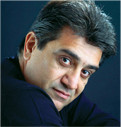
Performing the role of Scarpia in the opera Tosca at the National Centre for the Performing Arts in Bombay in end September 2010 he received an overwhelming applause from the predominantly Parsi crowd at the Jamshed Bhabha Theatre for word seemed to have passed around that Golesorkhi is of Zoroastrian descent. The lead soloists were accompanied by The Bergen Opera Choir, Coomi Wadia’s The Paranjoti Academy Chorus and The Symphony Orchestra of India conducted for the first time by an overseas lady Anne Randine Overby. Whilst Giacomo Puccini’s opera was rendered in Italian, the simultaneous translation in English flashed above the stage helped the audience better appreciate the tones and expressions of the artistes. Golesorkhi speaks five languages — English, German, Italian, French and Farsi, although he can sing in 10 languages including Russian, Armenian, Czech, Spanish and Catalan. "When I sing, I understand every word I am singing… You can’t sing ‘I killed your…’ with a smile,” he explains the importance of comprehending each passage that he sings.
Over the years there are 40 roles he has sung, some more frequently than others. The music of certain compositions is so ingrained in him that he can perform the roles with only 24 hours’ notice. These include the characters of Rigoletto in Rigoletto, Nabucco in Nabucco, Amonasro in Aida, Germont in La Traviata, Jago in Otello, Luna in Il Travatore, Macbeth in Macbeth, Scarpia in Tosca, Escamillo in Carmen, High Priest of Dagon in Samson et Delila… "I like them all. Thank God I have never had to accept a role I did not like,” he says but candidly admits that he would not like to perform Madama Butterfly again as he gets "emotionally involved. If something pushes you back to who you are instead of the character (you are enacting) then it is best you leave it. Emotionally it costs too much.”
He had made his operatic debut in the role of Amonasro in Opera Pacific’s Aida, Golesorkhi recalls. Filling in for the lead baritone he remembers getting a call barely three-and-a-half hours before the performance. "Before I had a chance to realize what was happening, I was singing in front of an audience of 3,600. The conductor was nervous, urging me to look at him during the performance but I was too stupid to be nervous.” After that Golesorkhi started receiving offers for other operas. Until 1993 he continued his singing career whilst financially managing the affairs of a Swiss-Russian gentleman with diverse business interests from oil to film production. Later though he chose to exclusively pursue his love for music. "It is much more fun. You are not worried about someone else’s money.”
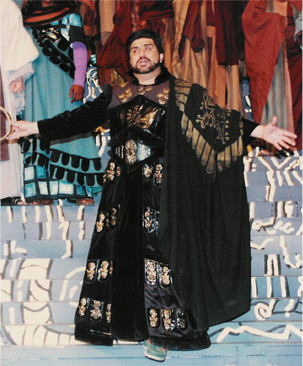
Top and above: Anooshah Golesorkhi sings as Nabucco
Today a regular guest of leading opera companies "he has achieved renown as a charismatic and forceful interpreter of the most demanding baritone roles,” notes his biography on the Internet. For an operatic performance, the chorus is generally local but the soloists are freelancers who are signed on a contract and depending on the terms he/she may charge a performance fee or a separate rehearsal fee. Often the lead singers meet on stage for the first time on the day of the performance and introduce themselves as "Hello, I’m your father,” relates Golesorkhi. A series of four performances he is looking forward to next May is singing Aida in Florence (Teatro del Maggio Musicale Fiorentino) under the baton of Maestro Zubin Mehta for whom he had auditioned earlier.
Referring to his initial training "just for fun,” Golesorkhi recounts his student days at the University of San Diego and San Diego State University from where he earned his bachelor’s and master’s degree in chemistry. At the University there were many women willing to sing but few male singers. That’s when he signed up little realizing that "music is like a disease; it gets into your system without your knowing it and soon you can’t do without it.” Besides doing his bachelor’s in music composition Golesorkhi took private voice lessons and acknowledges the support he received from his mother and stepfather Richard Kirshberg "who really believed in me,” encouraging him to "take a gamble.” Even with his talent he was diffident for "mathematically the percentage of people who are successful is so small.”
Good health and good rest are necessary for a singer before a performance, he stresses. Speaking to Parsiana in the morning before the second show of Tosca in Bombay, he referred to exercising his vocal cords for 10 minutes in a room to be specially provided by the Taj and then sleeping through the afternoon such that he could look forward to the evening on stage. "My biggest critic is myself; my memory of what the music should sound like,” says the singer.
Reading the Avesta helps him to understand "my religion, traditions, where I came from, the collective work of my forefathers,” states Golesorkhi who feels the necessity to pray "in a more direct way. You can’t pray once in a while.” To him, prayer has to be a continuous process of cleansing, of removing negativity and ill feelings from one’s system. "Man makes religion so you never know what you are getting. You have to think and figure it out for yourself. Even the Avesta has so many versions,” points out Golesorkhi who has not been officially initiated into the Zoroastrian faith.
When one of the ladies from the organizing team escorted him on a tour of the city where he was shown the atash behrams and other Parsi landmarks of Bombay, Golesorkhi respected the sentiments of the community and did not enter the portals of the fire temple. "There is a wonderful richness you get from visiting a temple and observing traditions. But you can still be a good Zarathushti even if you don’t go to a temple,” he is convinced. Knowledgeable on the religion, he knew of the importance of the Ameshaspands, the duality of Ahura Mazda and Ahriman, the three cardinal tenets of "pendare nik, goftare nik, kerdare nik (modern Persian equivalents of good thoughts, words and deeds),” the need to walk towards the light, the early history of the Iranians…
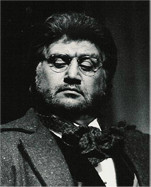
Anooshah Golesorkhi as Germont in La Traviata
He refers to his father’s attempts to trace his Zoroastrian roots. He was the director general of radio during the Shah’s regime, a conductor of an orchestra and founder of one of the first choruses in Iran. He is known to have composed nearly 300 songs that were rendered by his wife. But personal differences and ambitions drew them apart with Minoo choosing to make a new life in the USA. Iraj was adept at putting Iranian folk songs and music (horeh khani) into symphonies and even composed two Zoroastrian anthems. After the revolution, he was placed under house arrest and prohibited from leaving the country for several years. While his involvement with the government was brought to a halt with the end of the Shah’s regime, he continued to dedicate himself to music, writing books on the subject until he passed away in 2001. Researching on his Zoroastrian roots he was able to trace the family lineage to the priests who officiated at the atash kadeh in Mazandaran (the last part of Iran to fall to Arab conquerors due to high mountain ranges). When the son of a mobed fell in love with a Muslim girl, fearing the orthodox retribution the couple made their way south of Kerman and set up home there… His mother’s Zohrabi family was equally well known and his aunt was reportedly the dean of a Zarathushti girls’ school in Tehran, states Golesorkhi. His brother Shahravan (also settled in USA) was named thus so that the names of the two sons, Anoo-shah and Shah-ravan, when read conjointly would be Anooshahravan meaning immortal soul.
Choosing to remain single, Golesorkhi mentions how marriage and fatherhood would be difficult considering that "Ten months in a year I am traveling and staying in a hotel room. My child would then have to grow up with a photo of his father. Besides, who would want to live with me all her life?” In his free time he reads a lot, plays computer games and occasionally golf. Fond of cooking and experimenting with what tastes best, he says it "takes me back to chemistry…
"I have been kissed by farahizadi (blessed by the energy of God),” Golesorkhi is convinced that has helped him enjoy everything he does. "Even the so-called difficult things, in retrospect, have helped me to learn many things. To deal with pain, reality, the success that may be all gone tomorrow. Everything happens for the best.”
◆ ◆ ◆
From the archive