
Music
Parsifal and the Parsis
Could German composer Richard Wagner’s last opera have been based on Parsis and their prayer rituals with its origins in ancient Persian traditions?
Being passionate about the German composer Richard Wagner’s music and a member of The Wagner Society in the UK for the past 25 years, I have seen some live productions of his very last opera called Parsifal at the Royal Opera House in London; Metropolitan opera house in New York conducted by James Levine; and in Germany at the Bayreuth Festspielhaus conducted by the late Sinopoli. Though the story of Parsifal is based on the subject of the Christian Holy Grail, I have tried to enjoy this opera by imagining and relating the story not with Christian settings but with rituals performed in Parsi fire temples.
Wagner had never indicated any connection between his opera and the Parsis. However, the composer was bowled over by the classic beauty Judith Gautier, 33 years his junior, and in one of his secret love letters to her he wrote about this opera: "think of the Parsis, those fire worshippers” (Wagner’s Letters – Documentary Study by Barth, Mach and Voss and Wagner Handbook by Muller and Wepnewski).
Wagner had never indicated any connection between his opera and the Parsis. However, the composer was bowled over by the classic beauty Judith Gautier, 33 years his junior, and in one of his secret love letters to her he wrote about this opera: "think of the Parsis, those fire worshippers” (Wagner’s Letters – Documentary Study by Barth, Mach and Voss and Wagner Handbook by Muller and Wepnewski).
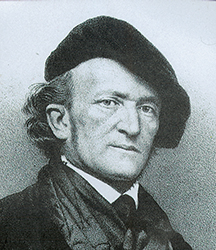
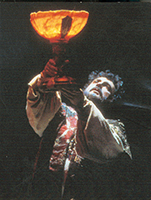
Richard Wagner; Parsifal holding the Grail
In 1930 a German orientalist, Dr Fredrick von Suhtscheck had made out a strong case for ancient Persian origin and setting for the Parsifal story. Also, during the middle of the 12th century an Armenian had rendered the Parsifal story in French literature, arguing in favor of its connections with ancient Persia (The Wagner Operas by Ernest Newman).
Parsifal, one of 13 operas composed by Wagner, was first performed in Festspielhaus in 1882, a year before he died. The opera is very long and lasts for four hours (at Bombay’s National Centre for the Performing Arts, where it was performed in August 2013, it lasted almost six hours — editors). In brief, the story is about the Christian Holy Grail kept inside a temple located on the mountain Monsalvat. Every day the high priest Titurel prays and performs the Grail ritual. When he becomes old and cannot carry on with his work, his son Amfortas takes on the job of looking after the Grail. Unfortunately, Amfortas succumbs to the evil magical powers of Klingsor and his succubus (female demon) Kundry, who render him spiritually and physically incapable of attending to the rituals, resulting in a serious crisis in the temple. Miraculously, a young man named Parsifal appears on the scene whose purity and spiritual qualities are recognized. He is able to successfully perform the Grail rituals and thereby revive the practice.
In the final act, Kundry anoints Parsifal with the contents of a golden phial. As a Parsi I can’t help imagining this liquid to be nirang, used during the navjote and some other ceremonies. From Kundry Parsifal learns that his father’s name was Gamuret. In our scriptures the name of the first man created is Gehmuret (geh meaning man and muret meaning mortal).
Wagner created Parsifal to convey compassion and redemption, but some critics have variously called it a clever cocktail of Parzival by Wolfram von Eschenbach (1170-1220) as well as the writings by the idealist German philosopher Arthur Schopenhaur (1788-1860) and the result of Wagner’s own unfulfilled relationships with women.
Wagner was born in 1813 and this year is the 200th anniversary of his birth, an event celebrated with great enthusiasm worldwide by performing his operas and highlighting his controversial lifestyle. His first two operas are not popular and rarely performed, but the other 11 are musical and dramatical masterpieces. The composer built his own opera house, Festspielhaus, in Bayreuth, Germany which was inaugurated in his presence with a set of four operas, The Ring Cycle, being performed in August 1876. Wagner having gained fame by that time, many dignitaries and musicians from all over the world had converged there to see his opera house. These included Kaiser Wilhelm, King Ludwig II, Emperor Don Pedro II of Brazil, the Grand Duke from Russia, Franz Liszt (Wagner’s father-in-law, only two years older than him!), Bruckner, Grieg, Tchaikovsky, Saint-Saëns, Neitzsche and many others. Piano makers Steinway and Sons of New York had sent a grand piano gratis, as a gift to Wagner. In the past, composers had paid homage to kings. Here, kings came to Bayreuth to offer homage to Wagner.
An aspect of Wagner’s life that has raised much controversy is his anti-Jewish stance. In his early days when he was a struggling composer in Paris, another German, the Jewish Giacomo Meyerbeer (1791-1864) had attained fame and success. Having received very little support from Meyerbeer, Wagner was naturally upset and began to harbor anti-Jewish feelings. He bitterly attacked Meyerbeer in a pamphlet titled Das Judenfum in der Music, even though Meyerbeer had offered some measure of assistance to him.
To my way of thinking, Wagner’s anti-Semitism has been severely enlarged and exaggerated after his death. In his operas Meistersinger and The Ring, the composer created Jewish characters such as Beckmesser, Alberich and Mime which are "mingy.” However, at the same time he had very close friends, singers and instrumentalists, who were Jews. Wagner chose a Jewish conductor for the first performance of Parsifal — Herman Levi, whose father was a rabbi! It was the Nazis who used Wagner’s music for war time propaganda, as is evident on reading the book about his daughter-in-law, Winifred Wagner: A Life at the Heart of Hitler’s Bayreuth by Brigitte Hamann.
Coming back to my original fancy, perhaps one day somebody will produce Parsifal with Parsi costumes and fire temple settings. Imagine Kundry, the female demon, running around on the stage in a chatta chheran ni sari (style worn by Parsis) and mathabanoo (cloth head covering worn by women)!
◆ ◆ ◆
From the archive