
Books
KaiKhosrow’s kaleidoscope
The New World-Encyclopedia of the Theory of Waves and the World of Waves by NarYman KaiKhosrow. Pp: 158. Price: Rs 900. The New World-Encyclopedia of the Khoorshid Nigirishn, Exposing the dead body to the cleansing rays of the Sun by NarYman KaiKhosrow. Pp: xvii + 504. Price: Rs 1,500.
It’s truly a labor of love. A labor, that, according to the author himself, lasted 45 years. Must be! The cornucopia of references he has waded through, the sources from which a host of photographs, both colored and black and white that adorn every page of his books, have been selected, the phenomenal number of illustrations and diagrams that he has reproduced, surely would be enough to exhaust the limits of patience and tolerance of most humans! But NarYman KaiKhosrow, the modern Parsi philanthropist, better known in the community as NarYman Dubash, is made of different stuff.
Everything is a class apart about his writings: his dictography, with a peculiar penchant for long vowels, even though the original language, Avesta or even Pazend for example, does not have them ("Khoorshid,” "Ahoora Maz-da,” or the strange "Zarathooss-tra”); his preference for the capital letters even in the middle of a word, as in his own name; his fanciful, at times, even whimsical theories and quaint approach to his subjects...
Take the first book on "Waves,” wherein he describes and comments on waves of all kinds prevalent in the Universe — from atmospheric and electromagnetic to radio, seismic and cosmic waves. All these are based on "The ‘Theory of Waves’ of the World-Prophet Righteous Zarathoosstra,” which, in the ultimate analysis, evolve from the four basic elements of fire, air, earth and water (that’s his sequence!).
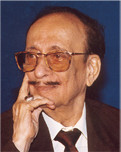
KaiKhosrow: labor of love
According to KaiKhosrow, a picture of the Prophet, carrying the Navgareh stick in his hand, shows four what-may-be called "inverted angles” on the garment he is wearing. This, according to the author is "the enlargement of ‘the Sign of the four Waves displayed on the garment-of-light of the World-Prophet... He has invented the ‘Sign of the four Waves’ to depict the four elements as waves...”
These, the garment that is worn by the Prophet in a picture (we are aware that there is no authentic picture of Prophet Zoroaster; what we have are different artists’ impressions based on one or the other extant rock-carvings in Iran) and the four basic elements fire, air, water and earth, form the basis of the author’s "Theory of Waves.” The book is replete with photographs, illustrations and diagrams of all sorts of waves and radiations, which would be a delight to any student of science. Why even a student with a non-scientific mind, will find many chapters fascinating.
But, it is the Khoorshid Nigirishn tome with 504 pages, that eclipses his earlier Waves book, in size, volume, contents and the vast array of material marshaled on the subject, by the author.
For some strange reason, it reminded this reviewer of another mammoth work — a musical one — by another Parsi, also a Kaikhosru (S. Sorabji), whose longest non-repetitious piece for piano, found its way in the Guinness Book of World Records.
In this literary heavy-weight about solar power, KaiKhosrow has left nothing unsaid about the origin and development of Khoorshid Nigirishn, throughout the world by different communities following different religions, for their departed, culminating into the "Sun Towers,” as he puts it, of the Parsis. He has referred to a plethora of books, both religious and scientific, encyclopedias and journals/magazines for this bulky volume, which those with heart or hernia trouble, should avoid lifting!
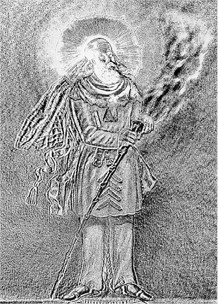
Picture of the Prophet with ‘inverted angles’ on garment below belt
The book abounds in a great deal of information about the various ways in which the sun’s rays have been used from primitive times, when they built open megalithic structures for the dead, to the "Aryans’ highly scientific megalithic open circular structures,” which are call the dakhmas or, as he calls it, the "Sun-Towers of Silence!” The author has admirably succeeded in reproducing a wealth of religious and scientific data and pictures about all the eschatological aspects — from the manner in which a dakhma is built, the preparation of the ‘Tana,’ comprising 301 iron nails and "a triple coiled spring, which acts as a pollution suppressor,” according to the author, to all the rituals to be performed from death onwards, to the Kerdar (a phantasmagoric form of our thoughts, words and deeds during lifetime, that orbits the soul after death the illustration of which on page 262, should be kept in every Parsi household), to the role of dogs, vultures, the resurrection, the advent of the Savior, etc. You tire of turning pages with quotes from the Sacred Books of the East, the Persian Rivayats, the Journal of the K. R. Cama Oriental Institute — everything just boggles your mind!
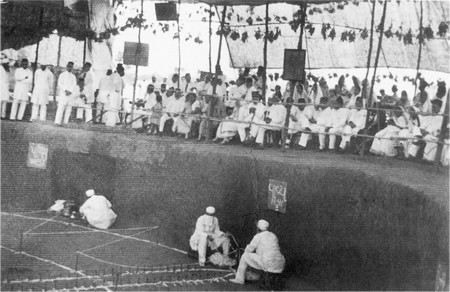
The beginning of the Tana ceremony while consecrating the Bangalore dakhma in 1939
In the welter of all that the author has to tell us, one factor stands out prominently: the author’s abounding, implicit faith in "Righteous Zarathoosstra,” the scientist par excellence!
Printed on glossy art paper, by Tata Donnelley Limited, these hard-covered volumes are collector’s items and should be on the shelves of public and university libraries throughout the world!
Adi Doctor
◆ ◆ ◆
From the archive