
Books
Nature's prayers
Five Niyaeshes — Translated and Explained by Adil F. Rangoonwalla. Published in 2004 by the author, M/4, Dalal Estate, Lamington Road, Bombay 400008. Pp: 341. Price: Rs 350.
The five Niyaeshes (the word ‘niyaesh’ means praise or prayer) are among the favorite prayers recited by Zarathushtrians — mostly without fully understanding their spiritual implications.
Even if we skip the Avestan texts and the English rendering, Adil Rangoonwalla’s explanations and commentaries are most informative and inspire us to a better understanding of our religious teachings and their spiritual significance. For the benefit of those who desire to study the subject in depth, he has added authoritative references and notes.
Rangoonwalla refers to the Khorshed Niyaesh as "the most powerful prayer in the universe.” Due to the constraints of our very fast moving life style, most Parsis, when they go to the fire-temples, start reciting the Atash Niyaesh straight away. The faraziyat or obligatory prayers like the Khorshed/Meher Niyaeshes are required to be offered first. We invoke their aid. Khorshed Yazad presides over sun. Light is the very basis of life. We depend on light all the time. A mind blessed with light will follow the path of Asha — Righteousness. Meher Yazad presides over the rays of the Sun. He is the fairest yazad and judges all souls fairly. The Niyaesh emphasizes that the most powerful light among all powerful lights is that of the sun.

Rangoonwalla: creating religious awareness
Meher Yazad — the Lord of celestial light is also referred to as the Lord of wide pastures. The twin litanies — Khorshed/Meher Niyaeshes — are prayed together in three sunlight gahs only. Ahura Mazda states, "You must worship the strong, celestial, most exalted, forgiving, away from falsehood, of strong abode, valorous and mighty warrior, Meher Yazad.”
The Mah Bokhtar Niyaesh represents Mah Bokhtar Yazad as the formless divinity who presides over moon. The moon reflects the sun’s light. We request him to come to our aid. The sun is the life creator. The moon preserves the "Chithra” (seed) of life, especially of animal life. Mah Bokhtar Yazad is a hamkar — a co-worker of Bahman Ameshashpand. Rangoonwalla has emphasized that plants are said to grow best if sown two days before the full moon.
Ava Ardvisura Banu — the reservoir of divinity — bestows purity, divine knowledge, power and salvation, asserts Rangoonwalla. Ava Yazad is a female divinity. Water is worshipped in many religions and cultures. The ancient Iranians worshipped the river Ardvisura. We often refer to Ava Ardvisura as ‘Anahita’ which means ‘undefiled.’ She ensures purity and bestows well-being. She makes the world progressive and also prosperous. Ardvisura Banu purifies the seed of men, bestows purity to the womb of all mothers, blesses them with easy delivery and milk. She gives purity to the reproductive process.
In Avesta, fire has been given the exalted status of the greatest Yazata. Atash Puthro Ahura Mazdao — Fire, the son of Ahura Mazda — all Zarathushtrians the world over worship fire. He is a great purifier. People believe that the Atash Niyaesh prayer helps in overcoming difficulties and in the fulfillment of cherished desires. The Niyaesh also pays homage to Adar Yazad, who presides over all fires on earth. The source of all energy on earth is fire.
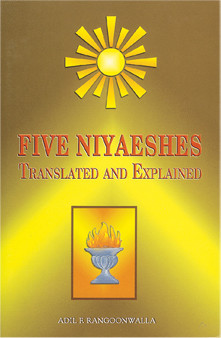
Since Rangoonwalla has a diploma in counseling psychology and since he has taken to studies in Zoroastrian religion, he is eminently suited to guide our youth and to create awareness in them on matters religious and ethical.
I think he should target the youth. His goal should be to produce a series of self-contained booklets, on selective basis, covering the basic tenets of our religion and the important divinities and their spiritual functions. This would not only familiarize our youth with the basic principles of our Prophet’s teachings but also give them an ethical code of good thoughts, good words, good deeds. I may also advocate that instead of giving cash prizes at schools, colleges and at elocution or essay writing competitions, books such as these, be given as prizes.
I was delighted that the book has been dedicated to Ervad Kavasji Edulji Kanga, one of the greatest Avestan scholars of all times, on his 100th death anniversary in 2004. This humble, very simple, unassuming reputed scholar had the unique distinction of translating into Gujarati the Vendidad, Yasna, Yashts and giving us the Khordeh Avesta Ba Maeni. His commentary on Visparad and his Avesta-English Dictionary are made use of by Avestan students and scholars. His magnum opus Gatha Ba Maeni and our daily prayer book Khordeh Avesta — would be remembered, revived and used by Zarathushtrians for ever. Credit goes to Dinshaw K. Tamboly, managing trustee and the World Zoroastrian Organisation Trust for generously sponsoring this most informative book.
Capt Hormazdiar J. M. Desai
◆ ◆ ◆
From the archive